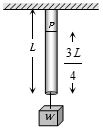
One end of a uniform wire of length $L$ and of weight $W$ is attached rigidly to a point in the roof and a weight ${W_1}$ is suspended from its lower end. If $S$ is the area of cross-section of the wire, the stress in the wire at a height $3L/4$ from its lower end is
IIT 1992, Medium


Download our appand get started for free
Experience the future of education. Simply download our apps or reach out to us for more information. Let's shape the future of learning together!No signup needed.*
Similar Questions
- 1Match List-$I$ with List-$II$ :View Solution
List-$I$ List-$II$ $(A)$ A force thatrestores anelastic body of unit area to its original state $(I)$ Bulkmodulus $(B)$ Two equal andopposite forcesparallel toopposite faces $(II)$Young'smodulus $(C)$Forcesperpendiculareverywhere tothe surface perunit areasameeverywhere $(III)$ Stress $(D)$Two equal andopposite forceperpendicular toopposite faces $(IV)$ Shearmodulus Choose the correct answer from the options given below:
- 2A boy’s catapult is made of rubber cord which is $42\, cm$ long, with $6\, mm$ diameter of cross -section and of negligible mass. The boy keeps a stone weighing $0.02\, kg$ on it and stretches the cord by $20\, cm$ by applying a constant force. When released, the stone flies off with a velocity of $20\, ms^{-1}$. Neglect the change in the area of cross section of the cord while stretched. The Young’s modulus of rubber is closest toView Solution
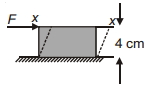
- 3A steel plate of face area $1 \,cm ^2$ and thickness $4 \,cm$ is fixed rigidly at the lower surface. A tangential force $F=10 \,kN$ is applied on the upper surface as shown in the figure. The lateral displacement $x$ of upper surface w.r.t. the lower surface is .............. $m$ (Modulus of rigidity for steel is $8 \times 10^{11} \,N / m ^2$ )View Solution
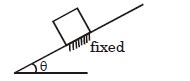
- 4View SolutionAssume that a block of very low shear modulus is fixed on an inclined plane as shown. Due to elastic forces it will deform. What will be the shape of the block ?
- 5When a rubber ball is taken to the bottom of a sea of depth $1400 \,m$, its volume decreases by $2 \%$. The Bulk modulus of rubber ball is .................. $\times 10^8 N / m ^2$ [density of water is $1 \,g cc$ and $g=10 \,m / s ^2$ ]View Solution
- 6The ratio of Young's modulus of the material of two wires is $2 : 3.$ If the same stress is applied on both, then the ratio of elastic energy per unit volume will beView Solution
- 7Two wires $A$ and $B $ of same length and of the same material have the respective radii ${r_1}$ and ${r_2}$. Their one end is fixed with a rigid support, and at the other end equal twisting couple is applied. Then the ratio of the angle of twist at the end of $A$ and the angle of twist at the end of $B $ will beView Solution
- 8$Assertion :$ Hollow shaft is found to be stronger than a solid shaft made of same equal material.View Solution
$Reason :$ Torque required to produce a given twist in hollow cylinder is greater than that required to twist a solid cylinder of same length and material. - 9The stress-strain curves are drawn for two different materials $X$ and $Y$. It is observed that the ultimate strength point and the fracture point are close to each other for material $X$ but are far apart for material $Y$. We can say that materials $X$ and $Y$ are likely to be (respectively)View Solution
- 10In an experiment, brass and steel wires of length $1\,m$ each with areas of cross section $1\,mm^2$ are used. The wires are connected in series and one end of the combined wire is connected to a rigid support and other end is subjected to elongation. The stress requires to produced a new elongation of $0.2\,mm$ is [Given, the Young’s Modulus for steel and brass are respectively $120\times 10^9\,N/m^2$ and $60\times 10^9\,N/m^2$ ]View Solution