Question
A bullet fired against a window glass pane makes a hole in it without any cracks while a stone striking the same glass pane smashes it; explain with reason.

Answer

When the bullet strikes the glass, the part of the glass coming in contact with the bullet immediately shares the large velocity of the bullet and makes a hole in it while the rest of the glass pane, due to the inertia of rest, remains at rest and so is not smashed. But when a stone strikes the same glass pan, the surrounding part of the glass gets time to share the comparatively low velocity of stone and so it is smashed.

Need a full question paper?

Generate a complete, print-ready paper with questions like this in minutes — across 16+ boards, with answer keys.

Start Generating Free

Similar questions

Why is that the same current flowing through the bulb heats up the filament, while the leads are not heated up?
State the condition when a body is in (i) static, (ii) dynamic, equilibrium. Give one example each of static and dynamic equilibrium.
(i) A molten metal weighing 150 g is kept at its melting point 800°C. When it is allowed to solidify at the same temp, it gives out 75000 J of heat. What is the specific heat of the metal?

(ii) If its specific heat capacity is 200 J/kgK? How much additional heat will it give out in cooling to -50°C?
What length of copper wire of resistivity 1.7 × 10⁻⁸ 𝛀 m and radius 1 mm is required so that its resistance is 1𝛀?
A ball of mass $0.20$ kg is thrown vertically upwards with an initial velocity of $20 m s ^{-1}$. Calculate the maximum potential energy it gains as it goes up.
What type of lever is formed by the human body while raising a load on the palm ?
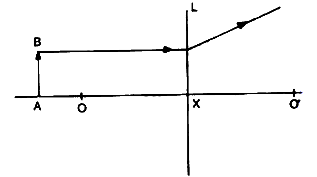
Refer to fig
(i) Name the lens L.
(ii) What are the points O, O' called?
(iii) Complete the diagram to form the image of the object AB.
(iv) Write three characteristics of the image.
A ray of light is incident on a glass surface at an angle of $50^\circ $ with the corresponding angle of refraction $30^\circ $. Find the value of the R.I. of glass.
Draw the ray diagrams of a converging lens, when the object is placed at a distance greater than twice the focal length of the lens.
Draw and label the diagram of a simple D.C. motor.
(a) Explain the rotation of the coil, giving a reason for your answer.
(b) How can you reverse the direction of rotation of the armature?
(c) How can you increase the speed of rotation of the motor?