A bullet of mass $2\, gm$ is having a charge of $2\,\mu C$. Through what potential difference must it be accelerated, starting from rest, to acquire a speed of $10\,m/s$
AIPMT 2004, Easy
Download our app for free and get started
(b) By using $\frac{1}{2}m{v^2} = QV$
$==>$ $\frac{1}{2} \times 2 \times {10^{ - 3}} \times {(10)^2} = 2 \times {10^{ - 6}}\,V$
$==>$ $V = 50\,kV$

Download our appand get started for free
Experience the future of education. Simply download our apps or reach out to us for more information. Let's shape the future of learning together!No signup needed.*
Similar Questions
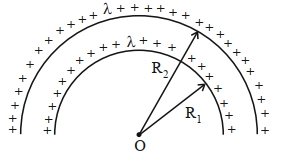
- 1The electric potential at the centre of two concentric half rings of radii $R_1$ and $R_2$, having same linear charge density $\lambda$ isView Solution
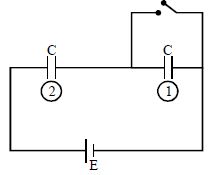
- 2View SolutionCalculate the charge on the second capacitor before and after switch in the circuit is closed
- 3A particle of mass $100\, gm$ and charge $2\, \mu C$ is released from a distance of $50\, cm$ from a fixed charge of $5\, \mu C$. Find the speed of the particle when its distance from the fixed charge becomes $3\, m$. Neglect any other force........$m/s$View Solution
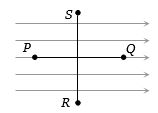
- 4View SolutionThepoints resembling equal potentials are
- 5A capacitor $4\,\mu F$ charged to $50\, V$ is connected to another capacitor of $2\,\mu F$ charged to $100 \,V$ with plates of like charges connected together. The total energy before and after connection in multiples of $({10^{ - 2}}\,J)$ isView Solution
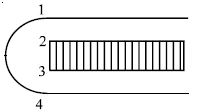
- 6Four identical plates $1, 2, 3$ and $4$ are placed parallel to each other at equal distance as shown in the figure. Plates $1$ and $4$ are joined together and the space between $2$ and $3$ is filled with a dielectric of dielectric constant $k$ $=$ $2$. The capacitance of the system between $1$ and $3$ $\&$ $2$ and $4$ are $C_1$ and $C_2$ respectively. The ratio $\frac{{{C_1}}}{{{C_2}}}$ isView Solution
- 7View SolutionEqual charges are given to two spheres of different radii. The potential will
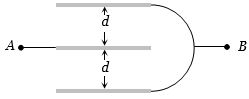
- 8Three plates of common surface area $A$ are connected as shown. The effective capacitance will beView Solution
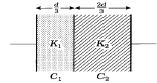
- 9A parallel plate capacitor with air between the plates has capacitance of $9\ pF$. The separation between its plates is '$d$'. The space between the plates is now filled with two dielectrics. One of the dielectrics has dielectric constant $k_1 = 3$ and thickness $\frac{d}{3}$ while the other one has dielectric constant $k_2 = 6$ and thickness $\frac{2d}{3}$ . Capacitance of the capacitor is now.......$pF$View Solution
- 10Consider a sphere of radius $R$ having charge $q$ uniformly distributed inside it. At what minimum distance from its surface the electric potential is half of the electric potential at its centre?View Solution