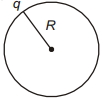
Consider a sphere of radius $R$ having charge $q$ uniformly distributed inside it. At what minimum distance from its surface the electric potential is half of the electric potential at its centre?
Medium


Download our appand get started for free
Experience the future of education. Simply download our apps or reach out to us for more information. Let's shape the future of learning together!No signup needed.*
Similar Questions
- 1Two identical capacitors are joined in parallel, charged to potential $V$, separated and then, connected in series, $i.e.$, the positive plate of one is connected to the negative plate of the other. ThenView Solution
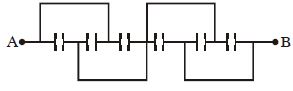
- 2All capacitors used in the diagram are identical and each is of capacitance $C$. Then the effective capacitance between the points $A$ and $B$ isView Solution
- 3View SolutionA parallel plate capacitor is charged to a certain potential and the charging battery is then disconnected. Now, if the plates of the capacitor are moved apart then:
- 4The capacity of a parallel plate condenser is $5\,\mu F$. When a glass plate is placed between the plates of the conductor, its potential becomes $1/8^{th}$ of the original value. The value of dielectric constant will beView Solution
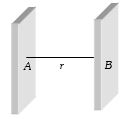
- 5There are two equipotential surface as shown in figure. The distance between them is $r$. The charge of $-q\,$ coulomb is taken from the surface $A$ to $B$, the resultant work done will beView Solution
- 6A $10\,\mu F$ capacitor is charged to a potential difference of $50\;V$ and is connected to another uncharged capacitor in parallel. Now the common potential difference becomes $20\;volt$. The capacitance of second capacitor is....$\mu F$View Solution
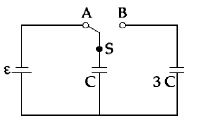
- 7In the figure shown, after the switch $‘S’$ is turned from position $‘A’$ to position $‘B’$, the energy dissipated in the circuit in terms of capacitance $‘C’$ and total charge $‘Q’$ isView Solution
- 8During charging a capacitor variation of potential $V$ of the capacitor with time $t$ is shown asView Solution
- 9Uniform electric field of magnitude $100$ $V/m$ in space is directed along the line $y = 3 + x$. Find the potential difference between point $A$ $ (3, 1)$ $\&$ $B$ $(1, 3)$.......$V$View Solution
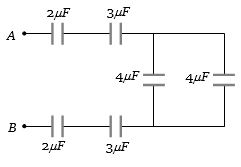
- 10The effective capacity between $A$ and $B$ in the figure given isView Solution