A bullet of mass $2\, gm$ is having a charge of $2\,\mu C$. Through what potential difference must it be accelerated, starting from rest, to acquire a speed of $10\,m/s$
AIPMT 2004, Easy


Download our appand get started for free
Experience the future of education. Simply download our apps or reach out to us for more information. Let's shape the future of learning together!No signup needed.*
Similar Questions
- 1Three capacitors, each of $3\,\mu F$, are provided. These cannot be combined to provide the resultant capacitance of.........$\mu F$View Solution
- 2Two identical thin metal plates has charge $q _{1}$ and $q _{2}$ respectively such that $q _{1}> q _{2}$. The plates were brought close to each other to form a parallel plate capacitor of capacitance $C$. The potential difference between them is.View Solution
- 3If an $\alpha$-particle and a proton are accelerated from rest by a potential difference of 1 megavolt then the ratio of their kinetic energy will beView Solution
- 4A parallel plate capacitor has plate of length $'l',$ width $'w'$ and separation of plates is $'d'.$ It is connected to a battery of emf $V$. A dielectric slab of the same thickness '$d$' and of dielectric constant $k =4$ is being inserted between the plates of the capacitor. At what length of the slab inside plates, will be energy stored in the capacitor be two times the initial energy stored$?$View Solution
- 5A particle has a mass $400$ times than that of the electron and charge is double than that of a electron. It is accelerated by $5\,V$ of potential difference. Initially the particle was at rest, then its final kinetic energy will be......$eV$View Solution
- 6Consider a sphere of radius $R$ with uniform charge density and total charge $Q$. The electrostatic potential distribution inside the sphere is given by $\theta_{(r)}=\frac{Q}{4 \pi \varepsilon_{0} R}\left(a+b(r / R)^{C}\right)$. Note that the zero of potential is at infinity. The values of $(a, b, c)$ areView Solution
- 7View SolutionA parallel plate air capacitor is charged and then isolated. When a dielectric material is inserted between the plates of the capacitor, then which of the following does not change
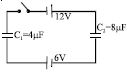
- 8In the circuit shown initially $C_1, C_2$ are uncharged. After closing the switchView Solution
- 9View SolutionWhen a negative charge is taken at a height from earth's surface, then its potential energy
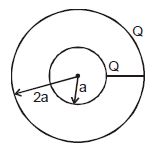
- 10Figure shows a solid metal sphere of radius $‘a’$ surrounded by a concentric thin metal shell of radius $2a$ . Initially both are having charges $Q$ each. When the two are connected by a conducting wire as shown in the figure, then amount of heat produced in this process will beView Solution