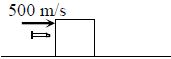
A bullet of mass $20\, g$ travelling horizontally with a speed of $500 \,m/s$ passes through a wooden block of mass $10.0 \,kg$ initially at rest on a surface. The bullet emerges with a speed of $100\, m/s$ and the block slides $20 \,cm$ on the surface before coming to rest, the coefficient of friction between the block and the surface. $(g = 10\, m/s^2)$
Difficult
Download our app for free and get started
Mass of bullet $m=0.02 \mathrm{kg}$
Initial velocity of bullet $v_{1}=500 \mathrm{m} / \mathrm{s}$
Mass of block $M=10 \mathrm{kg}$
Initial velocity $v_{2}=0$
Final velocity $v_{1}^{\prime}=100 \mathrm{m} / \mathrm{s}$
Now, the final velocity of block when bullet comes out
If block velocity $=v^{\prime}_{2}$
$m v_{1}+M v_{2}=m v_{1}+M v_{2}^{\prime}$
$0.02 \times 500=0.02 \times 100+10 v_{2}^{\prime}$
$v_{2}^{\prime}=\frac{10-2}{10}$
$v_{2}^{\prime}=0.8 \mathrm{m} / \mathrm{s}$
Now, after moving $0.2$ $\mathrm{m}$
Change in kinetic energy $=$ work done
$0-\frac{1}{2} \times 10 \times(0.8)^{2}=-\mu \times 10 \times 10 \times 0.2$
$\mu=0.16$
Hence, the friction coefficient is $0.16$

Download our appand get started for free
Experience the future of education. Simply download our apps or reach out to us for more information. Let's shape the future of learning together!No signup needed.*
Similar Questions
- 1$A$ block of mass $M$ is placed on $a$ horizontal surface and it is tied with an inextensible string to $a$ block of mass, as shown in figure. A block of mass $m_0$ is also placed on $M$ In previous problem, the tension in the string will beView Solution

- 2View SolutionWhich of the following statements is not true
- 3The maximum velocity (in $ms^{-1}$) with which a car driver must traverse a flat curve of radius $150 \,m$ and coefficient of friction $0.6$ to avoid skidding isView Solution
- 4View SolutionA motor cycle driver doubles its velocity when he is having a turn. The force exerted outwardly will be
- 5$A$ particle is moving in a circle :View Solution
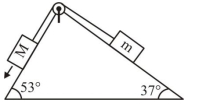
- 6In the given arrangement of a doubly inclined plane two blocks of masses $\mathrm{M}$ and $\mathrm{m}$ are placed. The blocks are connected by a light string passing over an ideal pulley as shown. The coefficient of friction between the surface of the plane and the blocks is $0.25$ . The value of $\mathrm{m}$, for which $\mathrm{M}=10$ $\mathrm{kg}$ will move down with an acceleration of $2 \mathrm{~m} / \mathrm{s}^2$, is : (take $\mathrm{g}=10 \mathrm{~m} / \mathrm{s}^2$ and $\left.\tan 37^{\circ}=3 / 4\right)$View Solution
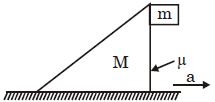
- 7As shown in the figure, block m and wedge $M$ move together with a horizontal acceleration of $20\, m/s^2$. Given $m = 1\, kg$, $\mu = 0.6$ (between $m$ and $M$) and $g = 10\, m/s^2$. Choose the $CORRECT$ alternative :-View Solution
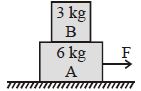
- 8Two blocks $A$ and $B$ of masses $6\, kg$ and $3\, kg$ rest on a smooth horizontal surface as shown in the figure. If coefficient of friction between $A$ and $B$ is $0.4$, the maximum horizontal force which can make them without separation is ........ $N$View Solution
- 9A block of mass $0.1 \,kg$ is held against a wall by applying a horizontal force of $5\, N$ on the block. If the coefficient of friction between the block and the wall is $0.5$, the magnitude of the frictional force acting on the block is ........ $N$View Solution
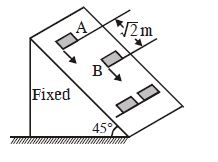
- 10Two blocks $A$ and $B$ of equal masses are sliding down along straight parallel lines on an inclined plane of $45^o$ . Their coefficients of kinetic friction are $\mu _A = 0.2$ and $\mu _B = 0.3$ respectively. At $t = 0$ , both the blocks are at rest and block $A$ is $\sqrt 2$ metre behind block $B$ . The time and distance from the initial position where the front faces of the blocks come in line on the inclined plane as shown in figure. (Use $g = 10\, ms^{-2}$ )View Solution