$A$ particle is moving in a circle :
Medium


Download our appand get started for free
Experience the future of education. Simply download our apps or reach out to us for more information. Let's shape the future of learning together!No signup needed.*
Similar Questions
- 1A car of $800 \mathrm{~kg}$ is taking turn on a banked road of radius $300 \mathrm{~m}$ and angle of banking $30^{\circ}$. If coefficient of static friction is $0.2$ then the maximum speed with which car can negotiate the turn safely : $\left(\mathrm{g}=10 \mathrm{~m} / \mathrm{s}^2, \sqrt{3}=1.73\right)$View Solution
- 2A block of mass $15 \,kg $ is resting on a rough inclined plane as shown in figure. The block is tied up by a horizontal string which has tension of $50\,N$. The minimum coefficient of friction between the surfaces of contact is $(g = 10\,m/s^2)$View Solution
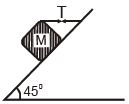
- 3A block of mass $m$ is lying on an inclined plane. The coefficient of friction between the plane and the block is $\mu$. The force $(F_1)$ required to move the block up the inclined plane will beView Solution
- 4$A$ block of mass $M$ is placed on $a$ horizontal surface and it is tied with an inextensible string to $a$ block of mass, as shown in figure. A block of mass $m_0$ is also placed on $M$ If friction force exists between the block $M$ and the block $m_0$ and not between the block $M$ and the horizontal surface, then the minimum value of $\mu$ for which the block m remains stationary isView Solution

- 5View SolutionA homogeneous rectangular brick lies on a rough inclined plane of very small inclination. Which half part of brick exters greater contact force on plane
- 6Put a uniform meter scale horizontally on your extended index fingers with the left one at $0.00 cm$ and the right one at $90.00 cm$. When you attempt to move both the fingers slowly towards the center, initially only the left finger slips with respect to the scale and the right finger does not. After some distance, the left finger stops and the right one starts slipping. Then the right finger stops at a distance $x_R$ from the center ( $50.00 cm$ ) of the scale and the left one starts slipping again. This happens because of the difference in the frictional forces on the two fingers. If the coefficients of static and dynamic friction between the fingers and the scale are $0.40$ and $0.32$ , respectively, the value of $x_R($ in $cm )$ is. . . . . . .View Solution
- 7A small ball of mass $m$ starts at a point $A$ with speed $v_0$ and moves along a frictionless track $AB$ as shown. The track $BC$ has coefficient of friction $\mu $. The ball comes to stop at $C$ after travelling a distance $L$ which isView Solution
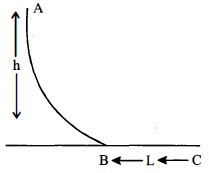
- 8In figure, the coefficient of friction between the floor and the block $B$ is $0.1$. The coefficient of friction between the blocks $B$ and $A$ is $0.2$. The mass of $A$ is $\frac{m}{2}$ and of $B$ is $m$. ........ $mg$ is the maximum horizontal force $F$ can be applied to the block $B$ so that two blocks move together ?View Solution
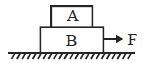
- 9A train is running at $20 \,m / s$ on a railway line with radius of curvature $40,000$ metres. The distance between the two rails is $1.5$ metres. For safe running of train the elevation of outer rail over the inner rail is ......$mm$ $\left( g =10 \,m / s ^2\right)$View Solution
- 10Concretemixture is made by mixing cement, stone and sand in a rotating cylindrical drum . If the drum rotates too fast, the ingredients remain stuck to the wall of the drum and proper mixing of ingredients does not take place. The maximum rotational speed of the drum in revolutions per minute (rpm) to ensure proper mixing is close to (Take the radius of the drum to be $1.25\, m$ and its axle to be horizontal)View Solution