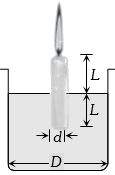
A candle of diameter $ d$ is floating on a liquid in a cylindrical container of diameter $D $ $(D>>d)$ as shown in figure. If it is burning at the rate of $2$ cm/hour then the top of the candle will
AIIMS 2005, Medium
Download our app for free and get started
The candle floats on the water with half its length above and below water level. Let its length be $10\, cm$. with $5\, cm$. below the surface and $5\, cm$. above it. If its length is reduced to $8\, cm$. It will have $4\, cm$. above water surface. So we see tip going down by $1\, cm$. So rate of fall of tip $= 1\, cm/hour$.

Download our appand get started for free
Experience the future of education. Simply download our apps or reach out to us for more information. Let's shape the future of learning together!No signup needed.*
Similar Questions
- 1A large tank is filled with water to a height $H$. A small hole is made at the base of the tank. It takes ${T_1}$ time to decrease the height of water to $\frac{H}{\eta }\,(\eta > 1)$; and it takes ${T_2}$ time to take out the rest of water. If ${T_1} = {T_2}$, then the value of $\eta $ isView Solution
- 2A barometer is constructed using a liquid (density $\left.=760 \;kg / m ^{3}\right) .$ What would be the height (In $m$) of the liquid column, when a mercury barometer reads $76 \;cm ?$ (density of mercury $\left.=13600 \;kg / m ^{3}\right)$View Solution
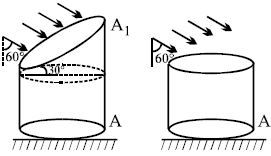
- 3A vertical cylindrical container of base area $A$ and upper cross-section area $A_1$ making an angle $30^o $ with the horizontal is placed in an open rainy field as shown near another cylindrical container having same base area $A$. The ratio of rates of collection of water in the two containers will beView Solution
- 4A streamlined body falls through air from a height $h$ on the surface of a liquid. If $d$ and $D(D > d) $ represents the densities of the material of the body and liquid respectively, then the time after which the body will be instantaneously at rest, isView Solution
- 5View SolutionWater coming out of the mouth of a tap and falling vertically in streamline flow forms a tapering column, i.e., the area of cross-section of the liquid column decreases as it moves down. Which of the following is the most accurate explanation for this
- 6The average mass of rain drops is $3.0\times10^{-5}\, kg$ and their avarage terminal velocity is $9\, m/s$. Calculate the energy transferred by rain to each square metre of the surface at a place which receives $100\, cm$ of rain in a yearView Solution
- 7Two substances of densities ${\rho _1}$ and ${\rho _2}$ are mixed in equal volume and the relative density of mixture is $4$. When they are mixed in equal masses, the relative density of the mixture is $3$. The values of ${\rho _1}$ and ${\rho _2}$ areView Solution
- 8View SolutionBernoulli’s principle is based on the law of conservation of
- 9View SolutionViscosity is the property of a liquid due to which it :
- 10A cubical block of side $0.5\,m$ floats on water with $30\%$ of its volume under water. ....... $kg$ is the maximum weight that can be put on the block without fully submerging it under water ? [Take density of water $= 10^3\,kg/m^3$ ]View Solution