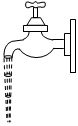
Water coming out of the mouth of a tap and falling vertically in streamline flow forms a tapering column, i.e., the area of cross-section of the liquid column decreases as it moves down. Which of the following is the most accurate explanation for this
Medium
Download our app for free and get started
(c) For the water flowing from tap, using equation of continuity- $A_{1} V_{1}=A_{2} V_{2}$
where $A=$ cross-section area of water
$V=$ velocity of water
As water goes down its velocity increases due to gravitational force so cross$-$sectional area will decrease as velocity increases.

Download our appand get started for free
Experience the future of education. Simply download our apps or reach out to us for more information. Let's shape the future of learning together!No signup needed.*
Similar Questions
- 1A horizontal pipe line carries water in a streamline flow.At a point along the tube where the cross-sectional area is $10^{-2}$ $m^2$, the water velocity is $2$ $ms^{^{-1}}$ and the pressure is $8000 $ $Pa$. The pressure of water at another point where the cross-sectional area is $0.5$ $\times 10^{-2}$ $m^2$ is ........ $Pa$View Solution
- 2View SolutionIf there were no gravity. which of the following will not be there for a fluid?
- 3A small sphere of mass $m$ is dropped from a great height. After it has fallen $100\; m$ , it has attained its terminal velocity and continues to fall at that speed. The work done by air friction against the sphere during the first $ 100 \;m $ of fall isView Solution
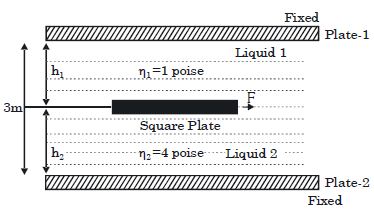
- 4A thin square plate of side $2\ m$ is moving at the interface of two very viscous liquids of viscosities ${\eta _1} = 1$ poise and ${\eta _2} = 4$ poise respectively as shown in the figure. Assume a linear velocity distribution in each fluid. The liquids are contained between two fixed plates. $h_1 + h_2 = 3\ m$ . A force $F$ is required to move the square plate with uniform velocity $10\ m/s$ horizontally then the value of minimum applied force will be ........ $N$View Solution
- 5A liquid flows through a horizontal tube. The velocities of the liquid in the two sections, which have areas of cross-section ${A_1}$ and ${A_2}$, are ${v_1}$ and ${v_2}$ respectively. The difference in the levels of the liquid in the two vertical tubes is $ h$View Solution
- 6View SolutionA small steel ball is dropped into a long cylinder containing glycerine. Which one of the following is the correct representation of the velocity time graph for the transit of the ball?
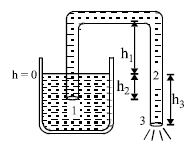
- 7Figure shows a siphon. Choose the wrong statement : ( $P_0 =$ atmospheric pressure)View Solution
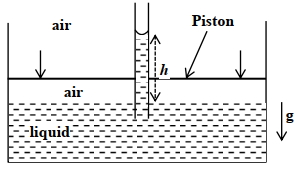
- 8An incompressible liquid is kept in a container having a weightless piston with a hole. A capillary tube of inner radius $0.1 \mathrm{~mm}$ is dipped vertically into the liquid through the airtight piston hole, as shown in the figure. The air in the container is isothermally compressed from its original volume $V_0$ to $\frac{100}{101} V_0$ with the movable piston. Considering air as an ideal gas, the height $(h)$ of the liquid column in the capillary above the liquid level in $\mathrm{cm}$ is. . . . . . .View Solution
[Given: Surface tension of the liquid is $0.075 \mathrm{Nm}^{-1}$, atmospheric pressure is $10^5 \mathrm{~N} \mathrm{~m}^{-2}$, acceleration due to gravity $(g)$ is $10 \mathrm{~m} \mathrm{~s}^{-2}$, density of the liquid is $10^3 \mathrm{~kg} \mathrm{~m}^{-3}$ and contact angle of capillary surface with the liquid is zero]
- 9The two thigh bones (femurs), each of cross-sectional area $10\; cm ^{2}$ support the upper part of a human body of mass $40\; kg$. Estimate the average pressure sustained by the femurs.View Solution
- 10$A U-$ tube having horizontal arm of length $20$ $cm$, has uniform cross-sectional area $=1\ cm^2$. It is filled with water of volume $60$ $cc$. What volume of a liquid of density $4$ $g/cc$ should be poured from one side into the $U -$ tube so that no water is left in the horizontal arm of the tube ........ $cc$ ?View Solution