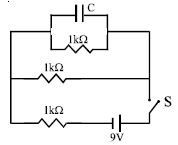
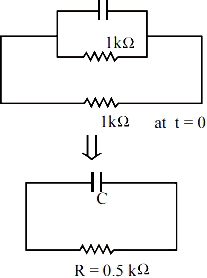
A capacitor $C = 100$ $ \mu F$ is connected to three resistor each of resistance $1$ $k\Omega$ and a battery of $emf$ $9\,V$. The switch $S$ has been closed for long time so as to charge the capacitor. When switch $S$ is opened, the capacitor discharges with time constant......$ms$
Diffcult


Download our appand get started for free
Experience the future of education. Simply download our apps or reach out to us for more information. Let's shape the future of learning together!No signup needed.*
Similar Questions
- 1$64$ small drops of mercury, each of radius $ r$ and charge $q$ coalesce to form a big drop. The ratio of the surface density of charge of each small drop with that of the big drop isView Solution
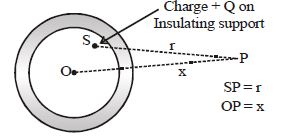
- 2The adjacent diagram shows a charge $+Q$ held on an insulating support $S$ and enclosed by a hollow spherical conductor. $O$ represents the centre of the spherical conductor. and $P$ is a point such that $OP = x $ and $SP = r$ . The electric field at point $P$ will beView Solution
- 3Effective capacitance of parallel combination of two capacitors $\mathrm{C}_{1}$ and $\mathrm{C}_{2}$ is $10\; \mu \mathrm{F}$. When these capacitors are individually connected to a voltage source of $1\; \mathrm{V},$ the energy stored in the capacitor $\mathrm{C}_{2}$ is $4$ times that of $\mathrm{C}_{1}$. If these capacitors are connected in series, their effective capacitance will beView Solution
- 4In a certain reglon of space with volume $0.2\, m ^{3}$ the electric potential is found to be $5\, V$ throughout. The magnitude of electric field in this region is ______ $N/C$View Solution
- 5View SolutionThe energy stored in a condenser is in the form of
- 6Two parallel plate capacitor with different plate seperation but the same capacitance are connected in series to a battery. Both capacitors are filled with air. The quantity that is $NOT$ the same for both the capacitors when they are fully charged isView Solution
- 7A neutral spherical copper particle has a radius of $10 \,nm \left(1 \,nm =10^{-9} \,m \right)$. It gets charged by applying the voltage slowly adding one electron at a time. Then, the graph of the total charge on the particle versus the applied voltage would look likeView Solution
- 8The plates of a parallel plate capacitor with no dielectric are connected to a voltage source. Now a dielectric of dielectric constant $K $ is inserted to fill the whole space between the plates with voltage source remaining connected to the capacitor.View Solution
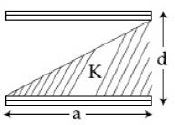
- 9A parallel plate capacitor is made of two square plates of side $a$, separated by a distance $d\,(d < < a)$. The lower triangular portion is filled with a dielectric of dielectric constant $K$, as shown in the figure. Capacitance of this capacitor isView Solution
- 10A $500 \,\mu F$ capacitor is charged at a steady rate of $100\, \mu C/sec$. The potential difference across the capacitor will be $10\, V$ after an interval of.....$sec$View Solution