Question
A capacitor has some dielectric between its plates and the capacitor is connected to a DC source. The battery is now disconnected and then the dielectric is removed. State whether the capacitance, the energy stored in it, the electric field, charge stored and voltage will increase, decrease or remain constant.

Answer

Assume a parallel-plate capacitor, of plate area A and plate separation d is filled with a dielectric of relative permittivity (dielectric constant) $k$. Its capacitance is $C =\frac{k \varepsilon_0 A}{d} \ldots \ldots \ldots \ldots$

(1)
If it is charged to a voltage (potential) V, the charge on its plates is Q = CV.

Since the battery is disconnected after it is charged, the charge Q on its plates, and consequently the product CV, remain unchanged.

On removing the dielectric completely, its capacitance becomes from Eq. (1),
$
C^{\prime}=\frac{\varepsilon_0 A}{d}=\frac{1}{k} C
$
that is, its capacitance decreases by the factor $k$. Since $C^{\prime} V^{\prime}=C V$, its new voltage is $V ^{\prime}=\frac{C}{C^{\prime}} V = kV$
so that its voltage increases by the factor $k$. The stored potential energy, $U=\frac{1}{2} Q V$, so that $Q$ remaining constant, $U$ increases by the factor $k$. The electric field, $E=V / d$, so that $E$ also increases by a factor $k$.
Need a full question paper?

Generate a complete, print-ready paper with questions like this in minutes — across 16+ boards, with answer keys.

Start Generating Free

Similar questions

State Biot-Savert law. Apply it to
(i) infinitely long current carrying conductor and (ii) a point on the axis of a current carrying circular loop.
What is meant by degrees of freedom ? Explain the degrees of freedom for
(i) an atom
(ii) a diatomic molecule.
A wheel of diameter $40 \mathrm{~cm}$ starts from rest and attains a speed of $240 \mathrm{rpm}$ in 4 minutes. Calculate its angular displacement in this time interval.
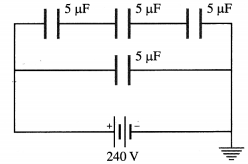
A network of four capacitors, 5 µF each, are connected to a 240 V supply. Determine the equivalent capacitance of the network and the charge on each capacitor.
Image
Derive the relation between the surface tension and surface energy of a liquid.
OR
Derive the relation between surface tension and surface energy per unit area.
OR
Show that the surface tension of a liquid is numerically equal to the surface energy per unit area.
A solid sphere rolls up a plane inclined at $45^{\circ}$ to the horizontal. If the speed of its centre of mass at the bottom of the plane is $5 \mathrm{~m} / \mathrm{s}$, find how far the sphere travels up the plane.
The displacement of a particle performing SHM is given by $x=\left[5 \sin \pi t+12 \sin \left(\pi t+\frac{\pi}{2}\right)\right.$ $cm$. Determine the amplitude, period and initial phase of the motion.
Derive an expression for capillary rise for a liquid having a concave meniscus.
Obtain an expression for the potential energy of a dipole in an external field.
A battery of emf 4 volt and internal resistance 1 Ω is connected in parallel with
another battery of emf 1 V and internal resistance 1 Ω (with their like poles connected together). The combination is used to send current through an external resistance of 2 Ω. Calculate the current through the external resistance.