Question
A capacitor having capacitance  C is charged to a voltage V. It is then removed and connected in parallel with another identical capacitor which is uncharged. The new charge on each capacitor is now(a) CV(b) CV / 2(c) 2 CV   (d) CV / 4
       

Answer

(b) CV / 2

Need a full question paper?

Generate a complete, print-ready paper with questions like this in minutes — across 16+ boards, with answer keys.
Start Generating Free

Similar questions

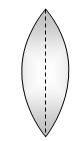
A convex lens has a focal length $f.$  It is cut into two parts along the dotted line as shown in the figure.  The focal length of each part will be
A charged particle enters a magnetic field H with its initial velocity making an angle of 45° with H. Then the path of the particle will be:
The average binding energy per nucleon is maximum for the nucleus$:$
Green light of wavelength 5460 $\stackrel{\circ}{A}$ is incident on an air-glass interface. If the refractive index of glass is 1⋅ 5, the wavelength of light in glass would be (Given that the velocity of light in air, $c =3 \times 10^8 m s ^{-1}$ )
Why the current does not rise immediately in a circuit containing inductance(a) Because of induced emf(b) Because of high voltage drop(c) Because of low power consumption (d) Because of Joule heating
   
   
The fringe width in Young’s double slit experiment increases when (a) Wavelength increases(b) Distance between the slits increases(c) Distance between the source and screen decreases(d) The width of the slits increases
   
   
A photon collides with a stationary hydrogen atom in ground state inelastically. Energy of the colliding photon is 10.2 eV. After a time interval of the order of micro second another photon collides with same hydrogen atom inelastically with an energy of 15 eV. What will be observed by the detector (a) 2 photon of energy 10.2 eV(b) 2 photon of energy of 1.4 eV(c) One photon of energy 10.2 eV and an electron of  energy 1.4 eV(d) One photon of energy 10.2 eV and another photon of 1.4 eV


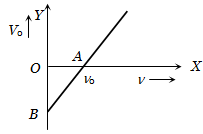
In an experiment on photoelectric effect the frequency $f$ of the incident light is plotted against the stopping potential $V_0$ . The work function of the photoelectric surface is given by $(e$ is electronic charge$)$
A block $A$ kept on an inclined surface just begins to slide if the inclination is $30^\circ$ . The block is replaced by another block $B$ and it is found that it just begins to slide if the inclination is $40^\circ$ :
  1. Mass of $A >$ mass of $ B$.
  2. Mass of $A <$ mass of $B$.
  3. Mass of $A =$ mass of $B.$
  4. All the three are possible.
$O_2$ molecule consists of two oxygen atoms. In the molecule, nuclear force between the nuclei of the two atoms$:$