A capacitor is charged by using a battery which is then disconnected. A dielectric slab is then slipped between the plates, which results in
Easy
Download our app for free and get started
(c) Battery in disconnected so $Q$ will be constant as $C \propto \,K$. So with introduction of dielectric slab capacitance will increase using $Q = CV$, $V$ will decrease and using $U = \frac{{{Q^2}}}{{2C}}$, energy will decrease.

Download our appand get started for free
Experience the future of education. Simply download our apps or reach out to us for more information. Let's shape the future of learning together!No signup needed.*
Similar Questions
- 1A fully charged capacitor has a capacitance $‘C’$. It is discharged through a small coil of resistance wire embedded in a thermally insulated block of specific heat capacity $‘s’$ and mass $‘m’$. If the temperature of the block is raised by ‘$\Delta T$’, the potential difference $‘V’$ across the capacitance isView Solution
- 2A parallel plate capacitor has plate of length $'l',$ width $'w'$ and separation of plates is $'d'.$ It is connected to a battery of emf $V$. A dielectric slab of the same thickness '$d$' and of dielectric constant $k =4$ is being inserted between the plates of the capacitor. At what length of the slab inside plates, will be energy stored in the capacitor be two times the initial energy stored$?$View Solution
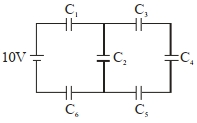
- 3In the given circuit, $C _1=2\,\mu F , C _2=0.2\,\mu F$, $C _3=2\,\mu F , C _4=4\,\mu F,$ $C _5=2\,\mu F , C _6=2\,\mu F$, the charge stored on capacitor $C _4$ is $.....\mu C$.View Solution
- 4Three charges $-q, Q$ and $-q$ are placed respectively at equal distances on a straight line. If the potential energy of the system of three charges is zero, then what is the ratio of $Q: q$ ?View Solution
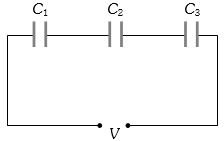
- 5In the figure, three capacitors each of capacitance $6\,pF$ are connected in series. The total capacitance of the combination will beView Solution
- 6View SolutionThe energy stored in the condenser is
- 7Positive and negative point charges of equal magnitude are kept at $\left(0,0, \frac{a}{2}\right)$ and $\left(0,0, \frac{-a}{2}\right)$, respectively. The work done by the electric field when another positive point charge is moved from $(-a, 0,0)$ to $(0, a, 0)$ isView Solution
- 8Two uniformly charged spherical conductors $A$ and $B$ of radii $5 mm$ and $10 mm$ are separated by a distance of $2 cm$. If the spheres are connected by a conducting wire, then in equilibrium condition, the ratio of the magnitudes of the electric fields at the surface of the sphere $A$ and $B$ will be .View Solution
- 9Three concentric metallic spherical shell $A, B$ and $C$ or radii $a, b$ and $c$ $(a < b < c)$ have surface charge densities $- \sigma , + \sigma ,$ and $- \sigma $ respectively. The potential of shell $A$ is :View Solution
- 10An electric charge $10^{-6} \mu \mathrm{C}$ is placed at origin $(0,0)$ $\mathrm{m}$ of $\mathrm{X}-\mathrm{Y}$ co-ordinate system. Two points $\mathrm{P}$ and $\mathrm{Q}$ are situated at $(\sqrt{3}, \sqrt{3}) \mathrm{m}$ and $(\sqrt{6}, 0) \mathrm{m}$ respectively. The potential difference between the points $P$ and $Q$ will be :View Solution