Two uniformly charged spherical conductors $A$ and $B$ of radii $5 mm$ and $10 mm$ are separated by a distance of $2 cm$. If the spheres are connected by a conducting wire, then in equilibrium condition, the ratio of the magnitudes of the electric fields at the surface of the sphere $A$ and $B$ will be .
JEE MAIN 2022, Medium


Download our appand get started for free
Experience the future of education. Simply download our apps or reach out to us for more information. Let's shape the future of learning together!No signup needed.*
Similar Questions
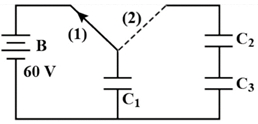
- 1A capacitor $C_1$ is charged up to a voltage $V\, = 60\,V$ by connecting it to battery $B$ through switch $( 1)$, Now $C_1$ is disconnected from battery and connected to a circuit consisting of two uncharged capacitors $C_2\, = 3.0\,\mu F$ and $C_3\,= 6.0\,\mu F$ through a switch $(2)$ as shown in the figure. The sum of final charges on $C_2$ and $C_3$ is......$\mu C$View Solution
- 2The work done in carrying a charge of $5\,\mu \,C$ from a point $A$ to a point $B$ in an electric field is $10\,mJ$. The potential difference $({V_B} - {V_A})$ is thenView Solution
- 3A parallel plate capacitor is made of two square parallel plates of area $A$ , and separated by a distance $d < < \sqrt A $ . The capacitor is connected to a battery with potential $V$ and allowed to fully charge. The battery is then disconnected. A square metal conducting slab also with area $A$ but thickness $\frac {d}{2}$ is then fully inserted between the plates, so that it is always parallel to the plates. How much work has been done on the metal slab by external agent while it is being inserted?View Solution
- 4The work done in placing a charge of $8 \times {10^{ - 18}}$ coulomb on a condenser of capacity $100\, micro-farad$ isView Solution
- 5The electric potential at the surface of an atomic nucleus $(Z = 50)$ of radius $9.0×{10^{ - 13}}\, cm$ isView Solution
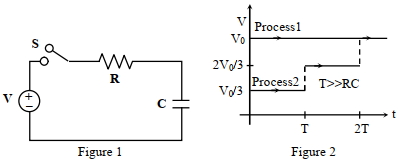
- 6Consider a simple $RC$ circuit as shown in Figure $1$.View Solution
Process $1$: In the circuit the switch $S$ is closed at $t=0$ and the capacitor is fully charged to voltage $V_0$ (i.e. charging continues for time $T \gg R C$ ). In the process some dissipation ( $E_D$ ) occurs across the resistance $R$. The amount of energy finally stored in the fully charged capacitor is $EC$.
Process $2$: In a different process the voltage is first set to $\frac{V_0}{3}$ and maintained for a charging time $T \gg R C$. Then the voltage is raised to $\frac{2 \mathrm{~V}_0}{3}$ without discharging the capacitor and again maintained for time $\mathrm{T} \gg \mathrm{RC}$. The process is repeated one more time by raising the voltage to $V_0$ and the capacitor is charged to the same final
take $\mathrm{V}_0$ as voltage
These two processes are depicted in Figure $2$.
($1$) In Process $1$, the energy stored in the capacitor $E_C$ and heat dissipated across resistance $E_D$ are released by:
$[A]$ $E_C=E_D$ $[B]$ $E_C=E_D \ln 2$ $[C]$ $\mathrm{E}_{\mathrm{C}}=\frac{1}{2} \mathrm{E}_{\mathrm{D}}$ $[D]$ $E_C=2 E_D$
($2$) In Process $2$, total energy dissipated across the resistance $E_D$ is:
$[A]$ $\mathrm{E}_{\mathrm{D}}=\frac{1}{2} \mathrm{CV}_0^2$ $[B]$ $\mathrm{E}_{\mathrm{D}}=3\left(\frac{1}{2} \mathrm{CV}_0^2\right)$ $[C]$ $\mathrm{E}_{\mathrm{D}}=\frac{1}{3}\left(\frac{1}{2} \mathrm{CV}_0^2\right)$ $[D]$ $\mathrm{E}_{\mathrm{D}}=3 \mathrm{CV}_0^2$
Given the answer quetion ($1$) and ($2$)
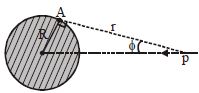
- 7A dipole having dipole moment $p$ is placed in front of a solid uncharged conducting sphere as shown in the diagram. The net potential at point $A$ lying on the surface of the sphere is :-View Solution
- 8View SolutionA capacitor is charged by a battery. The battery is removed and another identical uncharged capacitor is connected in parallel. The total electrostatic energy of resulting system
- 9A capacitor is connected to a battery of voltage $V$. Now a di electric slab of dielectric constant $k$ is completely inserted between the plates, then the final charge on the capacitor will beView Solution
(If initial charge is $q_{0}$ )
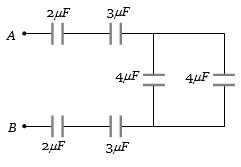
- 10The effective capacity between $A$ and $B$ in the figure given isView Solution