A capacitor is connected to a battery of voltage $V$. Now a di electric slab of dielectric constant $k$ is completely inserted between the plates, then the final charge on the capacitor will be
(If initial charge is $q_{0}$ )
AIIMS 2019, Medium
Download our app for free and get started
The initial charge on the capacitor is,
$q_{0}=C_{0} V$
$=\frac{\varepsilon_{0} A}{d} V$
The charge on the capacitor when di$-$electric is inserted is,
$q=k q_{0}$
$=\frac{k \varepsilon_{0} A}{d} V$

Download our appand get started for free
Experience the future of education. Simply download our apps or reach out to us for more information. Let's shape the future of learning together!No signup needed.*
Similar Questions
- 1A $400\, pF$ capacitor is charged with a $100\, V$ battery. After disconnecting battery this capacitor is connected with another $400\, pF$ capacitor. Then find out energy loss.View Solution
- 2Three capacitors of capacitance $1\ \mu F$, $2 \ \mu F$ and $3\ \mu F$ are connected in series and a potential difference of $11 V$ is applied across the combination. Then, the potential difference across the plates of $1\ \mu F$ capacitor is......$V$View Solution
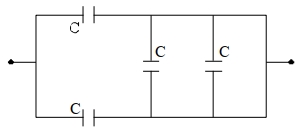
- 3View SolutionThe equivalent capacitance of the combination shown is
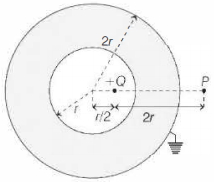
- 4Consider an initially neutral hollow conducting spherical shell with inner radius $r$ and outer radius $2 r$. A point charge $+Q$ is now placed inside the shell at a distance $r / 2$ from the centre. The shell is then grounded by connecting the outer surface to the earth. $P$ is an external point at a distance $2 r$ from the point charge $+Q$ on the line passing through the centre and the point charge $+Q$ as shown in the figure. The magnitude of the force on a test charge $+q$ placed at $P$ will beView Solution
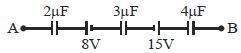
- 5The potential of the point $A$ is greater than that of $B$ by $19\, volt$. What is the potential difference in volts across the $3\,\mu F$ capacitor ?View Solution
- 6Electric field at a point $(x, y, z)$ is represented by $\vec E = 2x\hat i + {y^2}\hat j$ if potential at $(0,0,0)$ is $2\, volt$ find potential at $(1, 1, 1)$View Solution
- 7A parallel plate capacitor of capacitance $90\ pF$ is connected to a battery of $emf$ $20\ V$. If a dielectric material of dielectric constant $K = \frac{5}{3}$ is inserted between the plates, the magnitude of the induced charge will be.......$n $ $C$View Solution
- 8A capacitor of capacitance $C$ is initially charged to a potential difference of $V$ $volt$. Now it is connected to a battery of $2V$ with opposite polarity. The ratio of heat generated to the final energy stored in the capacitor will beView Solution
- 9View SolutionIf two conducting spheres are separately charged and then brought in contact
- 10Two charged spheres of radii $10\, cm$ and $15\, cm$ are connected by a thin wire. No current will flow, if they haveView Solution