Three capacitors of capacitance $1\ \mu F$, $2 \ \mu F$ and $3\ \mu F$ are connected in series and a potential difference of $11 V$ is applied across the combination. Then, the potential difference across the plates of $1\ \mu F$ capacitor is......$V$
Medium
Download our app for free and get started
(d) Equivalent capacitance $\frac{1}{{{C_{eq}}}} = \frac{1}{1} + \frac{1}{2} + \frac{1}{3}$
$==>$ ${C_{eq}} = \frac{6}{{11}}\,\mu F$
Charge supplied from battery $Q = \frac{6}{{11}} \times 11 = 6\,\mu C$
Hence potential difference across $1 \ \mu F$ capacitor $ = \frac{6}{1} = 6V$
$==>$ ${C_{eq}} = \frac{6}{{11}}\,\mu F$
Charge supplied from battery $Q = \frac{6}{{11}} \times 11 = 6\,\mu C$
Hence potential difference across $1 \ \mu F$ capacitor $ = \frac{6}{1} = 6V$

Download our appand get started for free
Experience the future of education. Simply download our apps or reach out to us for more information. Let's shape the future of learning together!No signup needed.*
Similar Questions
- 1Two parallel large thin metal sheets have equal surface charge densities $\left(\sigma=26.4 \times 10^{-12} C / m ^{2}\right)$ of same signs. The electric field between these sheet isView Solution
- 2In the circuit shown initially $C_1, C_2$ are uncharged. After closing the switchView Solution
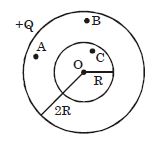
- 3A hollow conducting sphere of inner radius $R$ and outer radius $2R$ is given a charge $Q$ as shown in the figure, then the :View Solution
- 4The diagram shows a small bead of mass $m$ carrying charge $q$. The bead can freely move on the smooth fixed ring placed on a smooth horizontal plane. In the same plane a charge $+Q$ has also been fixed as shown. The potential atthe point $P$ due to $+Q$ is $V$. The velocity with which the bead should projected from the point $P$ so that it can complete a circle should be greater thanView Solution

- 5Two equal positive point charges are kept at points $A$ and $B$ . The electric potential, while moving from $A$ to $B$ along straight lineView Solution
- 6A $500\,\mu F$ capacitor is charged at a steady rate of $100\, \mu C/sec$. The potential difference across the capacitor will be $10\, V$ after an interval of.....$sec$View Solution
- 7View SolutionWhen a parallel plates capacitor is connected to a source of constant potential difference,
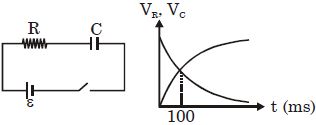
- 8In the $RC$ circuit shown, switch is closed at $t = 0$ . Graphs showing variation of potential $(V_R)$ across resistor and potential $(V_C)$ across capacitor are given. Time constant of circuit is approximately equal to.....$ms$View Solution
- 9View SolutionThe electric potential inside a conducting sphere
- 10The given figure shows, two parallel plates $A$ and $B$ of charge densities $+\sigma$ and $-\sigma$ respectively. Electric intensity will be zero in regionView Solution
