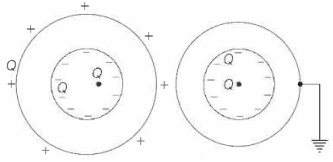
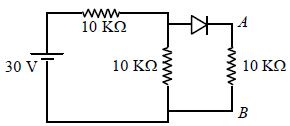
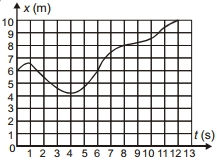
Consider an initially neutral hollow conducting spherical shell with inner radius $r$ and outer radius $2 r$. A point charge $+Q$ is now placed inside the shell at a distance $r / 2$ from the centre. The shell is then grounded by connecting the outer surface to the earth. $P$ is an external point at a distance $2 r$ from the point charge $+Q$ on the line passing through the centre and the point charge $+Q$ as shown in the figure. The magnitude of the force on a test charge $+q$ placed at $P$ will be
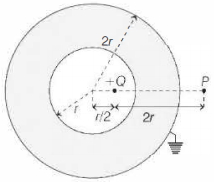
When a charge $+Q$ is placed inside the shell, it induces a charge $-Q$ on the inner surface of shell and a charge of $+Q$ appears on outer surface of shell.
When outer surface is earthed, charge on outer surface is neutralised.
As, now net charge inside the shell is zero.
Hence, net field outside the shell is zero.
$\therefore$ Force on charge at an external point $P$ is zero.
Download our app
and get started for free
Experience the future of education. Simply download our apps or reach out to us for more information. Let's shape the future of learning together!No signup needed.*
Shown in the figure is a semicircular metallic strip that has thickness $t$ and resistivity $\rho$. Its inner radius is $R_1$ and outer radius is $R_2$. If a voltage $V_0$ is applied between its two ends, a current $I$ flows in it. In addition, it is observed that a transverse voltage $\Delta V$ develops between its inner and outer surfaces due to purely kinetic effects of moving electrons (ignore any role of the magnetic field due to the current). Then (figure is schematic and not drawn to scale)-
The given figure shows, two parallel plates $A$ and $B$ of charge densities $+\sigma$ and $-\sigma$ respectively. Electric intensity will be zero in region
Three concentric metallic spherical shells of radii $R, 2R, 3R$, are given charges $Q_1, Q_2, Q_3$, respectively. It is found that the surface charge densities on the outer surfaces of the shells are equal. Then, the ratio of the charges given to the shells, $Q_1 : Q_2 : Q_3$ is
Assume that an electric field $\vec E = 30{x^2}\hat i$ exists in space. Then the potential difference $V_A-V_O$ where $V_O$ is the potential at the origin and $V_A$ the potential at $x = 2\ m$ is....$V$
A $16\ \Omega$ wire is bend to form a square loop. A $9 \mathrm{~V}$ battery with internal resistance $1\ \Omega$ is connected across one of its sides. If a $4\ \mu \mathrm{F}$ capacitor is connected across one of its diagonals, the energy stored by the capacitor will be $\frac{x}{2} \ \mu \mathrm{J}$. where $x=$________.
charge $Q$ is uniformly distributed over a long rod $AB$ of length $L$ as shown in the figure. The electric potential at the point $O$ lying at distance $L$ from the end $A$ is
The electric potential in volts due to an electric dipole of dipole moment $2 \times 10^{-8}$ coulomb-metre at a distance of $3 \,m$ on a line making an angle of $60^{\circ}$ with the axis of the dipole is ..........
A $400\, pF$ capacitor is charged with a $100\, V$ battery. After disconnecting battery this capacitor is connected with another $400\, pF$ capacitor. Then find out energy loss.