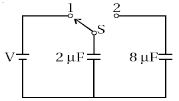
A capacitor of $2\,\, \mu F$ is charged as shown in the diagram. When the switch $S$ is turned to position $2,$ the percentage of its stored energy dissipated is ......$\%$
NEET 2016, Diffcult
Download our app for free and get started
Initially, the energy stored in $2 \,\mu F$ capacitor is
$U_{i}=\frac{1}{2} C V^{2}=\frac{1}{2}\left(2 \times 10^{-6}\right) V^{2}=V^{2} \times 10^{-6}\, \mathrm{J}$
Initially, the charge stored in $2\, \mu \mathrm{F}$ capacitor is
$Q_{i}=C V=\left(2 \times 10^{-6}\right)\, V=2 V \times 10^{-6}$ coulomb. When switch $S$ is turned to position $2,$ the charge flows and both the capacitors share charges till a common potential $V_{c}$ is reached.
$V_{C}=\frac{\text { total charge }}{\text { total capacitance }}=\frac{2 V \times 10^{-6}}{(2+8) \times 10^{-6}}=\frac{V}{5} \text { volt }$
Finally, the energy stored in both the capacitors
$U_{f}=\frac{1}{2}\left[(2+8) \times 10^{-6}\right]\left(\frac{V}{5}\right)^{2}=\frac{V^{2}}{5} \times 10^{-6} \,\mathrm{J}$
$\%$ loss of energy, $\Delta U=\frac{U_{i}-U_{f}}{U_{i}} \times 100 \%$
$=\frac{\left(V^{2}-V^{2} / 5\right) \times 10^{-6}}{V^{2} \times 10^{-6}} \times 100 \%=80 \%$

Download our appand get started for free
Experience the future of education. Simply download our apps or reach out to us for more information. Let's shape the future of learning together!No signup needed.*
Similar Questions
- 1This question has Statement $-1$ and Statement $-2$ Of the four choices given after the Statements, choose the one that best describes the two StatementsView Solution
Statement $1$ : No work is required to be done to move a test charge between any two points on an equipotential surface
Statement $2$ : Electric lines of force at the equipotential surfaces are mutually perpendicular to each other
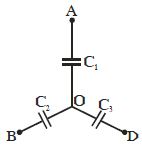
- 2Three uncharged capacitors of capacitance $C_1$, $C_2$ and $C_3$ are connected as shown in figure to one another and to points $A$, $B$ and $D$ at potentials $V_A$, $V_B$ and $V_D$. Then the potential at $O$ will beView Solution
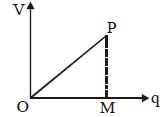
- 3Charge $'q'$ on a capacitor varies with voltage $'V'$ as shown. The area of $\Delta OPM$ representsView Solution
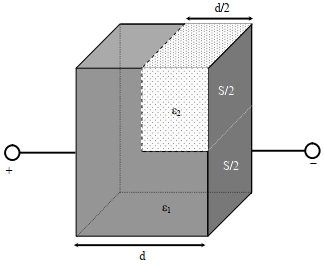
- 4A parallel plate capacitor having plates of area $S$ and plate separation $d$, has capacitance $C _1$ in air. When two dielectrics of different relative permittivities $\left(\varepsilon_1=2\right.$ and $\left.\varepsilon_2=4\right)$ are introduced between the two plates as shown in the figure, the capacitance becomes $C _2$. The ratio $\frac{ C _2}{ C _1}$ isView Solution
- 5View SolutionA long, hollow conducting cylinder is kept coaxially inside another long, hollow conducting cylinder of larger radius. Both the cylinders are initially electrically neutral.
- 6If the dielectric constant and dielectric strength be denoted by $k$ and $x$ respectively, then a material suitable for use as a dielectric in a capacitor must haveView Solution
- 7A series combination of $n_1$ capacitors, each of value $C_1$ is charged by a source of potential difference $4\, V.$ When another parallel combination of $n_2$ capacitors, each of value $C_2,$ is charged by a source of potential difference $V$, it has the same (total) energy stored in it, as the first combination has. The value of $C_2,$ in terms of $C_1$ is thenView Solution
- 8A parallel plate air capacitor is charged to a potential difference of $V\, volts$. After disconnecting the charging battery, the distance between the plates of the capacitor is increased using an insulating handle. As a result, the potential difference between the platesView Solution
- 9In the circuit shown in figure $C_1=2C_2$. Switch $S$ is closed at time $t=0$. Let $i_1$ and $i_2$ be the currents flowing through $C_1$ and $C_2$ at any time $t$, then the ratio $i_1/ i_2$View Solution
- 10Two charges of $4\,\mu C$ each are placed at the corners $A$ and $B $ of an equilateral triangle of side length $0.2\, m $ in air. The electric potential at $C$ is $\left[ {\frac{1}{{4\pi {\varepsilon _0}}} = 9 \times {{10}^9}\,\frac{{N{\rm{ - }}{m^2}}}{{{C^2}}}} \right]$View Solution