A series combination of $n_1$ capacitors, each of value $C_1$ is charged by a source of potential difference $4\, V.$ When another parallel combination of $n_2$ capacitors, each of value $C_2,$ is charged by a source of potential difference $V$, it has the same (total) energy stored in it, as the first combination has. The value of $C_2,$ in terms of $C_1$ is then
AIPMT 2010,AIEEE 2012, Diffcult
Download our app for free and get started
A series combination of $n_{1}$ capacitors each of capacitance $C_{1}$ are connected to $4 V$ source as shown in the figure.
Total capacitance of the series combination of the capacitors is
$\frac{1}{C_{s}}=\frac{1}{C_{1}}+\frac{1}{C_{1}}+\frac{1}{C_{1}}+\ldots \ldots \text { upto } n_{1} \text { terms }=\frac{n_{1}}{C_{1}}$
or $C_{s}=\frac{C_{1}}{n_{1}}.........(i)$
Total energy stored in a series combination of the capacitors is
$U_{s}=\frac{1}{2} C_{s}(4 V)^{2}=\frac{1}{2}\left(\frac{C_{1}}{n_{1}}\right)(4 V)^{2} \quad(\text { Using }(\mathrm{i})).........(ii)$
A parallel combination of $n_{2}$ capacitors each of capacitance $C_{2}$ are connected to $V$ source as shown in the figure.
Total capacitance of the parallel combination of capacitors is
$C_{p}=C_{2}+C_{2}+\ldots \ldots \ldots+\text { upto } n_{2} \text { terms }=n_{2} C_{2}$
or $\quad C_{p}=n_{2} C_{2}.........(iii)$
Total energy stored in a parallel combination of capacitors is
$U_{p} =\frac{1}{2} C_{p} V^{2}$
$=\frac{1}{2}\left(n_{2} C_{2}\right)(V)^{2}.........$ (Using $(iii))...(iv)$
According to the given problem,
$U_{s}=U_{p}$
Subst tuting the values of $U_s,$ and $U_p,$ from equations $(ii)$ and $(iv)$, we get
$\frac{1}{2} \frac{C_{1}}{n_{1}}(4 V)^{2}=\frac{1}{2}\left(n_{2} C_{2}\right)(V)^{2}$
or $\quad \frac{C_{1} 16}{n_{1}}=n_{2} C_{2}$ or $C_{2}=\frac{16 C_{1}}{n_{1} n_{2}}$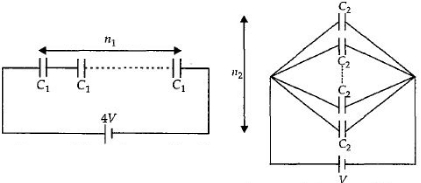

Download our appand get started for free
Experience the future of education. Simply download our apps or reach out to us for more information. Let's shape the future of learning together!No signup needed.*
Similar Questions
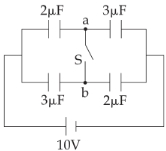
- 1In figure a system of four capacitors connected across a $10\, V$ battery is shown. Charge that will flow from switch $S$ when it is closed isView Solution
- 2An infinite non-conducting sheet has a surface charge density $\sigma = 0.10\, \mu C/m^2$ on one side. How far apart are equipotential surfaces whose potentials differ by $50\, V$View Solution
- 3The plates of a capacitor are charged to a potential difference of $320 \, volts$ and are then connected across a resistor. The potential difference across the capacitor decays exponentially with time. After $1 $ second the potential difference between the plates of the capacitor is $240 \, volts$, then after $2$ and $3$ seconds the potential difference between the plates will beView Solution
- 4Two opposite and equal charges $4 \times {10^{ - 8}}\,coulomb$ when placed $2 \times {10^{ - 2}}\,cm$ away, form a dipole. If this dipole is placed in an external electric field $4 \times {10^8}\,newton/coulomb$, the value of maximum torque and the work done in rotating it through $180^\circ $ will beView Solution
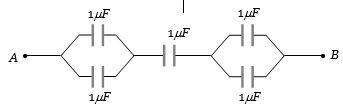
- 5The equivalent capacitance between $A$ and $B$ is.......$\mu \,F$View Solution
- 6Two positive charges of magnitude $q$ are placed at the ends of a side $1$ of a square of side $2a$. Two negative charges of the same magnitude are kept at the other corners. Starting from rest, if a charge $Q$, moves from the middle of side $1$ to the centre of square, its kinetic energy at the centre of square isView Solution
- 7View SolutionEqual charges are given to two spheres of different radii. The potential will
- 8The plates of a parallel plate capacitor of capacity $50\,\mu C$ are charged to a potential of $100\;volts$ and then separated from each other so that the distance between them is doubled. How much is the energy spent in doing soView Solution
- 9A $4\,\mu F$ condenser is connected in parallel to another condenser of $8\,\mu F$. Both the condensers are then connected in series with a $12\,\mu F$ condenser and charged to $20\;volts$. The charge on the plate of $4\,\mu F$ condenser is......$\mu C$View Solution
- 10View SolutionIn the transient shown the time constant of the circuit is :