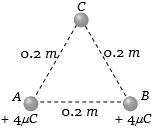
Two charges of $4\,\mu C$ each are placed at the corners $A$ and $B $ of an equilateral triangle of side length $0.2\, m $ in air. The electric potential at $C$ is $\left[ {\frac{1}{{4\pi {\varepsilon _0}}} = 9 \times {{10}^9}\,\frac{{N{\rm{ - }}{m^2}}}{{{C^2}}}} \right]$
Easy


Download our appand get started for free
Experience the future of education. Simply download our apps or reach out to us for more information. Let's shape the future of learning together!No signup needed.*
Similar Questions
- 1Electric charges of $ + 10\,\mu C,\; + 5\,\mu C,\; - 3\,\mu C$ and $ + 8\,\mu C$ are placed at the corners of a square of side $\sqrt 2 \,m$. the potential at the centre of the square isView Solution
- 2The work done in placing a charge of $8 \times {10^{ - 18}}$ coulomb on a condenser of capacity $100\, micro-farad$ isView Solution
- 3An electron of mass $m$ and charge $e$ is accelerated from rest through a potential difference $V$ in vacuum. The final speed of the electron will beView Solution
- 4View SolutionCan a metal be used as a medium for dielectric
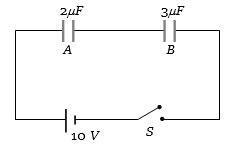
- 5Two capacitors $A$ and $B$ are connected in series with a battery as shown in the figure. When the switch $S$ is closed and the two capacitors get charged fully, thenView Solution
- 6A square of side ‘$a$’ has charge $Q$ at its centre and charge ‘$q$’ at one of the corners. The work required to be done in moving the charge ‘$q$’ from the corner to the diagonally opposite corner isView Solution
- 7The electric potential $V$ at any point $O$ ($x$, $y$, $z$ all in metres) in space is given by $V = 4{x^2}\,volt$. The electric field at the point $(1m,\,0,\,2m)$ in $volt/metre$ isView Solution
- 8The potential at a distance $R/2$ from the centre of a conducting sphere of radius $ R$ will beView Solution
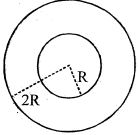
- 9Consider the shown system of two concentric thin metal shells. The inner hell has charge $Q$, while the outer shell is neutral. Potential difference between the shells is $V$. If the shell are joined by metal wire, then potential of the inner shell isView Solution
- 10The parallel combination of two air filled parallel plate capacitors of capacitance $C$ and $nC$ is connected to a battery of voltage, $V$. When the capacitor are fully charged, the battery is removed and after that a dielectric material of dielectric constant $K$ is placed between the two plates of the first capacitor. The new potential difference of the combined system isView Solution