A capacitor of capacitance $C$ is charged to potential difference $V_0$. Now this capacitor is connected to an ideal inductor. When $25\%$ of energy of capacitor is transferred to inductor then at that time what will be potential difference across capacitor
Medium
Download our app for free and get started
Initial energy in the capacitor is
$\mathrm{U}_{0}=\frac{\mathrm{q}_{0}^{2}}{2 \mathrm{C}}$
after connecting the inductor energy
$\mathrm{U}=\frac{3 \mathrm{U}_{0}}{4}$
So, $\mathrm{q}=\frac{\sqrt{3}}{2} \mathrm{q}_{0}$
and $\mathrm{V} \propto \mathrm{q}$
So, $\mathrm{V}=\frac{\sqrt{3}}{2} \mathrm{V}_{0}$

Download our appand get started for free
Experience the future of education. Simply download our apps or reach out to us for more information. Let's shape the future of learning together!No signup needed.*
Similar Questions
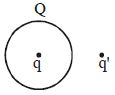
- 1A thin metallic spherical shell contains a charge $Q$ on it. A point charge $+q$ is placed at the centre of the shell and another charge $q'$ is placed outside it as shown in fig. All the three charges are positive. The force on the central charge due to the shell is :-View Solution
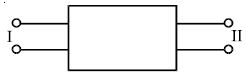
- 2If a battery of voltage $V$ is connected across terminals $I$ of the block box shown in figure, an ideal voltmeter connected to terminals $II$ gives a reading of $V/2$, while if the battery is connected to terminals $II$, a voltmeter across terminals $I$ reads $V$. The black box may containView Solution
- 3If charge on each plate of a parallel plate capacitor is $Q$ and the magnitude of electric field between the plates is $E$ then force on each plate of a parallel plate capacitor will beView Solution
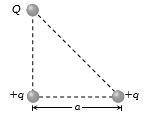
- 4Three charges $Q,\, + q$ and $ + q$ are placed at the vertices of a right-angled isosceles triangle as shown. The net electrostatic energy of the configuration is zero if $Q$ is equal toView Solution
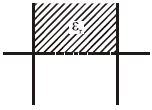
- 5What will be the capacity of a parallel-plate capacitor when the half of parallel space between the plates is filled by a material of dielectric constant ${\varepsilon _r}$ ? Assume that the capacity of the capacitor in air is $C$View Solution
- 6Two points $P$ and $Q$ are maintained at the potentials of $10\, V$ and $-4\,V$, respectively. The work done in moving $100$ electrons from $P$ and $Q$ isView Solution
- 7A capacitor is connected to a $20\, {V}$ battery through a resistance of $10\, \Omega .$ It is found that the potential difference across the capacitor rises to $2\, {V}$ in $1\, \mu {s}$. The capacitance of the capacitor is $....\,\mu {F}$ Given : $\ln \left(\frac{10}{9}\right)=0.105$View Solution
- 8In the circuit shown in figure, each capacitor has a capacity of $3\,\mu F$. The equivalent capacity between $A$ and $B$ is.......$\mu F$View Solution
- 9There are two equipotential surface as shown in figure. The distance between them is $r$. The charge of $-q\,$ coulomb is taken from the surface $A$ to $B$, the resultant work done will beView Solution
- 10Two charges of $4\,\mu C$ each are placed at the corners $A$ and $B $ of an equilateral triangle of side length $0.2\, m $ in air. The electric potential at $C$ is $\left[ {\frac{1}{{4\pi {\varepsilon _0}}} = 9 \times {{10}^9}\,\frac{{N{\rm{ - }}{m^2}}}{{{C^2}}}} \right]$View Solution