Two points $P$ and $Q$ are maintained at the potentials of $10\, V$ and $-4\,V$, respectively. The work done in moving $100$ electrons from $P$ and $Q$ is
Easy


Download our appand get started for free
Experience the future of education. Simply download our apps or reach out to us for more information. Let's shape the future of learning together!No signup needed.*
Similar Questions
- 1A parallel plate capacitor has plates of area $A$ separated by distance $d$ between them. It is filled with a dielectric which has a dielectric constant that varies as $\mathrm{k}(\mathrm{x})=\mathrm{K}(1+\alpha \mathrm{x})$ where $\mathrm{x}$ is the distance measured from one of the plates. If $(\alpha \text {d)}<<1,$ the total capacitance of the system is best given by the expressionView Solution
- 2A force of $10 \; N$ acts on a charged particle placed between two plates of a charged capacitor. If one plate of capacitor is removed, then the force acting on that particle will be ...... $N$View Solution
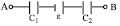
- 3A circuit shown in the figure consists of a battery of $emf$ $10$ $V$ and two capacitance $C_1$ and $C_2 $ of capacitances $1.0$ $ \mu F$ and $2.0$ $\mu F$ respectively. The potential difference $V_A - V_B$ is $5\,V$View Solution
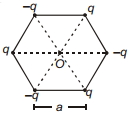
- 4Six point charges are placed at the vertices of a regular hexagon of side $a$ as shown. If $E$ represents electric field and $V$ represents electric potential at $O$, thenView Solution
- 5View SolutionA parallel plate capacitor is charged. Then battery is removed now If the plates are pulled apart
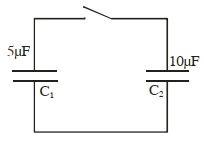
- 6A capacitor $C _{1}$ of capacitance $5\,\mu F$ is charged to a potential of $30\,V$ using a battery. The battery is then removed and the charged capacitor is connected to an uncharged capacitor $C _{2}$ of capacitance $10\,\mu F$ as shown in figure. When the switch is closed charge flows between the capacitors. At equilibrium, the charge on the capacitor $C _{2}$ is________ $\mu C$View Solution
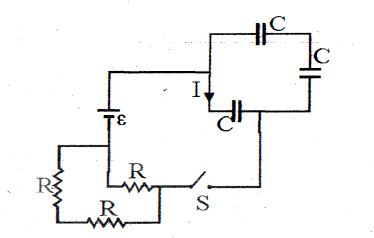
- 7In the given circuit switch $S$ is closed at $t = 0$ . The current $I$ in the figure at time $t$ isView Solution
- 8$0.2\,F$ capacitor is charged to $600\,V$ by a battery. On removing the battery, it is connected with another parallel plate condenser of $1\,F$. The potential decreases to.........$volts$View Solution
- 9View SolutionA non uniformly shaped conductor is charged then at it's sharpest point
- 10Three capacitors of capacitance $3\,\mu \,F$ are connected in a circuit. Then their maximum and minimum capacitances will beView Solution