A capacitor of capacitance $C=1\, \mu \,{F}$ is suddenly connected to a battery of $100\, volt$ through a resistance ${R}=100\, \Omega$. The time taken for the capacitor to be charged to get $50 \,{V}$ is $....\,\times \,10^{-4}\,s.$
[Take $\ln 2=0.69]$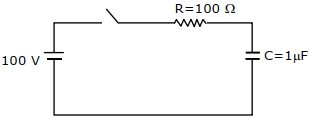
JEE MAIN 2021, Medium


Download our appand get started for free
Experience the future of education. Simply download our apps or reach out to us for more information. Let's shape the future of learning together!No signup needed.*
Similar Questions
- 1A $500\,\mu F$ capacitor is charged at a steady rate of $100\,\mu C/sec$ . The potential difference across the capacitor will be $10\,V$ after an interval of......$sec$View Solution
- 2Two insulated charged spheres of radii $20\,cm$ and $25\,cm$ respectively and having an equal charge $Q$ are connected by a copper wire, then they are separatedView Solution
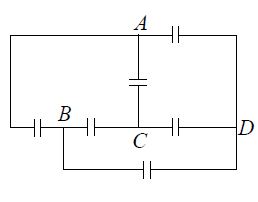
- 3Choose the correct statement for the given capacitor arrangement. (All the $6$ capacitor are of same capacitance)View Solution
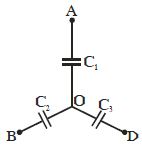
- 4Three uncharged capacitors of capacitance $C_1$, $C_2$ and $C_3$ are connected as shown in figure to one another and to points $A$, $B$ and $D$ at potentials $V_A$, $V_B$ and $V_D$. Then the potential at $O$ will beView Solution
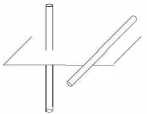
- 5Two mutually perpendicular infinitely long straight conductors carrying uniformly distributed charges of linear densities $\lambda_{1}$ and $\lambda_{2}$ are positioned at a distance $r$ from each other. Force between the conductors depends on $r$ asView Solution
- 6Consider a sphere of radius $R$ with uniform charge density and total charge $Q$. The electrostatic potential distribution inside the sphere is given by $\theta_{(r)}=\frac{Q}{4 \pi \varepsilon_{0} R}\left(a+b(r / R)^{C}\right)$. Note that the zero of potential is at infinity. The values of $(a, b, c)$ areView Solution
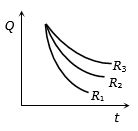
- 7Three identical capacitors are given a charge $Q$ each and they are then allowed to discharge through resistance $R_1, R_2\,$ and $\,R_3$. Their charges, as a function of time shown in the graph below. The smallest of the three resistance isView Solution
- 8The ratio of momenta of an electron and an $\alpha$-particle which are accelerated from rest by a potential difference of $100\, volts$ isView Solution
- 9Three point charges $q, q$ and $-2 q$ are placed at the corners of an equilateral triangle of side '$L$'. Calculate work done by extemal force in moving all the charges far apart without accelerationView Solution
- 10Two identical capacitors are joined in parallel, charged to potential $V$, separated and then, connected in series, $i.e.$, the positive plate of one is connected to the negative plate of the other. ThenView Solution