The ratio of momenta of an electron and an $\alpha$-particle which are accelerated from rest by a potential difference of $100\, volts$ is
Easy


Download our appand get started for free
Experience the future of education. Simply download our apps or reach out to us for more information. Let's shape the future of learning together!No signup needed.*
Similar Questions
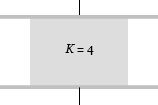
- 1Consider a parallel plate capacitor of $10\,\mu \,F$ (micro-farad) with air filled in the gap between the plates. Now one half of the space between the plates is filled with a dielectric of dielectric constant $4$, as shown in the figure. The capacity of the capacitor changes to.......$\mu \,F$View Solution
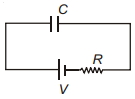
- 2As in the figure, if a capacitor of capacitance $C$ is charged by connecting it with resistance $R$, then energy given by the battery will beView Solution
- 3A thin-walled, spherical conducting shell $S$ of radius $R$ is given charge $Q$. The same amount of charge is also placed at its centre $C. $ Which of the following statements are correct ?View Solution
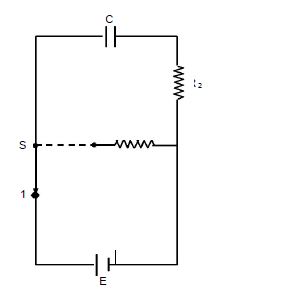
- 4Switch $S$ of circuit shown in figure is in position $1$ for a long time. At instant $t = 0$ , it is thrown from position $1$ to $2$ . The thermal power $P_1(t)$ generated in resistance $R_1$View Solution
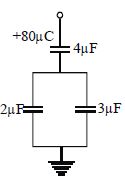
- 5In the given circuit, a charge of $+80\, \mu C$ is given to the upper plate of the $4\,\mu F$ capacitor. Then in the steady state, the charge on the upper plate of the $3\,\mu F$ capacitor is.....$\mu C$View Solution
- 6The radius of a metallic sphere if its capacitance is $1/9\,F$, isView Solution
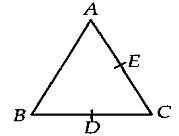
- 7Three charges, each $+q,$ are placed at the comers of an isosceles triangle $ABC$ of sides $BC$ and $AC, 2a.$ $D$ and $E$ are the mid-points of $BC$ and $CA.$ The work done in taking a charge $Q$ from $D$ to $E$ isView Solution
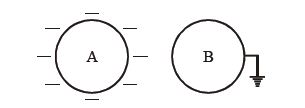
- 8Two concentric spheres $A$ and $B$ are kept very near to each other. $A$ is negatively charged and $B$ is earthed. The true statement isView Solution
$(A)$ Charge on $B$ is zero
$(B)$ Potential at $B$ is zero
$(C)$ Charge is uniformly distributed on $A$
$(D)$ Charge is non uniformly distributed on $A$
- 9Electric charges having same magnitude of electricicharge $q$ coulombs are placed at $x=1 \,m , 2 \,m , 4 \,m$, $8 \,m$....... so on. If any two consecutive charges have opposite sign but the first charge is necessarily positive, what will be the potential at $x=0$ ?View Solution
- 10Two charges of $4\,\mu C$ each are placed at the corners $A$ and $B $ of an equilateral triangle of side length $0.2\, m $ in air. The electric potential at $C$ is $\left[ {\frac{1}{{4\pi {\varepsilon _0}}} = 9 \times {{10}^9}\,\frac{{N{\rm{ - }}{m^2}}}{{{C^2}}}} \right]$View Solution