Two insulated charged spheres of radii $20\,cm$ and $25\,cm$ respectively and having an equal charge $Q$ are connected by a copper wire, then they are separated
Easy
Download our app for free and get started
(c)After the connection of wire ${V_1} = {V_2}$
$\frac{{{Q_1}}}{{25}} = \frac{{{Q_2}}}{{20}}$ $==>$ $\frac{{{Q_1}}}{{{Q_2}}} = \frac{{25}}{{20}}$ $ = = > $ ${Q_1} > {Q_2}$
$\frac{{{Q_1}}}{{25}} = \frac{{{Q_2}}}{{20}}$ $==>$ $\frac{{{Q_1}}}{{{Q_2}}} = \frac{{25}}{{20}}$ $ = = > $ ${Q_1} > {Q_2}$

Download our appand get started for free
Experience the future of education. Simply download our apps or reach out to us for more information. Let's shape the future of learning together!No signup needed.*
Similar Questions
- 1$27$ similar drops of mercury are maintained at $10 \,V$ each. All these spherical drops combine into a single big drop. The potential energy of the bigger drop is ....... times that of a smaller drop.View Solution
- 2Concentric metallic hollow spheres of radii $R$ and $4 R$ hold charges $Q _{1}$ and $Q _{2}$ respectively. Given that surface charge densities of the concentric spheres are equal, the potential difference $V ( R )- V (4 R )$ isView Solution
- 3The charges on two plates of a $10\,\mu f$ capacitor are $5\,\mu C$ and $15\,\mu C$ then the potential difference across the capacitor plates is........$V$View Solution
- 4Two conducting spheres of radii $5\, cm$ and $10\, cm$ are given a charge of $15\,\mu C$ each. After the two spheres are joined by a conducting wire, the charge on the smaller sphere is.......$\mu C$View Solution
- 5Two tiny electric dipoles of dipole moment $P_1$ and $P_2$ are placed $'r'$ distance coaxially find magnitude of electrostatic force between them.View Solution
- 6View SolutionOn increasing the plate separation of a charged condenser, the energy
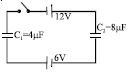
- 7In the circuit shown initially $C_1, C_2$ are uncharged. After closing the switchView Solution
- 8View SolutionTwo equal capacitors are first connected in series and then in parallel. The ratio of the equivalent capacities in the two cases will be
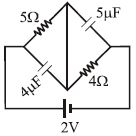
- 9Find the ratio of energy stored in $5\,\mu F$ and $4\,\mu F$ capacitor in the given circuit in steady stateView Solution
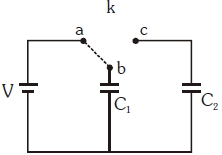
- 10Two Identical capacttors $\mathrm{C}_{1}$ and $\mathrm{C}_{2}$ of equal capacitance are connected as shown in the circult. Terminals $a$ and $b$ of the key $k$ are connected to charge capacitor $\mathrm{C}_{1}$ using battery of $emf \;V\; volt$. Now disconnecting $a$ and $b$ the terminals $b$ and $c$ are connected. Due to this, what will be the percentage loss of energy?.....$\%$View Solution