A capacitor of capacity $'C'$ is connected to a cell of $'V'\, volt$. Now a dielectric slab of dielectric constant ${ \in _r}$ is inserted in it keeping cell connected then
Easy


Download our appand get started for free
Experience the future of education. Simply download our apps or reach out to us for more information. Let's shape the future of learning together!No signup needed.*
Similar Questions
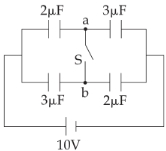
- 1In figure a system of four capacitors connected across a $10\, V$ battery is shown. Charge that will flow from switch $S$ when it is closed isView Solution
- 2In one design of capacitor thin sheets ot metal of area $80\ mm \times 80\ mm$ sandwich between them a piece of paper whose thickness is $40\ μm$. The relative permittivity of the paper is $4.0$ and its dielectric strength is $20\ MVm^{-1}$. Calculate the maximum charge that can be put on the capacitorView Solution
[permittivity of free space $ = 9 \times 10^{-12}\ Fm^{-1}$]
- 3The dielectric constant $k$ of an insulator cannot beView Solution
- 4$27$ identical drops are charged at $22\, V\,\,each.$ They combine to form a bigger drop. The potential of the bigger drop will be............ $V.$View Solution
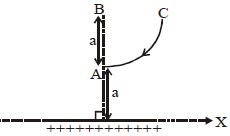
- 5For an infinite line of charge having charge density $\lambda $ lying along $x-$ axis, the work required in moving charge $q$ from $C$ to $A$ along arc $CA$ is :-View Solution
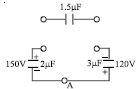
- 6Two capacitors of $2$ $\mu F$ and $3$ $\mu F$ are charged to $150$ $volt$ and $120$ $volt$ respectively. The plates of capacitor are connected as shown in the figure. A discharged capacitor of capacity $1.5$ $\mu F$ falls to the free ends of the wire. ThenView Solution
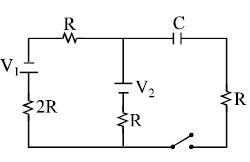
- 7View SolutionIn the transient current circuit shown, the time constant is
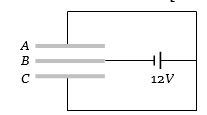
- 8Three plates $A,\;B,\;C$each of area $50\,c{m^2}$ have separation $3\,mm$ between $A$ and $B$ and $3\,mm$ between $B$ and $C$. The energy stored when the plates are fully charged isView Solution
- 9View SolutionOn increasing the plate separation of a charged condenser, the energy
- 10View SolutionIf eight identical drops are joined to form a bigger drop, the potential on bigger as compared to that on smaller drop will be