In one design of capacitor thin sheets ot metal of area $80\ mm \times 80\ mm$ sandwich between them a piece of paper whose thickness is $40\ μm$. The relative permittivity of the paper is $4.0$ and its dielectric strength is $20\ MVm^{-1}$. Calculate the maximum charge that can be put on the capacitor
[permittivity of free space $ = 9 \times 10^{-12}\ Fm^{-1}$]
Medium


Download our appand get started for free
Experience the future of education. Simply download our apps or reach out to us for more information. Let's shape the future of learning together!No signup needed.*
Similar Questions
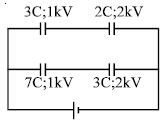
- 1The diagram shows four capacitors with capacitances and break down voltages as mentioned. What should be the maximum value of the external emf source such that no capacitor breaks down ? .......$kV$View Solution
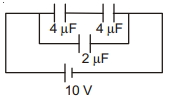
- 2If initial charge on all the capacitors were zero, work done by the battery in the circuit shown is ........... $mJ$View Solution
- 3An electron with kinetic energy $K _{1}$ enters between parallel plates of a capacitor at an angle $'\alpha'$ with the plates. It leaves the plates at angle $' \beta '$ with kinetic energy $K _{2}$. Then the ratio of kinetic energies $K _{1}: K _{2}$ will be ....... .View Solution
- 4Two conducting spheres of radii $R_1$ and $R_2$ are charged with charges $Q_1$ and $Q_2$ respectively. On bringing them in contact there isView Solution
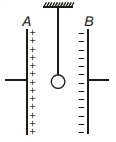
- 5View SolutionA small conducting sphere is hanged by an insulating thread between the plates of a parallel plate capacitor as shown in figure. The net force on the sphere is
- 6A metal ball of radius $R$ is placed concentrically inside a hollow metal sphere of inner radius $2R $ and outer radius $3R$. The ball is given a charge $+2Q$ and the hollow sphere a total charge $- Q$. The electrostatic potential energy of this system is :View Solution

- 7View SolutionAssertion : In the absence of an external electric field, the dipole moment per unit volume of a polar dielectric is zero.
Reason : The dipoles of a polar dielectric are randomly oriented.
- 8Two parallel large thin metal sheets have equal surface charge densities $\left(\sigma=26.4 \times 10^{-12} C / m ^{2}\right)$ of same signs. The electric field between these sheet isView Solution
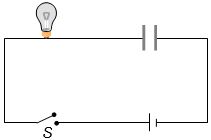
- 9A light bulb, a capacitor and a battery are connected together as shown here, with switch $S$ initially open. When the switch $S$ is closed, which one of the following is trueView Solution
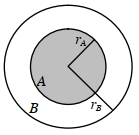
- 10In the figure, the inner (shaded) region $A$ represents a sphere of radius $r_A=1$, within which the electrostatic charge density varies with the radial distance $r$ from the center as $\rho_A=k r$, where $k$ is positive. In the spherical shell $B$ of outer radius $r_B$, the electrostatic charge density varies as $\rho_{\bar{B}}=\frac{2 k}{r}$. Assume that dimensions are taken care of. All physical quantities are in their $SI$ units.View Solution
Which of the following statement($s$) is(are) correct?