A capacitor of capacity $C$ is connected with a battery of potential $V$ in parallel. The distance between its plates is reduced to half at once, assuming that the charge remains the same. Then to charge the capacitance upto the potential $V$ again, the energy given by the battery will be
Easy
Download our app for free and get started
(d) Extra charge $Q$ = $(2CV -CV)$ = $CV$ flows through potential $V$ of the battery. Thus $W$ = $QV$ = $C{V^2}$

Download our appand get started for free
Experience the future of education. Simply download our apps or reach out to us for more information. Let's shape the future of learning together!No signup needed.*
Similar Questions
- 1A parallel plate capacitor is made of two square parallel plates of area $A$ , and separated by a distance $d < < \sqrt A $ . The capacitor is connected to a battery with potential $V$ and allowed to fully charge. The battery is then disconnected. A square metal conducting slab also with area $A$ but thickness $\frac {d}{2}$ is then fully inserted between the plates, so that it is always parallel to the plates. How much work has been done on the metal slab by external agent while it is being inserted?View Solution
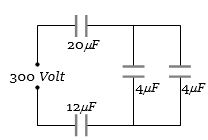
- 2In the adjoining figure, four capacitors are shown with their respective capacities and the $P.D.$ applied. The charge and the $P.D.$ across the $4\,\mu F$ capacitor will beView Solution
- 3Two identical capacitors are connected in parallel across a potenial difference $V$. After they are fully charged, the positive plate of first capacitor is connected to negative plate of second and negative plate of first is connected to positive plate of other. The loss of energy will beView Solution
- 4Two small equal point charges of magnitude $q$ are suspended from a common point on the ceiling by insulating mass less strings of equal lengths. They come to equilibrium with each string making angle $\theta $ from the vertical. If the mass of each charge is $m,$ then the electrostatic potential at the centre of line joining them will be $\left( {\frac{1}{{4\pi { \in _0}}} = k} \right).$View Solution
- 5We have three identical metallic spheres $A, B$ and $C$. $A$ is given a charge $Q$, and $B$ and $C$ are uncharged. The following processes of touching of two spheres are carried out in succession. Each process is carried out with sufficient time.View Solution
$(i)$ $A$ and $B$ $(ii)$ $B$ and $C$
$(iii)$ $C$ and $A$ $(iv)$ $A$ and $B$
$(v)$ $B$ and $C$
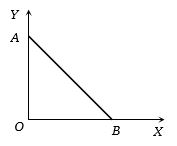
The final charges on the spheres are - 6As per this diagram a point charge $ + q$ is placed at the origin $O$. Work done in taking another point charge $ - Q$ from the point $A$ [co-ordinates $(0,\,a)$] to another point $B$ [co-ordinates $(a, 0)$] along the straight path $AB$ isView Solution
- 7View SolutionNo current flows between two charged bodies connected together when they have the same
- 8The diagram shows a small bead of mass $m$ carrying charge $q$. The bead can freely move on the smooth fixed ring placed on a smooth horizontal plane. In the same plane a charge $+Q$ has also been fixed as shown. The potential atthe point $P$ due to $+Q$ is $V$. The velocity with which the bead should projected from the point $P$ so that it can complete a circle should be greater thanView Solution

- 9View SolutionTwo identical conductors of copper and aluminium are placed in an identical electric fields. The magnitude of induced charge in the aluminium will be
- 10The capacitance of a spherical condenser is $1\,\mu F$. If the spacing between the two spheres is $1\,mm$, then the radius of the outer sphere isView Solution