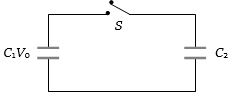
A capacitor of capacity ${C_1}$ is charged to the potential of ${V_o}$. On disconnecting with the battery, it is connected with a capacitor of capacity ${C_2}$ as shown in the adjoining figure. The ratio of energies before and after the connection of switch $S$ will be
Medium
Download our app for free and get started
(a) Energy $(U)$ $ = \frac{{{q^2}}}{{2C}}$. $q$ remains same so $U \propto \frac{1}{C}$
$==>$ $\frac{{{U_{Before}}}}{{{U_{After}}}} = $$\frac{{{C_1} + {C_2}}}{{{C_1}}}$
$==>$ $\frac{{{U_{Before}}}}{{{U_{After}}}} = $$\frac{{{C_1} + {C_2}}}{{{C_1}}}$

Download our appand get started for free
Experience the future of education. Simply download our apps or reach out to us for more information. Let's shape the future of learning together!No signup needed.*
Similar Questions
- 1Three capacitors $2$ $\mu F$, $3$ $\mu F$ and $5$ $\mu F$ can withstand voltages to $3\,V, 2\,V$ and $1\,V$ respectively. Their series combination can withstand a maximum voltage equal to.....$Volts$View Solution
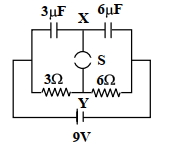
- 2A parallel plate capacitor is charged to a potential difference of $50\, V$. It is discharged through a resistance. After $1$ second, the potential difference between plates becomes $40 \,V$. ThenView Solution
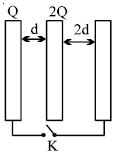
- 3Three large plates are arranged as shown. How much charge will flow through the key $k $ if it is closed?View Solution
- 4Two identical positive charges are placed on the $y$-axis at $y=-a$ and $y=+a$. The variation of $V$ (electric potential) along $x$-axis is shown by graphView Solution
- 5Two identical particles of mass m carry a charge $Q$ each. Initially one is at rest on a smooth horizontal plane and the other is projected along the plane directly towards first particle from a large distance with speed $v.$ The closest distance of approach beView Solution
- 6A spherical charged conductor has surface charge density $\sigma $ . The electric field on its surface is $E$ and electric potential of conductor is $V$ . Now the radius of the sphere is halved keeping the charge to be constant. The new values of electric field and potential would beView Solution
- 7A capacitor of capacitance $50 \; pF$ is charged by $100 \; V$ source. It is then connected to another uncharged identical capacitor. Electrostatic energy loss in the process is $\dots \; nJ$.View Solution
- 8Two charges of magnitude $+ q$ and $-\,3q$ are placed $100\,cm$ apart. The distance from $+ q$ between the charges where the electrostatic potential is zero is.......$cm$View Solution
- 9Uniform electric field of magnitude $ 100$ $V/m$ in space is directed along the line $y$ $=$ $3$ $+$ $x$. Find .........$V$ the potential difference between point $A (3, 1)$ $ \&$ $ B$ $ (1, 3)$View Solution
- 10A circuit is connected as shown in the figure with the switch $S$ open. When the switch is closed the total amount of charge that flows from $\mathrm{Y}$ to $\mathrm{X}$ isView Solution