Question
Three large plates are arranged as shown. How much charge will flow through the key $k $ if it is closed? 
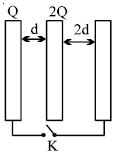
Answer

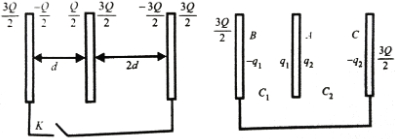
Before closing the switch After closing the switch

$q_{1}+q_{2}=2 Q$

$V_{A B}=V_{A C}$ or $\frac{Q_{1}}{C_{1}}=\frac{q_{2}}{C_{2}}$

$\frac{q_{1}}{q_{2}}=\frac{C_{1}}{C_{2}}=2$ or $q_{1}=2 q_{2}$

Solving, we get $q_{1}=\frac{4 Q}{3}, q_{2}=\frac{2 Q}{3}$

Charge flown through $K$ is $-\frac{Q}{2}-\left(-q_{1}\right)--\frac{Q}{2}+\frac{4 Q}{3}=5 Q / 6$
Need a full question paper?

Generate a complete, print-ready paper with questions like this in minutes — across 16+ boards, with answer keys.
Start Generating Free

Similar questions

A coil of radius $1\, cm$ and of turns $100$ is placed in the middle of a long solenoid of  radius $5\, cm$. and having $5\, turns/cm$. parallel to the axis of solenoid The mutual  inductance in millihenery will be
Two radioactive materials $A$ and $B$ have decay constants $10\,\lambda $ and $\lambda $, respectively. If initially they have the same number of nuclei, then the ratio of the number of nuclei of a to that of $B$ will be $1/e$ after a time
The activity of a radioactive sample falls from $700 \;\mathrm{s}^{-1}$ to $500\; \mathrm{s}^{-1}$ in $30\;min$. Its half life is close to.........$min$
Critical angle of incidence for a pair of optical media is $45^{\circ}$. The refractive indices of first and second media are in the ratio:
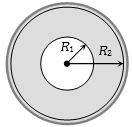
A sphere of mass $M$ and radius $R_2$ has a concentric cavity of radius $R_1$ as shown in figure. The force $F$ exerted by the sphere on a particle of mass $m$ located at a distance r from the centre of sphere varies as $(0 \le r \le \,\infty )$
The ratio of the shortest wavelength of Balmer series to the shortest wavelength of Lyman series for hydrogen atom is :
In a muonic atom, a muon of mass of $200$ times of that of electron and same charge is bound to the proton. The wavelengths of its Balmer series are in the range of
In an isothermal change, an ideal gas obeys
The wavelength of maximum intensity of radiation emitted by a star is $289.8 \,nm$. The radiation intensity for the star is : (Stefan’s constant $5.67 \times {10^{ - 8}}W{m^{ - 2}}{K^{ - 4}}$, constant $b = 2898\mu mK)$
Hydrogen gas is filled in a balloon at $20^\circ C$. If temperature is made $40^\circ C$, pressure remaining same, what fraction of Hydrogen will come out