A capacitor of capacity ${C_1}$ is charged upto $V$ volt and then connected to an uncharged capacitor of capacity ${C_2}$. Then final potential difference across each will be
AIPMT 2002, Medium
Download our app for free and get started
(c) Common potential $V' = \frac{{{C_1}V + {C_2} \times 0}}{{{C_1} + {C_2}}} = \frac{{{C_1}}}{{{C_1} + {C_2}}}.V$

Download our appand get started for free
Experience the future of education. Simply download our apps or reach out to us for more information. Let's shape the future of learning together!No signup needed.*
Similar Questions
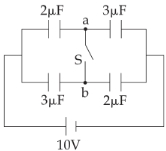
- 1In figure a system of four capacitors connected across a $10\, V$ battery is shown. Charge that will flow from switch $S$ when it is closed isView Solution
- 2The electrostatic potential inside a charged spherical ball is given by $\phi= a{r^2} + b$ where $r$ is the distance from the centre and $a, b$ are constants. Then the charge density inside the ball is:View Solution
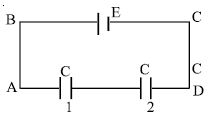
- 3In the adjoining figure, capacitor $(1)$ and $(2)$ have a capacitance $‘C’$ each. When the dielectric of dielectric consatnt $K$ is inserted between the plates of one of the capacitor, the total charge flowing through battery isView Solution
- 4A short electric dipole has a dipole moment of $16 \times 10^{-9}\, Cm .$ The electric potential due to the dipole at a point at a distance of $0.6\, m$ from the centre of the dipole, situated on a line making an angle of $60^{\circ}$ with the dipole axis is $.........V$View Solution
$\left(\frac{1}{4 \pi \in_{0}}=9 \times 10^{9} Nm ^{2} / C ^{2}\right)$
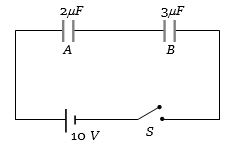
- 5Two capacitors $A$ and $B$ are connected in series with a battery as shown in the figure. When the switch $S$ is closed and the two capacitors get charged fully, thenView Solution
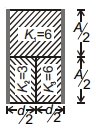
- 6View SolutionThree different dielectrics are filled in a parallel plate capacitor as shown. What should be the dielectric constant of a material, which when fully filled between the plates produces same capacitance?
- 7View SolutionDielectric constant for metal is
- 8A spherical metal shell $A$ of radius $R_A$ and a solid metal sphere $B$ of radius $R_B\left( < R_A\right)$ are kept far apart and each is given charge ' $+Q$ '. Now they are connected by a thin metal wire. ThenView Solution
$(A)$ $E_A^{\text {lnside }}=0$
$(B)$ $Q_A > Q_B$
$(C)$ $\frac{\sigma_A}{\sigma_B}=\frac{R_B}{R_A}$
$(D)$ $E_A^{\text {on sulface }} < E_B^{\text {on uurface }}$
- 9Four charges of $1\ \mu C, 2\ \mu C, 3\ \mu C,$ and $- 6\ \mu C$ are placed one at each corner of the square of side $1\,m$. The square lies in the $x-y$ plane with its centre at the origin.View Solution
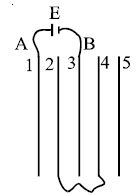
- 10Five conducting parallel plates having area $A$ and separation between them $d$, are placed as shown in the figure. Plate number $2$ and $4$ are connected wire and between point $A$ and $B$, a cell of emf $E$ is connected. The charge flown through the cell isView Solution