Four charges of $1\ \mu C, 2\ \mu C, 3\ \mu C,$ and $- 6\ \mu C$ are placed one at each corner of the square of side $1\,m$. The square lies in the $x-y$ plane with its centre at the origin.
Diffcult


Download our appand get started for free
Experience the future of education. Simply download our apps or reach out to us for more information. Let's shape the future of learning together!No signup needed.*
Similar Questions
- 1The plates of a parallel plate capacitor with no dielectric are connected to a voltage source. Now a dielectric of dielectric constant $K $ is inserted to fill the whole space between the plates with voltage source remaining connected to the capacitor.View Solution
- 2A parallel plate capacitor has capacitance $C$ . If charges of the plates are $Q$ and $-3Q$ , find the potential difference between the platesView Solution
- 3Two capacitors, each having capacitance $40\,\mu F$ are connected in series. The space between one of the capacitors is filled with dielectric material of dielectric constant $K$ such that the equivalence capacitance of the system became $24\,\mu F$. The value of $K$ will be.View Solution
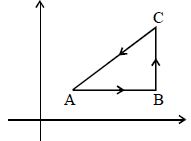
- 4As shown in figure, on bringing a charge $Q$ from point $A$ to $B$ and from $B$ to $C$, the work done are $2\, joule$ and $-3\, joule$ respectively. The work done to bring the charge from $C$ to $A$ isView Solution
- 5Twenty seven drops of same size are charged at $220\, \mathrm{~V}$ each. They combine to form a bigger drop. Calculate the potential of the bigger drop. (In $\mathrm{~V}$)View Solution
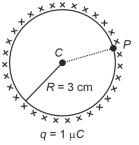
- 6A thin spherical shell is charged by some source. The potential difference between the two points $C$ and $P$ (in $V$) shown in the figure is:View Solution
(Take $\frac{1}{4 \pi \varepsilon_0}=9 \times 10^9$ $SI$ units)
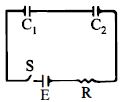
- 7In the following circuit, the switch $S$ is closed at $t = 0.$ The charge on the capacitor $C_1$ as a function of time will be given by $\left( {{C_{eq}}\, = {\kern 1pt} \,\frac{{{C_1}{C_2}}}{{{C_1} + {C_2}}}} \right).$View Solution
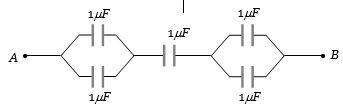
- 8The equivalent capacitance between $A$ and $B$ is.......$\mu \,F$View Solution
- 9A capacitor of capacitance $9 n F$ having dielectric slab of $\varepsilon_{ r }=2.4$ dielectric strength $20\, MV / m$ and $P.D. =20 \,V$ then area of plates is ....... $\times 10^{-4}\, m ^{2}$View Solution
- 10An uncharged parallel plate capacitor having a dielectric of constant $K$ is connected to a similar air cored parallel capacitor charged to a potential $V$. The two capacitors share charges and the common potential is $V$. The dielectric constant $K$ isView Solution