A capacitor with air as the dielectric is charged to a potential of $100\;volts$. If the space between the plates is now filled with a dielectric of dielectric constant $10$, the potential difference between the plates will be......$volts$
Easy
Download our app for free and get started
(c) New potential difference $ = \frac{V}{K} = \frac{{100}}{{10}} = 10\,V$

Download our appand get started for free
Experience the future of education. Simply download our apps or reach out to us for more information. Let's shape the future of learning together!No signup needed.*
Similar Questions
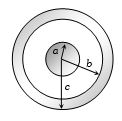
- 1A solid conducting sphere of radius $a$ has a net positive charge $2Q$. A conducting spherical shell of inner radius $b$ and outer radius $c$ is concentric with the solid sphere and has a net charge $-Q$. The surface charge density on the inner and outer surfaces of the spherical shell will beView Solution
- 2In the $R-C$ circuit shown in the figure the total energy of $3.6 \times 10^{-3}\ J$ is dissipated in the $10$ $\Omega$ resistor when the switch $S$ is closed. The initial charge on the capacitor is.....$\mu C$View Solution

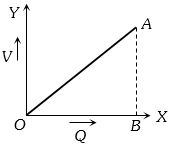
- 3Change $Q$ on a capacitor varies with voltage $V$ as shown in the figure, where $Q$ is taken along the $X$-axis and $V$ along the $Y$-axis. The area of triangle $OAB$ representsView Solution
- 4An electric dipole of moment $\vec p$ is lying along a uniform electric field $\vec E.$ The work done in rotating the dipole by $90^o $ isView Solution
- 5A disk of radius $R$ with uniform positive charge density $\sigma$ is placed on the $x y$ plane with its center at the origin. The Coulomb potential along the $z$-axis isView Solution
$V(z)=\frac{\sigma}{2 \epsilon_0}\left(\sqrt{R^2+z^2}-z\right)$
A particle of positive charge $q$ is placed initially at rest at a point on the $z$ axis with $z=z_0$ and $z_0>0$. In addition to the Coulomb force, the particle experiences a vertical force $\vec{F}=-c \hat{k}$ with $c>0$. Let $\beta=\frac{2 c \epsilon_0}{q \sigma}$. Which of the following statement($s$) is(are) correct?
$(A)$ For $\beta=\frac{1}{4}$ and $z_0=\frac{25}{7} R$, the particle reaches the origin.
$(B)$ For $\beta=\frac{1}{4}$ and $z_0=\frac{3}{7} R$, the particle reaches the origin.
$(C)$ For $\beta=\frac{1}{4}$ and $z_0=\frac{R}{\sqrt{3}}$, the particle returns back to $z=z_0$.
$(D)$ For $\beta>1$ and $z_0>0$, the particle always reaches the origin.
- 6How much work is required to carry a $6$ $\mu C$ charge from the negative terminal to the positive terminal of a $9\, V$ batteryView Solution
- 7View SolutionThe electric potential inside a conducting sphere
- 8The distance between the circular plates of a parallel plate condenser $40\,mm$ in diameter, in order to have same capacity as a sphere of radius $1\;metre$ is....$mm$View Solution
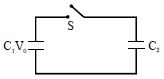
- 9A capacitor of capacity $C_1$ is charged to the potential of $V_0$. After disconnecting with the battery, it is connected with a neutral capacitor of capacity $C_2$ as shown in the adjoining figure. The ratio of energy of system before and after the connection of switch $S$ will beView Solution
- 10The work which is required to be done to make an arrangement of four particles each having a charge $+q$ such that the particles lie at the four corners of a square of side $a$ is .......View Solution