MCQ
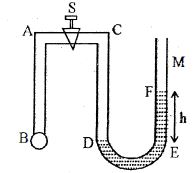
A capillary type tube $AB$ is connected to a manometer $M$ as shown in the figure. Stopper $S$ controls the flow of air. $AB$ is dipped into a soap solution where surface tension is $T$ . On opening the stopper for a while, a bubble is formed at $B$ end of the manometer and the level difference in manometer limbs is $h$ . If $P$ is the density of manometer soap solution and $r$ the radius of curvature of bubble, then the surface tension $T$ of the liquid is given by ...
  • A
    $2r\ \rho gh$
  • B
    $4r\ \rho gh$
  • C
    $r\ \rho gh$
  • $\frac{{r\rho gh}}{4}$

Answer

Correct option: D.
$\frac{{r\rho gh}}{4}$
d
Pressure at $\mathrm{B}=$ Pressure $\mathrm{E}$

$\mathrm{P}_{0}+\frac{4 \mathrm{T}}{\mathrm{r}}=\mathrm{P}_{0}+\rho \mathrm{gh}$

$\mathrm{T}=\frac{\mathrm{rpgh}}{4}$

Need a full question paper?

Generate a complete, print-ready paper with questions like this in minutes — across 16+ boards, with answer keys.

Start Generating Free

Similar questions

Two simple harmonic motions are represented by the equations ${y_1} = 0.1\sin \left( {100\pi t + \frac{\pi }{3}} \right)$ and ${y_2} = 0.1\cos \pi t.$ The phase difference of the velocity of particle $1$ with respect to the velocity of particle $2$ is
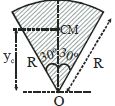
Sector of a circular plate shown in figure has position of centre of mass at $y_{CM} =$
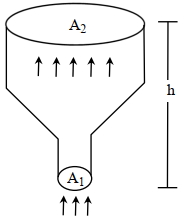
An ideal gas of density $\rho=0.2 kg m ^{-3}$ enters a chimney of height $h$ at the rate of $\alpha=0.8 kg s ^{-1}$ from its lower end, and escapes through the upper end as shown in the figure. The cross-sectional area of the lower end is $A_1=0.1 m ^2$ and the upper end is $A_2=0.4 m ^2$. The pressure and the temperature of the gas at the lower end are $600 Pa$ and $300 K$, respectively, while its temperature at the upper end is $150 K$. The chimney is heat insulated so that the gas undergoes adiabatic expansion. Take $g=10 ms ^{-2}$ and the ratio of specific heats of the gas $\gamma=2$. Ignore atmospheric pressure.

Which of the following statement($s$) is(are) correct?

The periodic time of a body executing simple harmonic motion is $3\, sec$. After how much interval from time $t = 0$, its displacement will be half of its amplitude ..... $\sec$
A mass $m$ moving horizontally (along the $x-$ axis) with velocity $v$ collides and sticks to a mass of $3m$ moving vertically upward (along the $y-$ axis) with velocity $2v$. The final velocity of the combination is
Choose the correct statement from the following : The radius of the orbit of a geostationary satellite depends upon
The temperature at which the vapour pressure of a liquid becomes equals to the external (atmospheric) pressure is its
The centre of mass of a system of particles is at the origin. It follows that:
Which of the following pair of quantities do not have the same dimensions
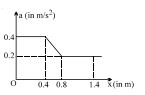
The acceleration of a particle which moves along the positive $x-$axis varies with its position as shown. If the velocity of the particle is $0.8 m/s$ at $x = 0$ , the velocity of the particle at $x = 1.4$ is(in $m/s$)