MCQ
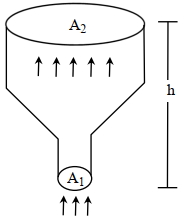
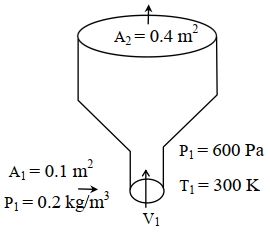
An ideal gas of density $\rho=0.2 kg m ^{-3}$ enters a chimney of height $h$ at the rate of $\alpha=0.8 kg s ^{-1}$ from its lower end, and escapes through the upper end as shown in the figure. The cross-sectional area of the lower end is $A_1=0.1 m ^2$ and the upper end is $A_2=0.4 m ^2$. The pressure and the temperature of the gas at the lower end are $600 Pa$ and $300 K$, respectively, while its temperature at the upper end is $150 K$. The chimney is heat insulated so that the gas undergoes adiabatic expansion. Take $g=10 ms ^{-2}$ and the ratio of specific heats of the gas $\gamma=2$. Ignore atmospheric pressure.

Which of the following statement($s$) is(are) correct?
  • A
    The pressure of the gas at the upper end of the chimney is $300 Pa$.
  • The velocity of the gas at the lower end of the chimney is $40 ms ^{-1}$ and at the upper end is $20 ms ^{-1}$.
  • C
    The height of the chimney is $590 m$.
  • D
    The density of the gas at the upper end is $0.05 kg m ^{-3}$.
Answer

Correct option: B.
The velocity of the gas at the lower end of the chimney is $40 ms ^{-1}$ and at the upper end is $20 ms ^{-1}$.
b
$\frac{ dm }{ dt }=\rho_1 A _1 v _1=0.8 kg / sA$

$v _1=\frac{0.8}{0.2 \times 0.1}=40 m / s$

$g=10 m / s ^2$

$\gamma=2$

Gas undergoes adiabatic expansion,

$p ^{1 \gamma} T ^\gamma=\text { Constant }$

$\frac{ P _2}{ P _1}=\left(\frac{ T _1}{ T _2}\right)^{\frac{ T }{1-\gamma}}$

$P _2=\left(\frac{300}{150}\right)^{\frac{2}{-1}} \times 600$

$P _2=\frac{600}{4}=150 Pa$

Now $\rho=\frac{ PM }{ RT } \Rightarrow \rho \propto \frac{ P }{ T }$

$\frac{\rho_1}{\rho_2}=\left(\frac{ P _1}{ P _2}\right)\left(\frac{ T _1}{ T _2}\right)=\left(\frac{150}{600}\right)\left(\frac{300}{150}\right)=\frac{1}{2}$

$\rho_2=\frac{\rho_1}{2}=0.1 kg / m ^3$

$\text { Now } \rho_2 A _2 V _2=0.8 \Rightarrow v _2=\frac{0.8}{0.1 \times 0.4}=20 m / s$

$\text { Now } W _{\text {on gas }}=\Delta K +\Delta U +\text { (Internal energy) }$

$P _1 A _1 \Delta x _1- P _2 A _2 \Delta x _2=\frac{1}{2} \Delta mV_{2 } ^ { 2 } -\frac{1}{2} \Delta mV V _1^2+\Delta mgh +\frac{ f }{2}\left( P _2 \Delta V _2- P _1 \Delta V _1\right)$

$\Rightarrow 2 P _1 \frac{\Delta V _1}{\Delta m }-2 P _2 \frac{\Delta V _2}{\Delta m }=\frac{ V _2^2- V _1^2}{2}+ gh$

$\Rightarrow \frac{2 \times 600}{0.2}-\frac{2 \times 150}{0.1}=\frac{20^2-40^2}{2}+10 h$

$h =360 m$

Need a full question paper?

Generate a complete, print-ready paper with questions like this in minutes — across 16+ boards, with answer keys.

Start Generating Free

Similar questions

A particle executes linear simple harmonic motion with an ampilitude of $3\,cm$ . When the particle is at $2\,cm$ from the mean position , the magnitude of its velocity is equal to that of its acceleration. Then its time period in seconds is 
Two identical spheres each of mass $2 \mathrm{~kg}$ and radius $50 \mathrm{~cm}$ are fixed at the ends of a light rod so that the separation between the centers is $150 \mathrm{~cm}$. Then, moment of inertia of the system about an axis perpendicular to the rod and passing through its middle point is $\frac{x}{20} \mathrm{~kg} \mathrm{~m}^2$, where the value of $\mathrm{x}$ is____.
To a person, going eastward in a car with a velocity of $25\, km/hr$, a train appears to move towards north with a velocity of $25\sqrt 3 $ $km/hr$. The actual velocity of the train will be..........$km/hr$
A block of mass $m$ is kept in an elevation which starts moving downward with an acceleration $a$ as shown in figure. The block is observed by two observers $A$ and $B$ for a time interval $t_0$. The observer $B$ finds that the work done by gravity on the block is
Two rectangular blocks, having indentical dimensions, can be arranged either in configuration $I$ or in configuration $II$ as shown in the figure, On of the blocks has thermal conductivity $k$ and the other $2 \ k$. The temperature difference between the ends along the $x$-axis is the same in both the configurations. It takes $9\ s$ to transport a certain amount of heat from the hot end to the cold end in the configuration $I$. The time to transport the same amount of heat in the configuration $II$ is :
A projectile is thrown at an angle $\theta$ with the horizontal and its range is $R_1$. It is then thrown at an angle $\theta$ with vertical and the range is $R_2$, then
When an object covers equal distances in equal time intervals, then its speed is:
A bob of mass $'m'$ suspended by a thread of length $l$ undergoes simple harmonic oscillations with time period ${T}$. If the bob is immersed in a liquid that has density $\frac{1}{4}$ times that of the bob and the length of the thread is increased by $1 / 3^{\text {rd }}$ of the original length, then the time period of the simple harmonic oscillations will be :-
A car accelerates from rest at a constant rate $\alpha $ for some time, after which it decelerates at a constant rate $\beta $ and comes to rest. If the total time elapsed is $t$, then the maximum velocity acquired by the car is
A block of mass $m$ slides on the wooden wedge, which in turn slides backward on the horizontal surface. The acceleration of the block with respect to the wedge is : Given ${m}=8 \,{kg}, {M}=16\, {kg}$

Assume all the surfaces shown in the figure to be frictionless.