MCQ
A car is moving with high velocity when it has a turn. A force acts on it outwardly because of
  • A
    Centripetal force
  • Centrifugal force
  • C
    Gravitational force
  • D
    All the above

Answer

Correct option: B.
Centrifugal force
b
(b)

Need a full question paper?

Generate a complete, print-ready paper with questions like this in minutes — across 16+ boards, with answer keys.
Start Generating Free

Similar questions

A hollow sphere and a solid sphere having same mass and same radii are rolled down a rough inclined plane:
A particle moves such that its acceleration $a$ is given by $a = - bx$, where $x$ is the displacement from equilibrium position and b is a constant. The period of oscillation is
The equation $\left(P+\frac{a}{V^2}\right)(V-b)=$ Constant. The units of a are
Time period of pendulum, on a satellite orbiting the earth, is
A $60 \,kg$ weight is dragged on a horizontal surface by a rope upto $ 2$ metres. If coefficient of friction is $\mu = 0.5$, the angle of rope with the surface is $60^°$ and $g = 9.8\,m/{\sec ^2}$, then work done is ........ $joules$
A sample of an ideal gas is contained in a cylinder. The volume of the gas is suddenly decreased. A student makes the following statements to explain the change in pressure of the gas
$I.$ The average kinetic energy of the gas atoms increases
$II.$ The atoms of the gas hit the walls of the cylinder more frequently
$III.$ Temperature of the gas remains unchanged
Which of these statements is true?
Two racing cars of masses ${m_1}$ and ${m_2}$ are moving in circles of radii ${r_1}$ and ${r_2}$ respectively. Their speeds are such that each makes a complete circle in the same duration of time $t$. The ratio of the angular speed of the first to the second car is
A spring is stretched by $0.20\, m$, when a mass of $0.50\, kg$ is suspended. When a mass of $0.25\, kg$ is suspended, then its period of oscillation will be .... $\sec$   $(g = 10\,m/{s^2})$
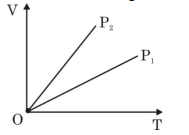
The given figure represents two isobaric processes for the same mass of an ideal gas, then
Hubble's law states that the velocity with which milky way is moving away from the earth is proportional to