A car of mass $m$ is moving on a level circular track of radius $R.$ If $\mu_s $ represents the static friction between the road and tyres of the car, the maximum speed of the car in circular motion is given by
AIPMT 2012, Medium
Download our app for free and get started
Force of friction provides the necessary centripetal force.
$f \leq \mu_{s} N=\frac{m w^{2}}{R}$
$v^{2} \leq \frac{\mu_{s} R N}{m}$
$v^{2} \leq \mu_{s} R g \quad[\because N=m g]$
$v \leq \sqrt{\mu_{s} m g}$
The maximum speed of the car in circular motion is $v_{\max }=\sqrt{\mu_{s} R g}$

Download our appand get started for free
Experience the future of education. Simply download our apps or reach out to us for more information. Let's shape the future of learning together!No signup needed.*
Similar Questions
- 1View SolutionMaximum value of static friction is called
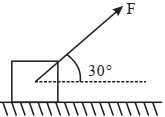
- 2As shown in the figure a block of mass $10\,kg$ lying on a horizontal surface is pulled by a force $F$ acting at an angle $30^{\circ}$, with horizontal. For $\mu_{ s }=0.25$, the block will just start to move for the value of $F..........\,N$ : $\left[\right.$ Given $\left.g =10\,ms ^{-2}\right]$View Solution
- 3A block of mass $2 \,kg$ rests on a rough inclined plane making an angle of $30°$ with the horizontal. The coefficient of static friction between the block and the plane is $ 0.7$. The frictional force on the block is ....... $N$.View Solution
- 4A string breaks if its tension exceeds $10$ newtons. A stone of mass $250\, gm$ tied to this string of length $10 \,cm$ is rotated in a horizontal circle. The maximum angular velocity of rotation can be .......... $rad/s$View Solution
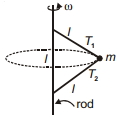
- 5In the figure, a ball of mass $m$ is tied with two strings of equal length as shown. If the rod is rotated with angular velocity $\omega$, thenView Solution
- 6A motor car has a width $1.1$ m between wheels. Its centre of gravity is $0.62$ m above the ground and the coefficient of friction between the wheels and the road is $0.8$. ...... $m/s$ is the maximum possible speed, if the centre of gravity inscribes a circle of radius $15$ m ? (Road surface is horizontal)View Solution
- 7A conveyor belt is moving at a constant speed of $2\, m s^{-1}$. A box is gently dropped on it. The coefficient of friction between them is $\mu = 0.5.$ The distance that the box will move relative to belt before coming to rest on it, taking $g = 10\, m s^{-2},$ is ........... $m$View Solution
- 8View SolutionChoose the correct statement.
- 9A mass is supported on a frictionless horizontal surface. It is attached to a string and rotates about a fixed centre at an angular velocity ${\omega _0}$. If the length of the string and angular velocity are doubled, the tension in the string which was initially ${T_0}$ is nowView Solution
- 10A sphere of mass $m$ is set in motion with initial velocity $v_o$ on a surface on which $kx^n$ is the frictional force with $k$ and $n$ as the constants and $x$ as the distance from the point of start. Find the distance in which sphere will stopView Solution