A string breaks if its tension exceeds $10$ newtons. A stone of mass $250\, gm$ tied to this string of length $10 \,cm$ is rotated in a horizontal circle. The maximum angular velocity of rotation can be .......... $rad/s$
Medium
Download our app for free and get started
(a) $T = m{\omega ^2}r$
$⇒$ $10 = 0.25 \times {\omega ^2} \times 0.1$
$⇒$ $\omega = 20\,rad/s$

Download our appand get started for free
Experience the future of education. Simply download our apps or reach out to us for more information. Let's shape the future of learning together!No signup needed.*
Similar Questions
- 1$Assertion$ : Angle of repose is equal to the angle of limiting friction.View Solution
$Reason$ : When the body is just at the point of motion, the force of friction in this stage is called limiting friction. - 2A block $A$ of mass $4\, kg$ is placed on another block $B$ of mass $5\, kg$, and the block $B$ rests on a smooth horizontal table. If the minimum force that can be applied on $A$ so that both the blocks move together is $12\, N$, the maximum force that can be applied to $B$ for the blocks to move together will be ....... $N$View Solution
- 3Consider a car moving along a straight horizontal road with a speed of $72\, km/h$. If the coefficient of kinetic friction between the tyres and the road is $0.5,$ the shortest distance in which the car can be stopped is ........ $m$ .$[g = 10\,m{s^{ - 2}}]$View Solution
- 4A plank is resting on a horizontal ground in the northern hemisphere of the earth at a $45^{\circ}$ latitude. Let the angular speed of the earth be $\omega$ and its radius $r_e$. The magnitude of the frictional force on the plank will beView Solution
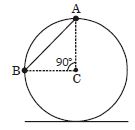
- 5Two beads connected by massless inextensible string are placed over the fixed ring as shown in figure. Mass of each bead is $m$ , and there is no friction between $B$ and ring. Find minimum value of coefficient of friction between $A$ and ring so that system remains in equilibrium. ( $C \to $center of ring, $AC$ line is vertical)View Solution
- 6A body of mass $1\, kg$ tied to one end of string is revolved in a horizontal circle of radius $0.1\, m$ with a speed of $3$ revolution/sec, assuming the effect of gravity is negligible, then linear velocity, acceleration and tension in the string will beView Solution
- 7View SolutionWhen a cube is in limiting equilibrium on an inclined plane and it is about to topple. The coefficient of friction between cube and plane is:-
- 8A body of mass $2$ kg is moving on the ground comes to rest after some time. The coefficient of kinetic friction between the body and the ground is $0.2$. The retardation in the body is ...... $m/s^2$View Solution
- 9A car of mass $800 \,kg$ moves on a circular track of radius $40\, m$. If the coefficient of friction is $0.5$, then maximum velocity with which the car can move is ......... $m/s$View Solution
- 10An isolated rail car originally moving with speed $v_0$ on a straight, frictionles, level track contains a large amount of sand. $A$ release valve on the bottom of the car malfunctions, and sand begins to pour out straight down relative to the rail car. What happens to the speed of the rail car as the sand pours out?View Solution