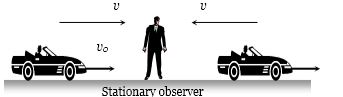
A car sounding a horn of frequency $ 1000 Hz$ passes an observer. The ratio of frequencies of the horn noted by the observer before and after passing of the car is $11 : 9$. If the speed of sound is v, the speed of the car is
Medium


Download our appand get started for free
Experience the future of education. Simply download our apps or reach out to us for more information. Let's shape the future of learning together!No signup needed.*
Similar Questions
- 1A pipe open at both ends produces a note of frequency $f_1$. When the pipe is kept with $\frac{3}{4}$th of its length it water, it produced a note of frequency $f_2$. The ratio $\frac{{{f_1}}}{{{f_2}}}$ isView Solution
- 2A wave equation which gives the displacement along the $Y$ direction is given by the equation $y = {10^4}\sin (60t + 2x)$, where $x$ and $y$ are in metres and $t$ is time in seconds. This represents a waveView Solution
- 3View SolutionAn observer is moving towards the stationary source of sound, then
- 4A uniform string oflength $20\ m$ is suspended from a rigid support. A short wave pulse is introduced at its lowest end. It starts moving up the string. The time taken to reach the supports is (take $g= 10 $ $ms^{-2}$ )View Solution
- 5An observer moves towards a stationary source of sound of frequency $n$. The apparent frequency heard by him is $2n$. If the velocity of sound in air is $332\, m/sec, $ then the velocity of the observer is .... $m/sec$View Solution
- 6The equation of a simple harmonic wave is given by $y = 3sin\frac{\pi }{2}\left( {50t - x} \right)\, $View Solution
where $x$ and $y$ are in metres and $t$ is in seconds. The ratio of maximum particle velocity to the wave velocity is
- 7Ten tuning forks are arranged in increasing order of frequency in such a way that any two consecutive tuning forks produce $4$ beats per second. The highest frequency is twice that of the lowest. Possible highest and lowest frequencies (in $Hz$ ) are ................View Solution
- 8A tuning fork of known frequency $256\,Hz$ makes $5$ beats per second with the vibrating string of a piano. The beat frequency decreases to $2$ beats per second when the tension in the piano string is slightly increased. The frequency of the piano string before increasing the tension wasView Solution
- 9Two stationary sources each emitting waves of wave length $\lambda$. An observer moves from one source to other with velocity $u .$ Then number of beats heared by himView Solution
- 10The two interfering waves have intensities in the ratio $9 : 4$. The ratio of intensities of maxima and minima in the interference pattern will beView Solution