The equation of a simple harmonic wave is given by $y = 3sin\frac{\pi }{2}\left( {50t - x} \right)\, $
where $x$ and $y$ are in metres and $t$ is in seconds. The ratio of maximum particle velocity to the wave velocity is
AIPMT 2012, Medium
Download our app for free and get started
The given wave equation is
$y=3 \sin \frac{\pi}{2}(50 t-x)$
$y=3 \sin \left(25 \pi t-\frac{\pi}{2} x\right)$ $...(i)$
The standard wave equation is
$y=A \sin (\omega t-k x)$ $...(ii)$
Comparing $(i)$ and $(ii),$ we get
$\omega=25 \pi, \quad k=\frac{\pi}{2}$
Wave velocity,
$v=\frac{\omega}{k}=\frac{25 \pi}{(\pi / 2)}=50 \mathrm{ms}^{-1}$
Particle velocity, $v_{p}=\frac{d y}{d t}=\frac{d}{d t}\left(3 \sin \left(25 \pi t-\frac{\pi}{2}\right)\right)$
$=75 \pi \cos \left(25 \pi t-\frac{\pi}{2}\right)$
Maximum particle velocity, $\left(v_{p}\right)_{\max }=75 \pi \mathrm{ms}^{-1}$
$\therefore \frac{\left(v_{p}\right)_{\max }}{v}=\frac{75 \pi}{50}=\frac{3}{2} \pi$

Download our appand get started for free
Experience the future of education. Simply download our apps or reach out to us for more information. Let's shape the future of learning together!No signup needed.*
Similar Questions
- 1$y = a\cos (kx + \omega t)$ superimposes on another wave giving a stationary wave having node at $x = 0.$ What is the equation of the other waveView Solution
- 2Two engines pass each other moving in opposite directions with uniform speed of $30\,m/s$ . One of them is blowing a whistle of frequency $540\,Hz.$ Calculate the frequency heard by driver of second engine before they pass each other ... $Hz$. Speed of sound is $330\,m/sec$View Solution
- 3View SolutionIn stationary waves all particles between two nodes pass through the mean position
- 4A man can hear sounds in frequency range $120\,Hz$ to $12020\,Hz$. only. He is vibrating a piano string having a tension of $240\,N$ and mass of $3\,gm$ . The string has a length of $8\,m$ . How many different frequencies can he hear ?View Solution
- 5The intensity of sound during the festival season increased by $100$ times. This could imply a decibel $(dB)$ level rise fromView Solution
- 6${v_1}$ and ${v_2}$ are the velocities of sound at the same temperature in two monoatomic gases of densities ${\rho _1}$ and ${\rho _2}$ respectively. If $\frac{\rho _1}{\rho _2} = \frac{1}{4}$ then the ratio of velocities ${v_1}$ and ${v_2}$ will beView Solution
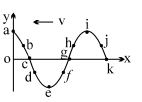
- 7The figure represents the instantaneous picture of a longitudinal harmonic wave travelling along the negative $x$-axis. Identify the correct statement $(s)$ related to the movement of the points shown in the figure. The points of maximum rarefaction areView Solution
- 8The velocity of sound in a gas at pressure $P$ and density $d$ isView Solution
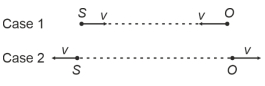
- 9A source $(S)$ of sound has frequency $240 \ Hz$. When the observer $(O)$ and the source move towards each other at a speed $v$ with respect to the ground (as shown in Case $1$ in the figure), the observer measures the frequency of the sound to be $288 \ Hz$. However, when the observer and the source move away from each other at the same speed $v$ with respect to the ground (as shown in Case $2$ in the figure), the observer measures the frequency of sound to be $n Hz$. The value of $n$ is. . . . . .View Solution
- 10Following statements are given for a stationary waveView Solution
$(a)$ Every particle has a fixed amplitude which is different from the amplitude of its nearest particle.
$(b)$ All the particles cross their mean position at the same time.
$(c)$ All the particles are oscillating with same amplitude.
$(d)$ There is no net transfer of energy across any plane.
$(e)$ There are some particles which are always at rest.
Which of the following is correct