Question
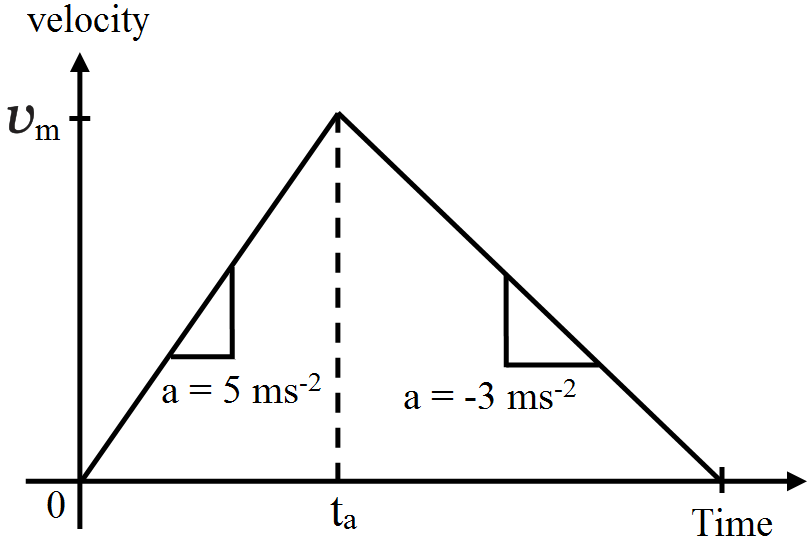
A car starting from rest, accelerates uniformly with $5m/s^2$ for sometime and then decelerates to come to rest with $3m/s^2$. Find the maximum velocity attained during the motion and the distance covered in a total time of 6 seconds of the journey.
Answer

During acceleration, $\text{v}_\text{m}=0+5\times\text{t}_\text{a}$
$\Rightarrow \text{t}_\text{a}=\frac{\text{v}_\text{m}}{5}$
$\text{v}^2_\text{m}=0+2\times5\times\text{s}_\text{a}$
$\Rightarrow \text{s}_\text{a}=\frac{\text{v}^2_\text{m}}{10}$

During deceleration, $0=\text{v}_\text{m}-3\text{t}_\text{d}$
$\Rightarrow \text{t}_\text{d}=\frac{\text{v}_\text{m}}{3}$
$0=\text{v}^2_\text{m}-2\times3\times\text{s}_\text{d}$
$\Rightarrow \text{s}_\text{d}=\frac{\text{v}^2_\text{m}}{6}$ Total time $=6=\text{t}_\text{a}+\text{t}_\text{d}$
$\therefore \text{v}_\text{m}=\frac{6\times5\times3}{8}=11.25\text{ms}^{-1}$ Total length covered $=\text{s}_\text{a}+\text{s}_\text{d}=\text{v}^2_\text{m}\Big(\frac{1}{10}+\frac{1}{6}\Big)$
$=(11.25)^2\frac{16}{60}$
$=33.75\text{m}$

Need a full question paper?

Generate a complete, print-ready paper with questions like this in minutes — across 16+ boards, with answer keys.

Start Generating Free

Similar questions

Explain:
  1. Why are ball bearings used in machinery?
  2. Why does a horse have to apply more force to start a cart than to keep it moving?
  3. What is the need for banking the tracks?
  4. State two advantages and two disadvantages of friction.
A car weighs $1800kg$. The distance between its front and back axles is $1.8m$. Its centre of gravity is $1.05m$ behind the front axle. Determine the force exerted by the level ground on each front wheel and each back wheel.
  1. Discuss elastic collision in one dimension. Obtain expressions for velocities of the two bodies after such collision.
  2. A railway carriage of mass $9000\ kg$ moving with a speed of $36\ km/ h$ collides with a stationary carriage of the same mass. After the collision, the two get coupled and move together. What is the common speed and what type of collision is this?
Establish the formula for work in the adiabatic process.
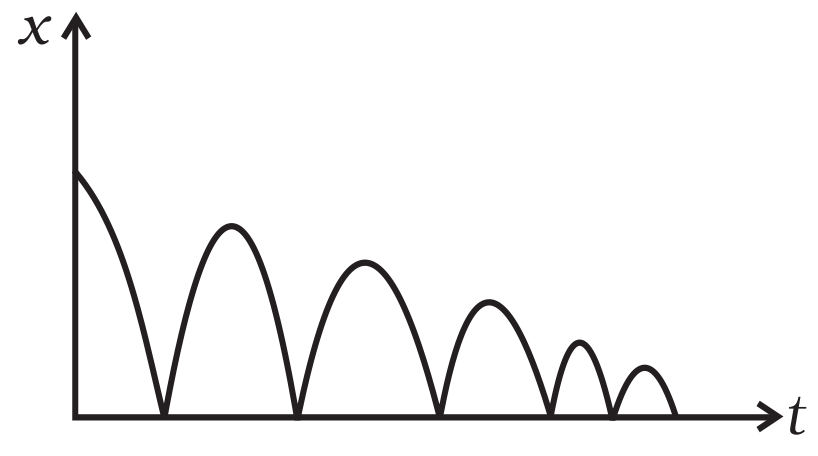
A ball is dropped and its displacement vs time graph is as shown Fig. $($displacement $x$ is from ground and all quantities are $+ve$ upwards$)$.
  1. Plot qualitatively velocity vs time graph.
  2. Plot qualitatively acceleration vs time graph.
Read statement below carefully and state with reasons and examples, if it is true or false; A particle in one-dimensional motion. With positive value of acceleration must be speeding up.
An airline passenger late for a flight walks on an airport moving sidewalk at a speed of $5.00km/ h$ relative to the sidewalk in the direction ofits motion. The sidewalkis moving at $3.00km/ h$ relative to the ground and has a total length of $135m$.
  1. What is the passenger's speed relative to the ground?
  2. How long does it take him to reach the end of the sidewalk?
  3. How much of the sidewalk has he covered by the time he reaches the end?
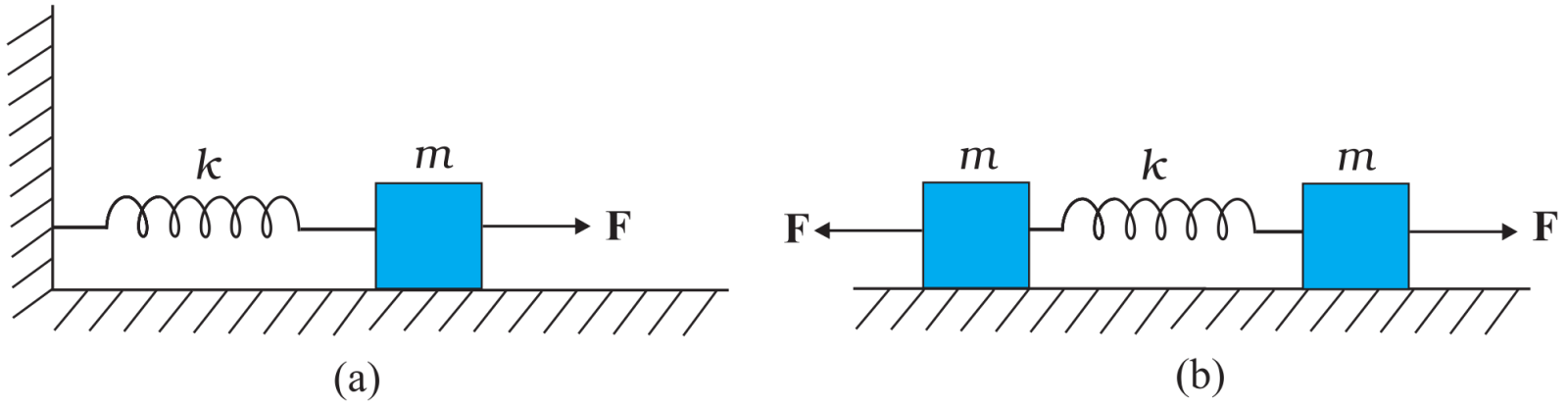
Figure (a) shows a spring of force constant k clamped rigidly at one end and a mass m attached to its free end. A force F applied at the free end stretches the spring. Figure (b) shows the same spring with both ends free and attached to a mass m at either end. Each end of the spring in Fig. (b) is stretched by the same force F.
If the mass in Fig. (a) and the two masses in Fig. (b) are released, what is the period of oscillation in each case?
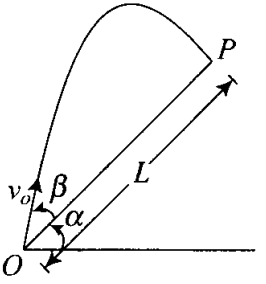
A particle is projected in air at an angle $\beta$ to a surface which itself is inclined at an angle $\alpha$ to the horizontal (Fig.).
  1. Time of flight.
(Hint: This problem can be solved in two different ways:
  1. Point P at which particle hits the plane can be seen as intersection of its trajectory (parobola) and straight line. Remember particle is projected at an angle $(\alpha+\beta)$ w.r.t. horizontal.
  2. We can take x-direction along the plane and y-direction perpendicular to the plane. In that case resolve g (acceleration due to gravity) in two differrent components, $g_x$ along the plane and $g_y$ perpendicular to the plane. Now the problem can be solved as two independent motions in x and y directions respectively with time as a common parameter.)
Obtain the formula for velocity of efflux from a hole in a tank h metres below the surface of water. Explain Toricelli's theory.