A car weighs $1800kg$. The distance between its front and back axles is $1.8m$. Its centre of gravity is $1.05m$ behind the front axle. Determine the force exerted by the level ground on each front wheel and each back wheel.
Exercise
Download our app for free and get started
Mass of the car, m = 1800kg Distance between the front and back axles, d = 1.8m Distance between the C.G. (centre of gravity) and the back axle = 1.05m The various forces acting on the car are shown in the following figure: 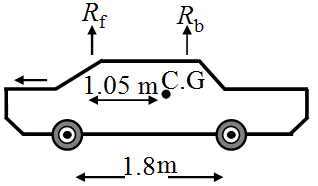
$R_f$ and $R_b$ are the forces exerted by the level ground on the front and back wheels respectively. At translational equilibrium: $R_f+R_b=m g=1800 \times 9.8=17640 \mathrm{~N} \ldots .$. (i) For rotational equilibrium, on taking the torque about the C.G., We have, $R_f(1.05)=R_b(1.8-1.05) \frac{R_b}{R_f}=\frac{7}{5} R_b=1.4 R_f \ldots$...(ii) Solving equations (i) and (ii), we get $1.4 R_f+R_f=$ $17640 R_f=7350 \mathrm{~N} \therefore R_b=17640-7350=10290 \mathrm{NT}$
Therefore, the force exerted on each front wheel $=\frac{7350}{2}=3675 \mathrm{~N}$ and, The force exerted on each back wheel $=\frac{10290}{2}=5145 \mathrm{~N}$
$R_f$ and $R_b$ are the forces exerted by the level ground on the front and back wheels respectively. At translational equilibrium: $R_f+R_b=m g=1800 \times 9.8=17640 \mathrm{~N} \ldots .$. (i) For rotational equilibrium, on taking the torque about the C.G., We have, $R_f(1.05)=R_b(1.8-1.05) \frac{R_b}{R_f}=\frac{7}{5} R_b=1.4 R_f \ldots$...(ii) Solving equations (i) and (ii), we get $1.4 R_f+R_f=$ $17640 R_f=7350 \mathrm{~N} \therefore R_b=17640-7350=10290 \mathrm{NT}$
Therefore, the force exerted on each front wheel $=\frac{7350}{2}=3675 \mathrm{~N}$ and, The force exerted on each back wheel $=\frac{10290}{2}=5145 \mathrm{~N}$

Download our appand get started for free
Experience the future of education. Simply download our apps or reach out to us for more information. Let's shape the future of learning together!No signup needed.*
Similar Questions
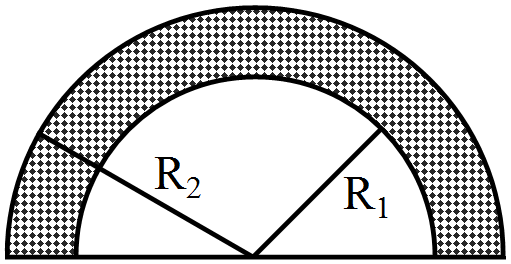
- 1Find the centre of mass of a uniform plate having semicircular inner and outer boundaries of radii $R_1$ and $R_2$.View Solution
- 2View Solution
- Obtain an expression for moment of inertia of uniform circular disc about an axis perpendicular to the plane of disc and passing through its centre.
- Three point masses of 1kg, 2kg and 3kg lie at (1, 2), (0, -1) and (2, -3) respectively. Calculate the co-ordinates of centre of mass of the system.
- 3The oxygen molecule has a mass of $5.30 \times 10^{-26}kg$ and a moment of inertia of $1.94 \times 10^{-46}kgm^2$ about an axis through its centre perpendicular to the lines joining the two atoms. Suppose the mean speed of such a molecule in a gas is 500m/s and that its kinetic energy of rotation is two thirds of its kinetic energy of translation. Find the average angular velocity of the molecule.View Solution
- 4Separation of Motion of a system of particles into motion of the centre of mass and motion about the centre of mass: Show $\text{p}=\text{p}'_\text{i}+\text{m}_\text{i}\text{V}$ where $p_i$ is the momentum of the ith particle (of mass $m_i$ ) and $p′_i = m_iv′_i.$ Note: $v′_i$ is the velocity of the ith particle relative to the centre of mass. Also, prove using the definition of the centre of mass.View Solution
- 53 A man stands on a rotating platform, with his arms stretched horizontally holding a 5kg weight in each hand. The angular speed of the platform is 30 revolutions per minute. The man then brings his arms close to his body with the distance of each weight from the axis changing from 90cm to 20cm. The moment of inertia of the man together with the platform may be taken to be constant and equal to $7.6kgm^2$.View Solution
- What is his new angular speed? (Neglect friction).
- Is kinetic energy conserved in the process? If not, from where does the change come about?
- 6Two particles of mass $2kg$ and $1kg$ are moving along the same line with speeds $2ms-1$ and $5ms^{-1}$ respectively. What is the speed of the centre of mass of the system if both the particles are moving (a) in same direction (b) in opposite direction?View Solution
- 7Separation of Motion of a system of particles into motion of the centre of mass and motion about the centre of mass: Show $\text{p}=\text{p}'_\text{i}+\text{m}_\text{i}\text{V}$ where $p_i$ is the momentum of the ith particle (of mass $m_i$ ) and $p′_i = m_iv′_i$. Note: $v′_i$ is the velocity of the ith particle relative to the centre of mass. Also, prove using the definition of the centre of mass.View Solution
- 8A hoop of radius $2m$ weighs $100kg$. It rolls along a horizontal floor so that its centre of mass has a speed of $20cm/s$. How much work has to be done to stop it?View Solution
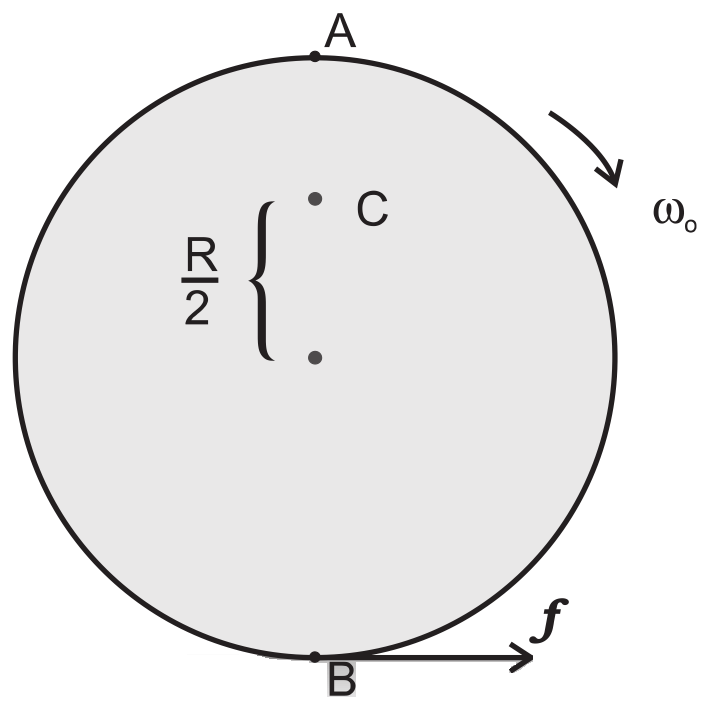
- 9A disc rotating about its axis with angular speed $\omega_0$ is placed lightly (without any translational push) on a perfectly frictionless table. The radius of the disc is R. What are the linear velocities of the points A, B and C on the disc shown in will the disc roll in the direction indicated?View Solution
- 10Prove that the velocity v of translation of a rolling body (like a ring, disc, cylinder or sphere) at the bottom of an inclined plane of height h is given by:$\text{v}^2=\frac{2\text{gh}}{\big(1+\frac{\text{K}^2}{\text{R}^2}\big)}$View Solution
Note K is the radius of gyration of the body about its symmetry axis, and R is the radius of the body. The body starts from rest at the top of the plane.