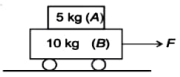
A car is moving with uniform velocity on a rough horizontal road. Therefore, according to Newton's first law of motion
Easy
Download our app for free and get started
(b) Since, force needed to overcome frictional force.

Download our appand get started for free
Experience the future of education. Simply download our apps or reach out to us for more information. Let's shape the future of learning together!No signup needed.*
Similar Questions
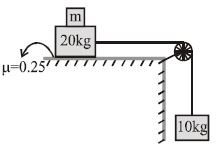
- 1Find the minimum value of $m$ that should placed on $20\, kg$, so that system remain at rest ........ $kg$View Solution
- 2A body takes time $t$ to reach the bottom of an inclined plane of angle $\theta$ with the horizontal. If the plane is made rough, time taken now is $2t$. The coefficient of friction of the rough surface isView Solution
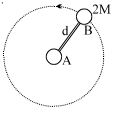
- 3The dumbell is placed on a frictionless horizontal table. Sphere $A$ is attached to a frictionless pivot so that $B$ can be made to rotate about $A$ with constant angular velocity. If $B$ makes one revolution in period $P$, the tension in the rod isView Solution
- 4When a body is placed on a rough plane inclined at an angle $\theta $ to the horizontal, its acceleration isView Solution
- 5A force of $19.6\, N$ when applied parallel to the surface just moves a body of mass $10 \,kg$ kept on a horizontal surface. If a $5\, kg$ mass is kept on the first mass, the force applied parallel to the surface to just move the combined body is........ $N.$View Solution
- 6The retarding acceleration of $7.35\, ms^{-2}$ due to frictional force stops the car of mass $400\, kg$ travelling on a road. The coefficient of friction between the tyre of the car and the road isView Solution
- 7View SolutionIf the overbridge is concave instead of being convex, the thrust on the road at the lowest position will be
- 8A small object placed on a rotating horizontal turn table just slips when it is placed at a distance $4\, cm$ from the axis of rotation. If the angular velocity of the turn-table is doubled, the object slips when its distance from the axis of rotation isView Solution
- 9Two balls of masses ${m_1}$ and ${m_2}$ are separated from each other by a powder charge placed between them. The whole system is at rest on the ground. Suddenly the powder charge explodes and masses are pushed apart. The mass ${m_1}$ travels a distance ${s_1}$ and stops. If the coefficients of friction between the balls and ground are same, the mass ${m_2}$ stops after travelling the distanceView Solution
- 10If acceleration of $A$ is $2 \,m / s ^2$ which is smaller than acceleration of $B$ then the value of frictional force applied by $B$ on $A$ is ......... $N$View Solution