A stone of mass of $16\, kg$ is attached to a string $144 \,m$ long and is whirled in a horizontal circle. The maximum tension the string can withstand is $16$ Newton. The maximum velocity of revolution that can be given to the stone without breaking it, will be ....... $ms^{-1}$
Easy


Download our appand get started for free
Experience the future of education. Simply download our apps or reach out to us for more information. Let's shape the future of learning together!No signup needed.*
Similar Questions
- 1A block $A$ of mass $m_1$ rests on a horizontal table. A light string connected to it passes over a frictionless pully at the edge of table and from its other end another block $B$ of mass $m_2$ is suspended. The coefficient of kinetic friction between the block and the table is $\mu _k.$ When the block $A$ is sliding on the table, the tension in the string isView Solution
- 2Find the maximum velocity for skidding for a car moved on a circular track of radius $100\, m$. The coefficient of friction between the road and tyre is $0.2$ ....... $m/s$View Solution
- 3Calculate the maximum acceleration (in $m s ^{-2}$) of a moving car so that a body lying on the floor of the car remains stationary. The coefficient of static friction between the body and the floor is $0.15$ $\left( g =10 m s ^{-2}\right)$.View Solution
- 4View SolutionWhich one of the following statements is correct
- 5A block of mass $0.1 \,kg$ is held against a wall by applying a horizontal force of $5\, N$ on the block. If the coefficient of friction between the block and the wall is $0.5$, the magnitude of the frictional force acting on the block is ........ $N$View Solution
- 6A uniform wooden stick of mass $1.6 \mathrm{~kg}$ and length $l$ rests in an inclined manner on a smooth, vertical wall of height $h( < l)$ such that a small portion of the stick extends beyond the wall. The reaction force of the wall on the stick is perpendicular to the stick. The stick makes an angle of $30^{\circ}$ with the wall and the bottom of the stick is on a rough focr. The reaction of the wall on the stick is equal in magnitude to the reaction of the floor on the st $ck$. The ratio $h / l$ and the frictional force $f$ at the bottom of the stick are $\left(g=10 \mathrm{~m} \mathrm{~s}^{-2}\right)$View Solution
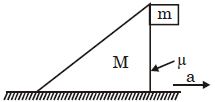
- 7As shown in the figure, block m and wedge $M$ move together with a horizontal acceleration of $20\, m/s^2$. Given $m = 1\, kg$, $\mu = 0.6$ (between $m$ and $M$) and $g = 10\, m/s^2$. Choose the $CORRECT$ alternative :-View Solution
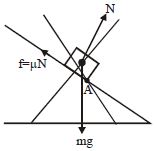
- 8View SolutionWhen a cube is in limiting equilibrium on an inclined plane and it is about to topple. The coefficient of friction between cube and plane is:-
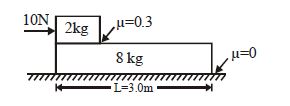
- 9Determine the time in which the smaller block reaches other end of bigger block in the figure. $(g = 10\ m s^{-2})$ .......... $\sec$View Solution
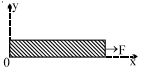
- 10A uniform rod of length $L$ and mass $M$ has been placed on a rough horizontal surface. The horizontal force $F$ applied on the rod is such that the rod is just in the state of rest. If the coefficient of friction varies according to the relation $\mu = Kx$ where $K$ is a $+$ ve constant. Then the tension at mid point of rod isView Solution