A carbon resistor of $(47 \pm 4.7) \;k\Omega$ is to be marked with rings of different colours for its identification. The colour code sequence will b
NEET 2018, Easy
Download our app for free and get started
$(47 \pm 4.7) \;k \Omega=47 \times 10^3 \pm 10 \%$
Yellow - Violet - Orange - Silver

Download our appand get started for free
Experience the future of education. Simply download our apps or reach out to us for more information. Let's shape the future of learning together!No signup needed.*
Similar Questions
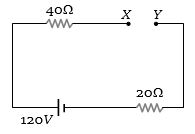
- 1Potential difference across the $40\,\Omega $ resistance will be ............ $V$View Solution
- 2View SolutionThe following four wires are made of the same material and are at the same temperature. Which one of them has highest electrical resistance
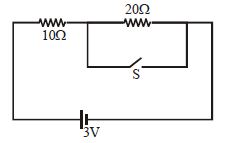
- 3Consider the circuit shown in fig. The current through the $10\,\Omega $ resistor when switch $'s'$ is $(a)$ open $(b)$ closed.View Solution
- 4View SolutionA constant voltage is applied between the two ends of a uniform metallic wire. Some heat is developed in it. The heat developed is double if
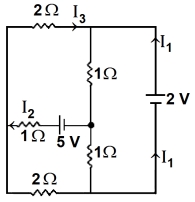
- 5In the following circuit, the magnitude of current $I _{ l }$, is $............A$.View Solution
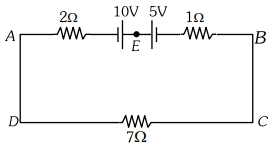
- 6View SolutionThe magnitude and direction of the current in the following circuit is :-
- 7In the circuit shown here, $E_1 = E_2 = E_3 = 2 V$ and $R_1 = R_2 = 4\,ohms$. The current flowing between points $A$ and $B$ through battery $E_2$ isView Solution
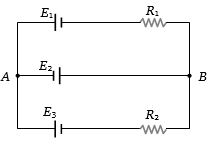
- 8A steady current $i$ is flowing through a conductor of uniform cross-section. Any segment of the conductor hasView Solution
- 9In an experiment to measure the internal resistance of a cell by potentiometer, it is found that the balance point is at a length of $2\,m$ when the cell is shunted by a $5\,\Omega $ resistance; and is at a length of $3\,m$ when the cell is shunted by a $10\,\Omega $ resistance. The internal resistance of the cell is, then ................ $\Omega $View Solution
- 10The drift velocity of free electrons in a conductor is ‘$v$’ when a current ‘$i$’ is flowing in it. If both the radius and current are doubled, then drift velocity will beView Solution