MCQ
A Carnot engine has efficiency $25\%$ . It operates between reservoirs of constant temperature with temperature difference of $80\,K$ . What is the temperature of low temperature reservoir ...... $^oC$
  • A
    $-22$
  • B
    $25$
  • $-33$
  • D
    $33$

Answer

Correct option: C.
$-33$
c
$\eta=25 \% \quad \eta=\frac{\mathrm{T}_{1}-\mathrm{T}_{2}}{\mathrm{T}_{1}} \times 100 \%$

$\therefore \frac{80}{\mathrm{T}_{1}} \times 100=25 \quad \Rightarrow \mathrm{T}_{1}=320 \mathrm{K}$

$\therefore \mathrm{T}_{2}=320-80=240 \mathrm{K}$

$=-33^{\circ} \mathrm{C}$

Need a full question paper?

Generate a complete, print-ready paper with questions like this in minutes — across 16+ boards, with answer keys.
Start Generating Free

Similar questions

If a current of $3.0$ $amperes$ flowing in the primary coil is reduced to zero in $0.001$ $second,$ then the induced $e.m.f$ in the secondary coil is $15000$ $volts$. The mutual inductance between the two coils is....$henry$
A charged particle moves in a magnetic field $\vec B = 10\,\hat i$ with initial velocity $\vec u = 5\hat i + 4\hat j$ The path of the  particle will be
A radioactive nucleus with $Z$ protons and $N$ neutrons emits an $\alpha - $ particle, $2\beta$- particles and $2$ gamma rays. The number of protons and neutrons in the nucleus left after the decay respectively, are
$A$ and $B$ are two wires. The radius of $A$ is twice that of $B.$ They are stretched by the some load. Then the stress on $B$ is
A $1.0\, kg$ ball drops vertically into a floor from a height of $25\, cm$. If rebounds to a height of $4\ cm$. The coefficient of restitution for the collision is
Shear modulus is zero for
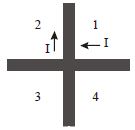
Identical currents flow in two perpendicular wires, as shown in the figure. The wires are very close but do not touch. The magnetic field can be zero:
Two balls of same size but the density of one is greater than that of the other are dropped from the same height, then which ball will reach the earth first (air resistance is negligible)
According to Kepler's law, the period of revolution of a planet $( T )$ and its mean distance from the sun $( R )$ are related by the equation:
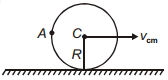
In case of pure rolling, what will be the velocity of point $A$ of the ring of radius $R$ ?