$A$ and $B$ are two wires. The radius of $A$ is twice that of $B.$ They are stretched by the some load. Then the stress on $B$ is
Medium
Download our app for free and get started
(b) ${\rm{Stress}} = \frac{{{\rm{force}}}}{{{\rm{Area}}}}$
$\therefore$ ${\rm{Stress}} \propto \frac{{\rm{1}}}{{\pi {{\rm{r}}^{\rm{2}}}}}$
$\frac{{{S_B}}}{{{S_A}}} = {\left( {\frac{{{r_A}}}{{{r_B}}}} \right)^2} = {(2)^2} \Rightarrow {S_B} = 4{S_A}$

Download our appand get started for free
Experience the future of education. Simply download our apps or reach out to us for more information. Let's shape the future of learning together!No signup needed.*
Similar Questions
- 1The upper end of a wire of radius $4\, mm$ and length $100\, cm$ is clamped and its other end is twisted through an angle of $30°$. Then angle of shear is ..... $^o$View Solution
- 2On applying a stress of $20 \times {10^8}N/{m^2}$ the length of a perfectly elastic wire is doubled. Its Young’s modulus will beView Solution
- 3Copper of fixed volume $V$ is drawn into wire of length $l$. When this wire is subjected to a constant force $F$, the extension produced in the wire is $\Delta l$. Which of the following graphs is a straight line?View Solution
- 4A $0.1 \mathrm{~kg}$ mass is suspended from a wire of negligible mass. The length of the wire is $1 \mathrm{~m}$ and its crosssectional area is $4.9 \times 10^{-7} \mathrm{~m}^2$. If the mass is pulled a little in the vertically downward direction and released, it performs simple harmonic motion of angular frequency $140 \ \mathrm{rad} \mathrm{s}^{-1}$. If the Young's modulus of the material of the wire is $\mathrm{n} \times 10^9 \mathrm{Nm}^{-2}$, the value of $\mathrm{n}$ isView Solution
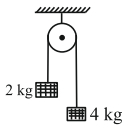
- 5Two blocks of mass $2 \mathrm{~kg}$ and $4 \mathrm{~kg}$ are connected by a metal wire going over a smooth pulley as shown in figure. The radius of wire is $4.0 \times 10^{-5}$ $\mathrm{m}$ and Young's modulus of the metal is $2.0 \times 10^{11} \mathrm{~N} / \mathrm{m}^2$. The longitudinal strain developed in the wire is $\frac{1}{\alpha \pi}$. The value of $\alpha$ is [Use $\mathrm{g}=10 \mathrm{~m} / \mathrm{s}^2$ )View Solution
- 6View SolutionThe breaking stress of a wire depends upon
- 7View SolutionHooke's law is applicable for ....
- 8Copper of fixed volume $V$ is drawn into wire of length $l$. When this wire is subjected to a constant force $F$, the extension produced in the wire is $\Delta l$. Which of the following graphs is a straight line?View Solution
- 9A force of ${10^3}$ newton stretches the length of a hanging wire by $1$ millimetre. The force required to stretch a wire of same material and length but having four times the diameter by $1$ millimetre isView Solution
- 10Three bars having length $l, 2l$ and $3l$ and area of cross-section $A, 2 A$ and $3 A$ are joined rigidly end to end. Compound rod is subjected to a stretching force $F$. The increase in length of rod is (Young's modulus of material is $Y$ and bars are massless)View Solution