Question
A carnot engine works between ice point and steam point. It is desired to increase the efficiency by 20% by (a) making temperature of the source as constant (b) making temperature of the sink as constant. Calculate the change in temperature in the two cases. Which one of these will you prefer and why?

Answer

$\eta=1-\frac{\text{T}_1}{\text{T}_1}=1-\frac{273}{373}=\frac{100}{373}$

Adding 20% i.e. $\big(\frac15\big)$ to the existing $\eta,$

$\eta=\frac{100}{3+3}+20\%=\frac{100}{373}+\frac15=\frac{873}{1865}$

  1. If the temperature of the sink corresponding to $\eta'$ be $\text{T}'_2$ (source at 373k), then,

Thus, $\eta'=1-\frac{\text{T}_2'}{373}$

$\frac{\text{T}_2'}{373}=1-\eta'=1-\frac{873}{1865}=\frac{992}{1865}$

$\text{T}'_2=198.4\text{K}$

$\text{T}_2'-\text{T}_2=198.4\text{K}-273\text{K}=-74.6\text{K}$

  1. If the temperature of the source corresponding to $\eta'$ be $\text{T}'_2$ (sinkb at 273K), then

$\eta'=1-\frac{\text{T}'_2}{\text{T}'_1}$ or $\frac{873}{1865}=1-\frac{273}{\text{T}'_1}$

$\frac{273}{\text{T}'_1}=1-\frac{873}{1865}=\frac{992}{1865}$

$\text{T}'_2=513\text{K}$

$\text{T}'_1-\text{T}_1=513\text{K}-373\text{K}$

$=149.25\text{K}=140^\circ\text{C}$
Need a full question paper?

Generate a complete, print-ready paper with questions like this in minutes — across 16+ boards, with answer keys.

Start Generating Free

Similar questions

Find the expression for the position of the center of mass of the system of two particles.
The $\text{K}_\alpha$ X-rays of aluminium (Z = 13) and zinc (Z = 30) have wavelengths 887pm and 146pm respectively. Use Moseley's law $\sqrt{\text{v}}=\text{a}(\text{z-b})$ to find the wavelengths of the $\text{K}_\alpha$ X-ray of iron (Z = 26).
A ball of mass m moving at a speed v makes a head-on collision with an identical ball at rest. The kinetic energy of the balls after the collision is three fourths of the original. Find the coefficient of restitution.
Give any three differences between progressive waves and stationary waves. A stationary wave is $\text{y}=12\sin300\text{t}\cos^2\text{x}.$ What is the distance between two nearest nodes?
A mild steel wire of length 1.0m and cross-sectional area 0.50 × 10⁻²cm2 is stretched, well within its elastic limit, horizontally between two pillars. A mass of 100g is suspended from the mid-point of the wire. Calculate the depression at the midpoint.
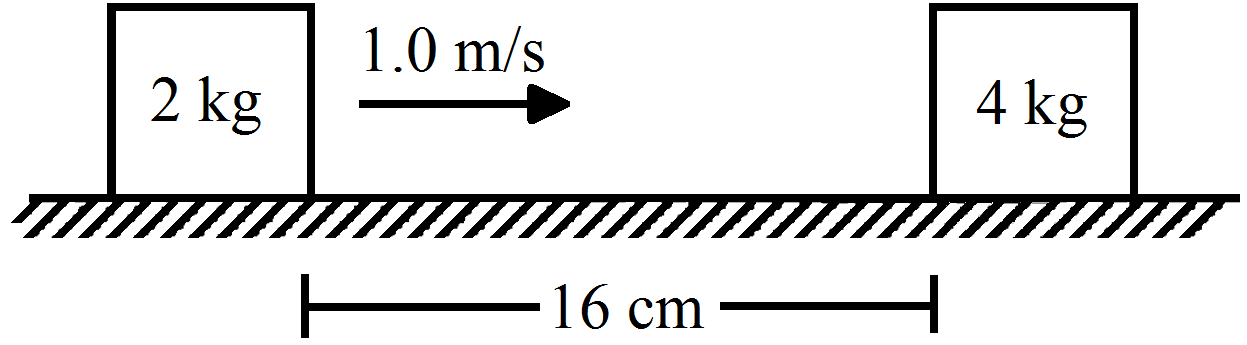
The friction coefficient between the horizontal surface and each of the blocks shown in figure is 0.20. The collision between the blocks is perfectly elastic. Find the separation between the two blocks when they come o rest. Take g = 10 m/s2.

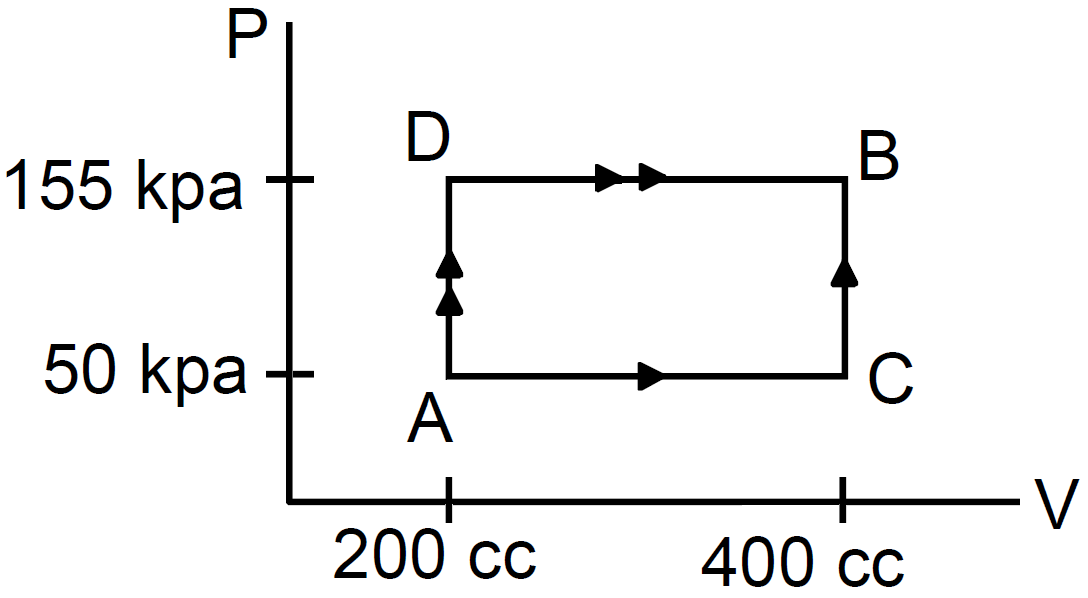
50cal of heat should be supplied to take a system from the state A to the state B through the path ACB as shown in figure. Find the quantity of heat to be supplied to take it from A to B via ADB.

The distance between the centres of carbon and oxygen atoms in carbon monoxide gas molecules is $=1.13\mathring{\text{A}}.$ Locate the centre of mass of the molecules relative to carbon atom.
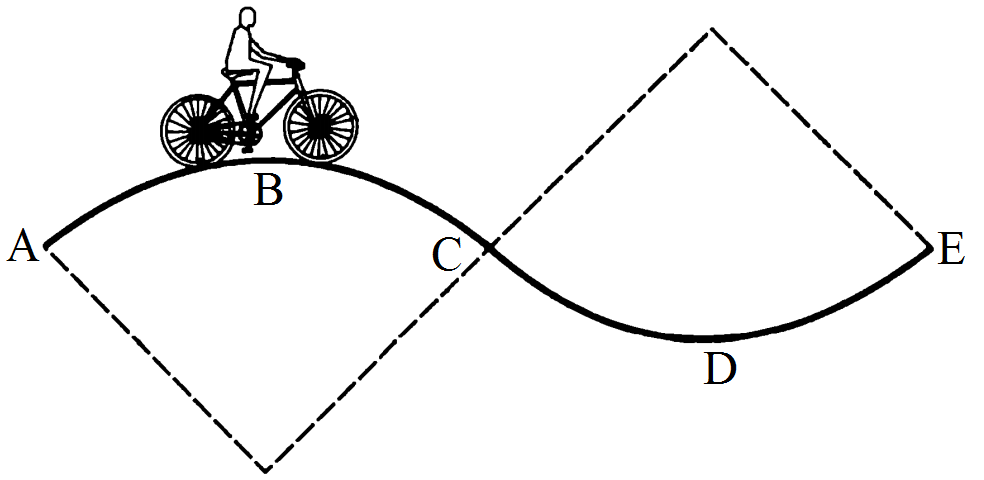
A track consists of two circular parts ABC and CDE of equal radius 100m and joined smoothly as shown in figure. Each part subtends a right angle at its centre. A cycle weighing 100 kg together with the rider travels at a constant speed of 18km/h on the track.
  1. Find the normal contact force by the road on the cycle when it is at B and at D.
  2. Find the force of friction exerted by the track on the tyres when the cycle is at B, C and D.
  3. Find the normal force between the road and the cycle just before and just after the cycle crosses C.
  4. What should be the minimum friction coefficient between the road and the tyre, which will ensure that the cyclist can move with constant speed? Take g= 10m/s2.

For the wave described in Exercise 15.8, plot the displacement (y) versus (t) graphs for x = 0, 2 and 4cm. What are the shapes of these graphs? In which aspects does the oscillatory motion in travelling wave differ from one point to another: amplitude, frequency or phase?