Question
A cell is constructed using $\frac{\text{Cu}^{2+}}{\text{Cu}}$ and $\frac{\text{Al}^{3+}}{\text{Al}}$ electrodes.
  1. Identify cathode and anode.
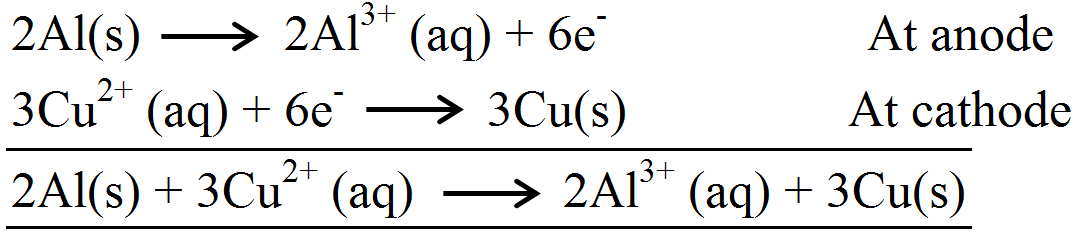
  2. Write the reactions at anode, cathode and net cell reaction.
  3. Calculate $\text{E}^0_\text{cell}$
$\text{E}^0_\frac{\text{Al}^{3+}}{\text{Ag}}=-1.66\text{V}$

$\text{E}^0_\frac{\text{Cu}^{2+}}{\text{Cu}}=+0.34\text{V}$
Answer

It is measured by potentiometer which does not have internal resistance.
  1. 'Al' will act as anode, 'Cu' will act as cathode because reduction potential of $\frac{\text{Cu}^{2+}}{\text{Cu}}$ is higher.
  2.  
  1. $\text{E}^0_\text{cell}=\text{E}^0_\frac{\text{cu}^{2+}}{\text{Cu}}-\text{E}^0_\frac{\text{Al}^{3+}}{\text{Al}}$
$=+0.34\text{V}-(-1.66\text{V})$

$=2.00\text{V}$

Need a full question paper?

Generate a complete, print-ready paper with questions like this in minutes — across 16+ boards, with answer keys.

Start Generating Free

Similar questions

The electron energy in hydrogen atom is given by $\text{E}_{\text{n}}=\frac{ (–2.18 \times 10–18 )}{\text{n}^2}\text{J}.$ Calculate the energy required to remove an electron completely from the n = 2 orbit. What is the longest wavelength of light in cm that can be used to cause this transition?
A neon-dioxygen mixture contains 70.6g dioxygen and 167.5g neon. If pressure of the mixture of gases in the cylinder is 25bar, what is the partial pressure of dioxygen and neon in the mixture?
Hydrogen reacts with nitrogen to produce ammonia according to the equation:
$3H_2(g) + N_2(g) → 2NH_3(g)$
Determine How much ammonia would be produced if 100g of $N_2$ reacts?
What is the energy in joules, required to shift the electron of the hydrogen atom from the first Bohr orbit to the fifth Bohr orbit and what is the wavelength of the light emitted when the electron returns to the ground state? The ground state electron energy is $=–2.18\times10^{-11}\text{ ergs}$.
Use the following data to calculate the $\Delta \mathrm{G}^{\circ}$ for the reaction in which $\mathrm{PF}_5(\mathrm{~g})$ forms from $\mathrm{PF}_3(\mathrm{~g})$ and $\mathrm{F}_2(\mathrm{~g})$ at 298 K .
$\mathrm{PF}_3(\mathrm{~g})+\mathrm{F}_2(\mathrm{~g}) \rightarrow \mathrm{PF}_5(\mathrm{~g})$
​​​​​​​$\begin{matrix}\Delta \text{H}^{\circ}_{f} & -919 \text{kJ mol}^{-1} & 0 & -1577 \text{kJ} \text{ K}^{-1} \text{mol}^{-1} \ \\\text{S}^{\circ}& 273 & 203 & 301 \end{matrix}$
 
MY and $\mathrm{NY}_3$ two nearly insoluble salts, have same $\mathrm{K}_{\text {sp }}$ values $6.2 \times 10^{-3}$ of non temperature. Calculate solubility of each salt. Which has more solubility.
How many atoms are present in 1 ml of $\mathrm{NH}_3$ at STP?
  1. Why do we add gypsum in final stages of preparation of cement?
  2. Why does Al dissolve both in acidic and basic.
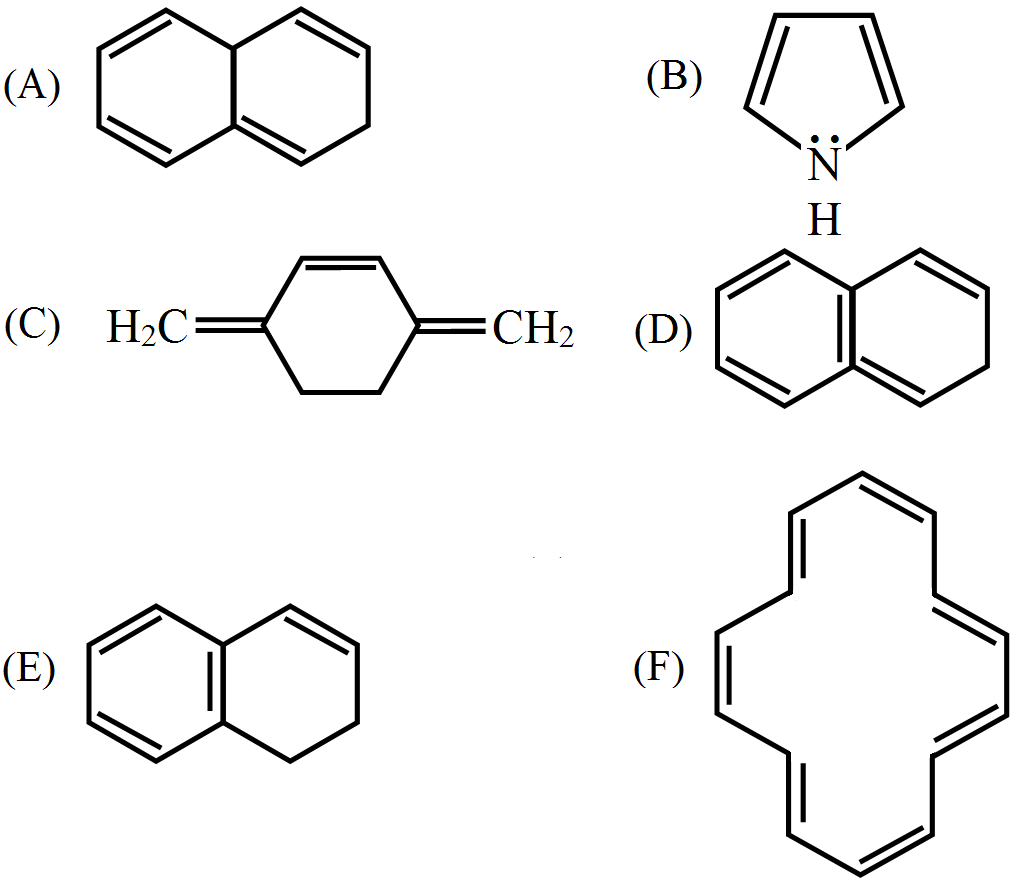
Which of the following compounds are aromatic according to Huckel's rule?
Write the electronic configurations of the following ions :
  1. $H^–$
  2. $Na^+$
  3. $O^{2–}$
  4. $F^–$