Question 13 Marks
What are the oxidation number of the underlined elements in the following and how do you rationalise your results?
$KI_3$
AnswerIn $KI_3$, the oxidation number (O.N.) of K is +1. Hence, the average oxidation number of I is $-\frac{1}{3}.$ However, O.N. cannot be fractional. Therefore, we will have to consider the structure of $KI_3$ to find the oxidation states. In a $KI_3$ molecule, an atom of iodine forms a coordinate covalent bond with an iodine molecule.
$\stackrel{{+1}}{\ \ \ \hbox{k}^+}\Big[\stackrel{{0}}{\hbox{I}}-\stackrel{{0}}{\hbox{I}}\leftarrow\stackrel{{-1}}{\hbox{I}}\Big]^-$
Hence, in a $KI_3$ molecule, the O.N. of the two I atoms forming the $I_2$ molecule is 0, whereas the O.N. of the I atom forming the coordinate bond is -1.
View full question & answer→Question 23 Marks
What are the oxidation number of the underlined elements in the following and how do you rationalise your results?
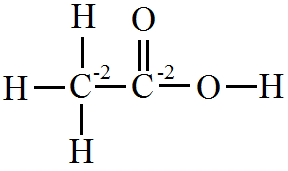
$\mathrm{CH}_3 \mathrm{COOH}$
Answer$2(x)+4(+1)+2(-2)=0$ or, $2 x=0$ or, $x=0$ However, 0 is average $O . N$. of $C$. The two carbon atoms present in this molecule are present in different environments. Hence, they cannot have the same oxidation number. Thus, C exhibits the oxidation states of +2 and -2 in $\mathrm{CH}_3 \mathrm{COOH}$.
View full question & answer→Question 33 Marks
Predict the products of electrolysis in the following:
An aqueous solution of $AgNO_3$ with silver electrodes.
Answer$AgNO_3$ ionizes in aqueous solutions to form $Ag^+$ and $\text{NO}^-_3$ ions.On electrolysis, either $Ag^+$ ions or $H_2O$ molecules can be reduced at the cathode. But the reduction potential of $Ag^+$ ions is higher than that of $H_2O$.
$\text{Ag}^+_{(\text{aq})}+\text{e}^-\rightarrow\text{Ag}_{(\text{s})};\ \text{E}^\circ=+0.80\text{V}$
$2\text{H}_2\text{O}_{(\text{l})}+2\text{e}^-\rightarrow\text{H}_{2(\text{g})}+2\text{OH}^-_{(\text{aq})};\ \text{E}^\circ=-0.83\text{V}$
Hence, $Ag^+$ ions are reduced at the cathode. Similarly, Ag metal or $H_2O$ molecules can be oxidized at the anode. But the oxidation potential of Ag is higher than that of $H_2O$ molecules.
$\text{Ag}_{(\text{s})}\rightarrow\text{Ag}^+_{(\text{aq})}+\text{e}^-;\ \text{E}^\circ=-0.80\text{V}$
$2\text{H}_2\text{O}_{(\text{l})}\rightarrow\text{O}_{2(\text{g})}+4\text{H}^+_{(\text{aq})}+4\text{e}^-;\ \text{E}^\circ=-1.23\text{V}$
Therefore, Ag metal gets oxidized at the anode.
View full question & answer→Question 43 Marks
Balance the following redox reactions by ion-electron method: $\mathrm{MnO}_4^{}{-}(\mathrm{aq})+\mathrm{SO}_2(\mathrm{g}) \rightarrow \mathrm{Mn}^{2+}(\mathrm{aq})+\mathrm{HSO}_4^{}{-}(\mathrm{aq})$ (in acidic solution).
AnswerFollowing the steps as in part (a), we have the oxidation half reaction as:$\text{SO}_{2(\text{g})}+2\text{H}_2\text{O}_{(\text{l})}\rightarrow\text{HSO}^-_{4(\text{aq})}+3\text{H}^+_{(\text{aq})}+2\text{e}^-_{(\text{aq})}$
And the reduction half reaction as:
$\text{MnO}^-_{4(\text{aq})}+8\text{H}^+_{(\text{aq})}+5\text{e}^{-}\rightarrow\text{Mn}^{2+}_{(\text{aq})}+4\text{H}_2\text{O}_{(\text{l})}$
Multiplying the oxidation half reaction by 5 and the reduction half reaction by 2, and then by adding them, we have the net balanced redox reaction as:
$2\text{MnO}^-_{4(\text{aq})}+5\text{SO}_{2(\text{g})}+2\text{H}_2\text{O}_{(\text{l})}+\text{H}^+_{(\text{aq})}\rightarrow\\2\text{Mn}^{2+}_{(\text{aq})}+5\text{HSO}^-_{4(\text{aq})}$
View full question & answer→Question 53 Marks
What are the oxidation number of the underlined elements in the following and how do you rationalise your results?
$\mathrm{CH}_3 \mathrm{CH}_2 \mathrm{OH}$
Answer2 (x) + 6 (+1) + 1 (-2) = 0
or, 2x + 4 = 0
or, x = -2
Hence, the O.N. of C is -2.
View full question & answer→Question 63 Marks
Using the standard electrode potentials given in the Table, predict if the reaction between the following is feasible: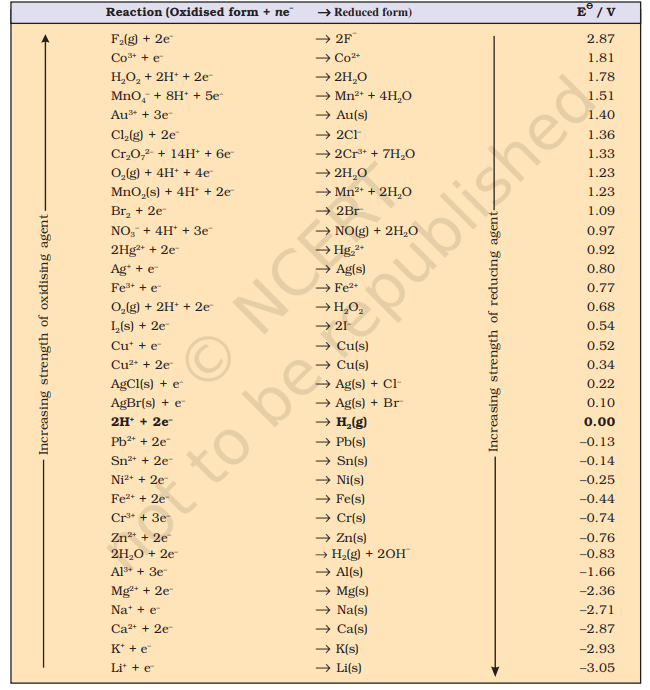
$\mathrm{Ag}^{+}(\mathrm{aq})$ and $\mathrm{Cu}(\mathrm{s})$. AnswerThe possible reaction between $\mathrm{Ag}^{+}(\mathrm{aq})$ + $\mathrm{Cu}(\mathrm{s})$. is given by,$2\text{Ag}^+_{(\text{aq})}+\text{Cu}_{(\text{s})}\rightarrow2\text{Ag}_{(\text{s})}+\text{Cu}^{2+}_{(\text{aq})}$
$\text{Oxidation half equation:}\ \ \ \ \ \ \ \ \text{Cu}_{(\text{s})}\xrightarrow{\ \ \ \ \ }\text{Cu}^{2+}_{(\text{aq})}+2\text{e}^-;\ \ \text{E}^\circ=-0.34\text{V}\\\text{Reduction half equation:}\ \ [\text{Ag}^+_{(\text{aq})}+\text{e}^-\xrightarrow{\ \ \ \ \ }\text{Ag}_{(\text{s})}]\times2;\ \ \ \text{E}^\circ=+0.80\text{V}\\\overline{\ \ \ \ \ \ \ \ \ \ \ \ \ \ \ \ \ \ \ \ \ \ \ \ \ \ \ \ \ \ \ \ \ \ \ \ \ \ \ \ \ \ \ \ \ \ \ \ \ \ \ \ \ \ \ \ \ \ \ \ \ \ \ \ \ \ \ \ \ \ \ \ \ \ \ \ \ \ \ \ \ \ \ \ \ \ \ \ \ \ \ \ \ \ \ \ \ \ \ \ \ \ \ \ \ \ \ \ \ \ \ \ \ \ \ \ \ \ }\\\ \ \ \ \ \ \ \ \ \ \ \ \ \ \ \ \ \ \ \ \ \ \ \ \ \ \ \ \ \ \ \ 2\text{Ag}^+_{(\text{aq})}+\text{Cu}_{(\text{s})}\xrightarrow{\ \ \ \ \ }2\text{Ag}_{(\text{s})}+\text{Cu}^{2+};\ \ \ \text{E}^\circ=+0.46\text{V}$
E° positive for the overall reaction is positive. Hence, the reaction between $\mathrm{Ag}^{+}(\mathrm{aq})$ and $\mathrm{Cu}(\mathrm{s})$. is feasible.
View full question & answer→Question 73 Marks
Consider the reactions: $6CO_2(g) + 6H_2O(l) → C_6H_{12}O_6(aq) + 6O_2(g)$Why it is more appropriate to write these reactions as:
$6CO_2(g) + 12H_2O(l) → C_6H_{12}O_6(aq) + 6H_2O(l) + 6O_2(g)$
Also suggest a technique to investigate the path of the above redox reactions.
AnswerThe process of photosynthesis involves two steps. Step 1: $H_2O$ decomposes to give $H_2 $and $O_2. 2H_2O_{(l)} → 2H_{2(g)} + O_{2(g)}$_Step 2:
The H_2 produced in step 1 reduces $CO_2,$ thereby producing glucose $(C_6H_{12}O_6)$ and $H_2O. 6CO_{2(g)} + 12H_{2(g)} → C_6H_{12}O_{6(s)} + 6H_2O_{(l)}$_ Now, the net reaction of the process is given as:$\ \ \ \ \ \ \ \ \ \ \ \ 2\text{H}_2\text{O}_{(\text{l})}\xrightarrow{\ \ \ \ \ \ \ \ \ }2\text{H}_{2(\text{g})}+\text{O}_{2(\text{g})}\big]\times6$
$\ \ \ \ \ 6\text{CO}_{2(\text{g})}+12\text{H}_{2(\text{g})}\xrightarrow{\ \ \ \ \ \ \ \ \ \ }\text{C}_6\text{H}_{12}\text{O}_{6(\text{g})}+6\text{H}_2\text{O}_{(\text{l})}$
$\overline{\ \ \ \ \ \ \ \ \ \ \ \ \ \ \ \ \ \ \ \ \ \ \ \ \ \ \ \ \ \ \ \ \ \ \ \ \ \ \ \ \ \ \ \ \ \ \ \ \ \ \ \ \ \ \ \ \ \ \ \ \ \ \ \ \ \ \ \ \ \ \ \ \ \ \ \ \ \ \ \ \ \ \ \ \ \ \ \ \ \ }$
$6\text{CO}_{2(\text{g})}+12\text{H}_2\text{O}_{(\text{l})}\rightarrow\text{C}_6\text{H}_{12}\text{O}_{6(\text{g})}+6\text{H}_2\text{O}_{(\text{l})}+6\text{O}_{2(\text{g})}$
It is more appropriate to write the reaction as given above because water molecules are also produced in the process of photosynthesis. The path of this reaction can be investigated by using radioactive $H_2O^{18}$ in place of $H_2O.$
View full question & answer→Question 83 Marks
Why does the following reaction occur?
$\text{XeO}^{4-}_6(\text{aq})+2\text{F}^{-}(\text{aq})+6\text{H}^+(\text{aq})\rightarrow\\\text{XeO}_3(\text{g})+\text{F}_2(\text{g})+3\text{H}_2\text{O(l)}$
What conclusion about the compound $Na_4XeO_6$ (of which $\text{XeO}^{4-}_6$ is a part) can be drawn from the reaction.
AnswerThe given reaction occurs because $\text{XeO}^{4-}_6$ oxidises $F^-$ and $F^-$ reduces $\text{XeO}^{4-}_6.$ $\stackrel{{+8}}{\ \ \ \ \ \hbox{XeO}}^{4-}_{6(\text{aq})}+\stackrel{{-1}}{2\ \ \hbox{F}^{-}}_{(\text{aq})}+6\text{H}^{+}_{(\text{aq})}\rightarrow\\\stackrel{{+6}}{\ \ \ \ \ \ \hbox{XeO}}_{3(\text{g})}+\stackrel{{0}}{\ \ \hbox{F}_2}_{(\text{g})}+3\text{H}_2\text{O}_{(\text{l})}$In this reaction, the oxidation number (O.N.) of Xe decreases from +8 in $\text{XeO}^{4-}_6$ to +6 in $XeO_3$ and the O.N. of F increases from -1 in $F^-$ to O in $F_2$.
Hence, we can conclude that $Na_4XeO_6$ is a stronger oxidising agent than $F^-$.
View full question & answer→Question 93 Marks
Using the standard electrode potentials given in the Table, predict if the reaction between the following is feasible:
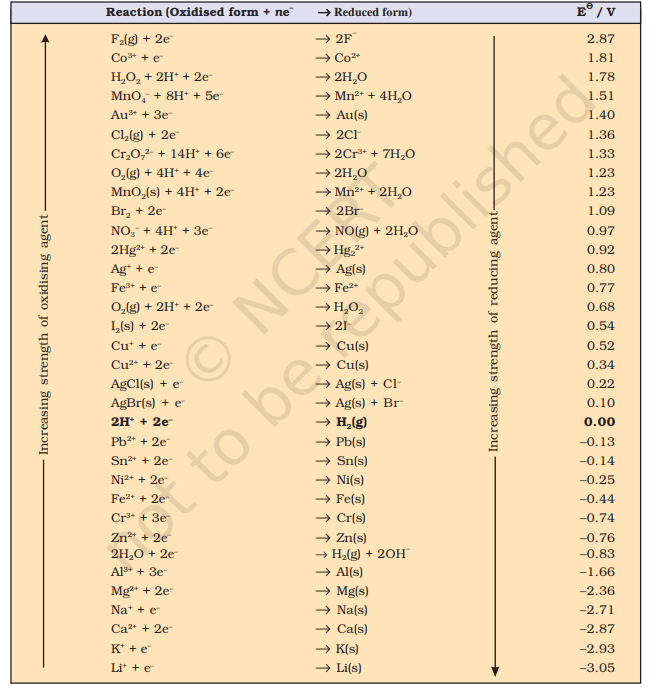
$\mathrm{Fe}^{3+}(\mathrm{aq})$ and $\mathrm{Cu}(\mathrm{s})$. AnswerThe possible reaction between $\mathrm{Fe}^{3+}(\mathrm{aq})$ and $\mathrm{Cu}(\mathrm{s})$. is given by, $2\text{Fe}^{3+}_{(\text{aq})}+\text{Cu}_{(\text{s})}\rightarrow2\text{Fe}^{2+}_{(\text{s})}+\text{Cu}^{2+}_{(\text{aq})}$ $\text{Oxidation half equation:}\ \ \ \ \ \ \ \text{Cu}_{(\text{s})}\xrightarrow{\ \ \ \ \ \ }\text{Cu}^{2+}_{(\text{aq})}+2\text{e}^-;\ \ \text{E}^\circ=-0.34\text{V}\\\text{Reduction half equation:}\ \ [\text{Fe}^{3+}_{(\text{aq})}+\text{e}^-\xrightarrow{\ \ \ \ \ }\text{Fe}^{2+}_{(\text{s})}]\times2;\ \ \ \text{E}^\circ=+0.77\text{V}\\\overline{\ \ \ \ \ \ \ \ \ \ \ \ \ \ \ \ \ \ \ \ \ \ \ \ \ \ \ \ \ \ \ \ \ \ \ \ \ \ \ \ \ \ \ \ \ \ \ \ \ \ \ \ \ \ \ \ \ \ \ \ \ \ \ \ \ \ \ \ \ \ \ \ \ \ \ \ \ \ \ \ \ \ \ \ \ \ \ \ \ \ \ \ \ \ \ \ \ \ \ \ \ \ \ \ \ \ \ \ \ \ \ \ \ \ \ \ \ \ }\\\ \ \ \ \ \ \ \ \ \ \ \ \ \ \ \ \ \ \ \ \ \ \ \ \ \ \ \ \ \ \ \ 2\text{Fe}^{3+}_{(\text{aq})}+\text{Cu}_{(\text{s})}\xrightarrow{\ \ \ \ \ }2\text{Fe}^{2+}_{(\text{s})}+\text{Cu}^{2+}_{(\text{aq})};\ \ \ \text{E}^\circ=+0.43\text{V}$E° positive for the overall reaction is positive. Hence, the reaction between $\mathrm{Fe}^{3+}(\mathrm{aq})$ and $\mathrm{Cu}(\mathrm{s})$. is feasible.
View full question & answer→Question 103 Marks
What are the oxidation number of the underlined elements in the following and how do you rationalise your results?
$\mathrm{Fe}_3 \mathrm{O}_4$
AnswerOn taking the O.N. of O as –2, the O.N. of Fe is found to be $+2\frac{2}{3}.$ However, O.N. cannot be fractional. Here, one of the three Fe atoms exhibits the O.N. of +2 and the other two Fe atoms exhibit the O.N. of +3.
$\stackrel{{+2}}{\ \ \ \ \ \ \hbox{FeO}},\stackrel{{+3}}{\ \ \ \ \hbox{Fe}_2}\text{O}_3$
View full question & answer→Question 113 Marks
Consider the reactions:
$H_3PO_2(aq) + 4AgNO_3(aq) + 2H_2O(l) → H_3PO_4(aq) + 4Ag(s) + 4HNO_3(aq)$
$H_3PO_2(aq) + 2CuSO_4(aq) + 2 H2O(l) → H_3PO_4(aq) + 2Cu(s) + H_2SO_4(aq)$
$C_6H_5CHO(l) + 2[Ag(NH_3)_2]^+(aq) + 3OH^-(aq) → C_6H_5COO^-(aq) + 2Ag(s) + 4NH_3(aq) + 2H_2O(l)$
$C_6H_5CHO(l) + 2Cu^{2+}(aq) + 5OH^-(aq) → N$o change observed.
What inference do you draw about the behaviour of $Ag^+$ and $Cu^{2+}$ from these reactions?
AnswerReactions (a) and (b) indicate that $H _3 PO _2$ (hypophosphorous acid) is a reducing agent and thus reduces both $AgNO _3$ and $CuSO _4$ to Ag and Cu respectively. Conversely, both $AgNO _3$ and $CuSO _4$ act as oxidising agent and thus oxidise $H _3 PO _2$ to $H _3 PO _4$ (orthophosphoric acid) Reaction (c) suggests that $\left[ Ag \left( NH _3\right)_2\right]^{+}$oxidises $C _6 H _5 CHO$ (benzaldehyde) to $C _6 H _5 COO ^{-}$(benzoate ion) but reaction (d) indicates that $Cu ^{2+}$ ions cannot oxidise $C _6 H _5 CHO$ to $C _6 H _5 COO ^{-}$. Therefore, from the above reactions, we conclude that $Ag ^{+}$ion is a strong deoxidising agent than $Cu ^{2+}$ ion.
View full question & answer→Question 123 Marks
Consider the reactions:$2\text{S}_2\text{O}^{2-}_{3}(\text{aq})+\text{I}_2(\text{s})\rightarrow\text{S}_4\text{O}^{2-}_{6}(\text{aq})+2\text{I}^{-}(\text{aq})$
$\text{S}_2\text{O}^{2-}_{3}(\text{aq})+2\text{Br}_2(\text{l})+5\text{H}_2\text{O(l)}\rightarrow\\2\text{SO}^{2-}_{4}(\text{aq})+4\text{Br}^{-}(\text{aq})+10\text{H}^+(\text{aq})$
Why does the same reductant, thiosulphate react differently with iodine and bromine?
AnswerThe average oxidation number (O.N.) of S in $\mathrm{S}_2 \mathrm{O}_3^{2-}$ is +2 . Being a stronger oxidising agent than $\mathrm{I}_2, \mathrm{Br}_2$ oxidises $\mathrm{S}_2 \mathrm{O}_3^{2-}$ to $\mathrm{SO}_4^{2-}$, in which the O.N. of S is +6 . However, $\mathrm{I}_2$ is a weak oxidising agent. Therefore, it oxidises $\mathrm{S}_2 \mathrm{O}_3^{2-}$ to $\mathrm{S}_4 \mathrm{O}_6^{2-}$, in which the average O.N. of S is only +2.5 . As a result, $\mathrm{S}_2 \mathrm{O}_3^{2-}$ reacts differently with iodine and bromine.
View full question & answer→Question 133 Marks
Using the standard electrode potentials given in the Table, predict if the reaction between the following is feasible:
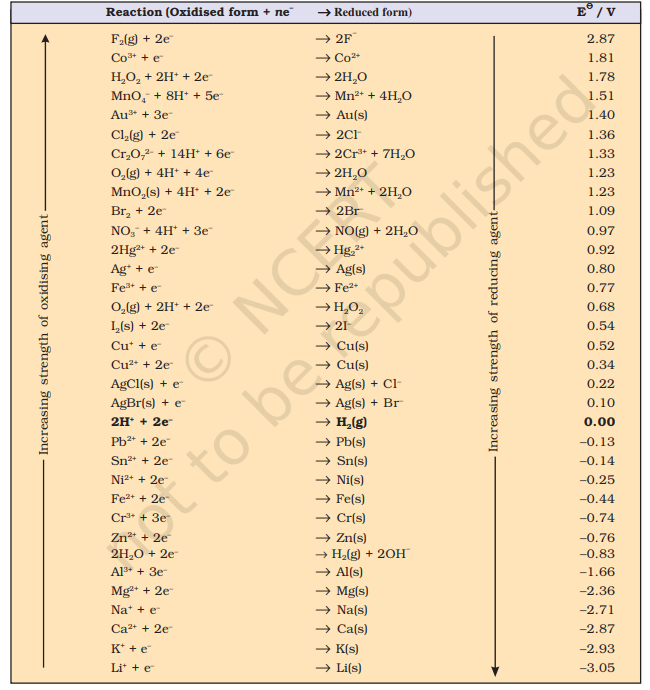
$\mathrm{Ag}(\mathrm{s})$ and $\mathrm{Fe}^{3+}(\mathrm{aq})$. AnswerThe possible reaction between $\mathrm{Ag}(\mathrm{s})$ and $\mathrm{Fe}^{3+}(\mathrm{aq})$. is given by, $\text{Ag}_{(\text{s})}+2\text{Fe}^{3+}_{(\text{aq})}\rightarrow\text{Ag}^{+}_{(\text{aq})}+\text{Fe}^{2+}_{(\text{aq})}$ $\text{Oxidation half equation:}\ \ \ \ \ \ \ \text{Ag}_{(\text{s})}\xrightarrow{\ \ \ \ \ \ }\text{Ag}^{+}_{(\text{aq})}+\text{e}^-;\ \ \text{E}^\circ=-0.80\text{V}\\\text{Reduction half equation:}\ \ \text{Fe}^{3+}_{(\text{aq})}+\text{e}^-\xrightarrow{\ \ \ \ \ }\text{Fe}^{2+}_{(\text{aq})};\ \ \ \ \ \ \ \ \text{E}^\circ=+0.77\text{V}\\\overline{\ \ \ \ \ \ \ \ \ \ \ \ \ \ \ \ \ \ \ \ \ \ \ \ \ \ \ \ \ \ \ \ \ \ \ \ \ \ \ \ \ \ \ \ \ \ \ \ \ \ \ \ \ \ \ \ \ \ \ \ \ \ \ \ \ \ \ \ \ \ \ \ \ \ \ \ \ \ \ \ \ \ \ \ \ \ \ \ \ \ \ \ \ \ \ \ \ \ \ \ \ \ \ \ \ \ \ \ \ \ \ \ \ \ \ \ \ \ }\\\ \ \ \ \ \ \ \ \ \ \ \ \ \ \ \ \ \ \ \ \ \ \ \ \ \ \ \ \ \ \ \ \ \text{Ag}^{}_{(\text{s})}+\text{Fe}^{3+}_{(\text{aq})}\xrightarrow{\ \ \ \ \ }\text{Ag}^{+}_{(\text{aq})}+\text{Fe}^{2+}_{(\text{aq})};\ \ \ \text{E}^\circ=-0.03\text{V}$Here, E° for the overall reaction is negative. Hence, the reaction between $\mathrm{Ag}(\mathrm{s})$ and $\mathrm{Fe}^{3+}(\mathrm{aq})$. is not feasible.
View full question & answer→Question 143 Marks
Balance the following redox reactions by ion-electron method:
$\text{Cr}_2\text{O}_7^{2-}+\text{SO}_2(\text{g})\rightarrow\text{Cr}^{3+}(\text{aq})+\text{SO}^{2-}_4(\text{aq})$ (in acidic solution).
AnswerFollowing the steps as in part (a), we have the oxidation half reaction as:
$\text{SO}_{2(\text{g})}+2\text{H}_2\text{O}_{(\text{l})}\rightarrow\text{SO}^{2-}_{4(\text{aq})}+4\text{H}^+_{(\text{aq})}+2\text{e}^-$
And the reduction half reaction as:
$\text{Cr}_2\text{O}^{2-}_{7(\text{aq})}+14\text{H}^{+}_{(\text{aq})}+6\text{e}^-\rightarrow2\text{Cr}^{3+}_{(\text{aq})}+7\text{H}_2\text{O}_{(\text{l})}$
Multiplying the oxidation half reaction by 3 and then adding it to the reduction half reaction, we have the net balanced redox reaction as:
$\text{Cr}_2\text{O}^{2-}_{7(\text{aq})}+3\text{SO}_{2(\text{g})}+2\text{H}^{+}_{(\text{aq})}\rightarrow2\text{Cr}^{3+}_{(\text{aq})}+3\text{SO}^{2-}_{4(\text{aq})}+\text{H}_2\text{O}_{(\text{l})}$
View full question & answer→Question 153 Marks
Fluorine reacts with ice and results in the change:
$H_2O(s) + F_2(g) → HF(g) + HOF(g)$
Justify that this reaction is a redox reaction.
AnswerLet us write the oxidation number of each atom involved in the given reaction above its symbol as:
$\stackrel{{+1}}{\ \ \text{H}_{2}}\stackrel{{-2}}{\ \ \text{O}}+\stackrel{{0}}{\text{F}_{2}}\ \rightarrow\stackrel{{+1}}{\text{H}}\stackrel{{-1}}{\ \text{F}}+\stackrel{{+1}}{\text{H}}\stackrel{{-2}}{\text{O}}\stackrel{{+1}}{\text{F}}$
Here, we have observed that the oxidation number of F increases from 0 in $F_2$ to +1 in HOF. Also, the oxidation number decreases from 0 in $F_2$ to -1 in HF. Thus, in the above reaction, F is both oxidized and reduced. Hence, the given reaction is a redox reaction.
View full question & answer→Question 163 Marks
Using the standard electrode potentials given in the Table, predict if the reaction between the following is feasible:
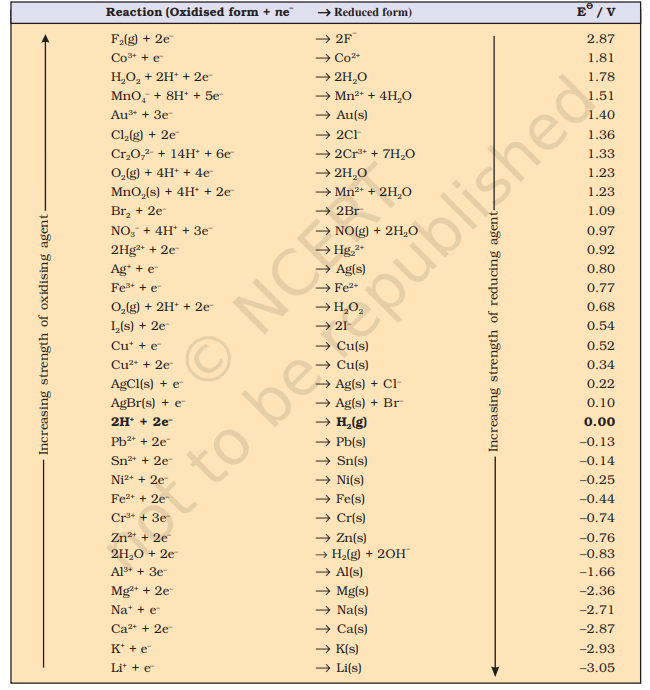
$\mathrm{Fe}^{3+}(\mathrm{aq})$ and $\mathrm{I}^{-}(\mathrm{aq})$. AnswerThe possible reaction between $\mathrm{Fe}^{3+}(\mathrm{aq})$ + $\mathrm{I}^{-}(\mathrm{aq})$. is given by, $2\text{Fe}^{3+}_{(\text{aq})}+2\text{I}^-_{(\text{aq})}\rightarrow2\text{Fe}^{2+}_{(\text{aq})}+\text{I}_{2(\text{s})}$$\text{Oxidation half equation:}\ \ \ \ \ \ \ \ \ \ 2\text{I}^-_{(\text{aq})}\xrightarrow{\ \ \ \ \ \ \ }\text{I}_{2(\text{s})}+2\text{e}^-;\ \ \text{E}^\circ=-0.54\text{V}\\\text{Reduction half equation:}\ [\text{Fe}^{3+}_{(\text{aq})}+\text{e}^-\xrightarrow{\ \ \ \ \ \ }\text{Fe}^{2+}_{(\text{aq})}]\times2;\ \ \text{E}^\circ=+0.77\text{V}\\\overline{\ \ \ \ \ \ \ \ \ \ \ \ \ \ \ \ \ \ \ \ \ \ \ \ \ \ \ \ \ \ \ \ \ \ \ \ \ \ \ \ \ \ \ \ \ \ \ \ \ \ \ \ \ \ \ \ \ \ \ \ \ \ \ \ \ \ \ \ \ \ \ \ \ \ \ \ \ \ \ \ \ \ \ \ \ \ \ \ \ \ \ \ \ \ \ \ \ \ \ \ \ \ \ \ \ \ \ \ \ \ \ \ \ \ \ \ \ \ }\\ \ \ \ \ \ \ \ \ \ \ \ \ \ \ \ \ \ \ \ \ \ \ \ \ \ \ \ \ \ \ \ \ \ \ \ \ \ \ 2\text{Fe}^{3+}_{(\text{aq})}+2\text{I}^-_{(\text{aq})}\xrightarrow{\ \ \ \ \ \ \ \ }2\text{Fe}^{2+}_{(\text{aq})}+\text{I}_{2(\text{s})};\ \ \text{E}^\circ=+0.23\text{V}$
E° for the overall reaction is positive. Thus, the reaction between $\text{Fe}^{3+}_{(\text{aq})}$ and $\text{I}^-_{(\text{aq})}$ is feasible.
View full question & answer→Question 173 Marks
Using the standard electrode potentials given in the Table, predict if the reaction between the following is feasible:
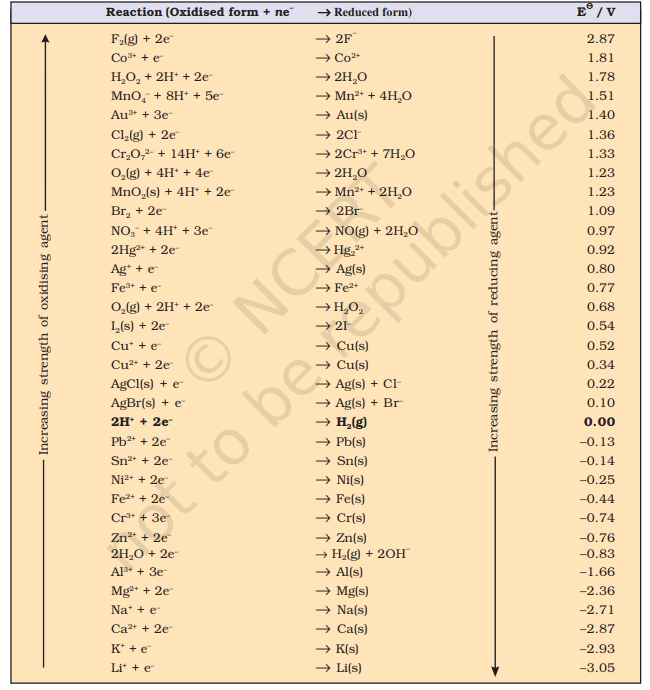
$\mathrm{Br}_2(\mathrm{aq})$ and $\mathrm{Fe}^{2+}(\mathrm{aq})$ AnswerThe possible reaction between $\mathrm{Br}_2(\mathrm{aq})$ and $\mathrm{Fe}^{2+}(\mathrm{aq})$ is given by, $\text{Br}_{2(\text{s})}+2\text{Fe}^{2+}_{(\text{aq})}\rightarrow2\text{Br}^-_{(\text{aq})}+2\text{Fe}^{3+}_{(\text{aq})}$ $\text{Oxidation half equation:}\ \ \ \ \ \ \ \text{Fe}^{2+}_{(\text{aq})}\xrightarrow{\ \ \ \ \ \ }\text{Fe}^{3+}_{(\text{aq})}+\text{e}^-]\times2\ \ ;\text{E}^\circ=-0.77\text{V}\\\text{Reduction half equation:}\ \ \text{Br}^{}_{2(\text{aq})}+2\text{e}^-\xrightarrow{\ \ \ \ \ }2\text{Br}^{-}_{(\text{aq})}\ \ \ \ \ \ \ \ \ ; \text{E}^\circ=+1.09\text{V}\\\overline{\ \ \ \ \ \ \ \ \ \ \ \ \ \ \ \ \ \ \ \ \ \ \ \ \ \ \ \ \ \ \ \ \ \ \ \ \ \ \ \ \ \ \ \ \ \ \ \ \ \ \ \ \ \ \ \ \ \ \ \ \ \ \ \ \ \ \ \ \ \ \ \ \ \ \ \ \ \ \ \ \ \ \ \ \ \ \ \ \ \ \ \ \ \ \ \ \ \ \ \ \ \ \ \ \ \ \ \ \ \ \ \ \ \ \ \ \ \ \ \ \ }\\\ \ \ \ \ \ \ \ \ \ \ \ \ \ \ \ \ \ \ \ \ \ \ \ \ \ \text{Br}^{}_{2(\text{aq})}+2\text{Fe}^{2+}_{(\text{aq})}\xrightarrow{\ \ \ \ \ }2\text{Br}^{-}_{(\text{aq})}+2\text{Fe}^{3+}_{(\text{aq})}\ \ \ \ \ ;\text{E}^\circ=-0.32\text{V}$Here, E° for the overall reaction is positive. Hence, the reaction between $\mathrm{Br}_2(\mathrm{aq})$ and $\mathrm{Fe}^{2+}(\mathrm{aq})$ is feasible.
View full question & answer→Question 183 Marks
Consider the reactions: $\mathrm{O}_3(\mathrm{~g})+\mathrm{H}_2 \mathrm{O}_2(\mathrm{l}) \rightarrow \mathrm{H}_2 \mathrm{O}(\mathrm{l})+2 \mathrm{O}_2(\mathrm{~g})$ Why it is more appropriate to write these reactions as:
$\mathrm{O}_3(\mathrm{~g})+\mathrm{H}_2 \mathrm{O}_2(\mathrm{l}) \rightarrow \mathrm{H}_2 \mathrm{O}(\mathrm{l})+\mathrm{O}_2(\mathrm{~g})+\mathrm{O}_2(\mathrm{~g})$
Also suggest a technique to investigate the path of the above redox reactions.
Answer$\mathrm{O}_2$ is produced from each of the two reactants $\mathrm{O}_3$ and $\mathrm{H}_2 \mathrm{O}_2$. For this reason, $\mathrm{O}_2$ is written twice. The given reaction involves two steps. First, $\mathrm{O}_3$ decomposes to form $\mathrm{O}_2$ and O . In the second step, $\mathrm{H}_2 \mathrm{O}_2$ reacts with the O produced in the first step, thereby producing $\mathrm{H}_2 \mathrm{O}$ and $\mathrm{O}_2$.
$\ \ \ \ \ \ \ \ \ \ \ \ \ \ \ \ \ \text{O}_{3(\text{g})}\xrightarrow{\ \ \ \ \ \ \ \ }\text{O}_{2(\text{g})}+\text{O}_{(\text{g})}\\ \ \ \ \text{H}_2\text{O}_{2(\text{l})}+\text{O}_{(\text{g})}\xrightarrow{\ \ \ \ \ \ \ \ }\text{H}_2\text{O}_{(\text{l})}+\text{O}_{2(\text{g})}\\\overline{\ \ \ \ \ \ \ \ \ \ \ \ \ \ \ \ \ \ \ \ \ \ \ \ \ \ \ \ \ \ \ \ \ \ \ \ \ \ \ \ \ \ \ \ \ \ \ \ \ \ \ \ \ \ \ \ \ \ \ \ \ \ \ \ \ \ \ \ \ \ \ \ \ \ }\\\text{H}_2\text{O}_{2(\text{l})}+\text{O}_{3(\text{g})}\xrightarrow{\ \ \ \ \ \ \ \ \ \ }\text{H}_2\text{O}_{(\text{l})}+\text{O}_{2(\text{g})}+\text{O}_{2(\text{g})}$
The path of this reaction can be investigated by using $\text{H}_2\text{O}_2^{18}$ or $\text{O}_3^{18}.$
View full question & answer→Question 193 Marks
What are the oxidation number of the underlined elements in the following and how do you rationalise your results?
$\mathrm{H}_2 \mathrm{~S}_4 \mathrm{O}_6$
Answer$\stackrel{{+1}}{\hbox{H}_2}\stackrel{{\text{x}}}{\\ \ \ \ \ \hbox{SO}_4}\stackrel{{-2}}{\ \ \hbox{O}_6}$Now, 2(+1) + 4(x) + 6(-2) = 0
⇒ 2 + 4x - 12 = 0
⇒ 4x = 10
$\Rightarrow\ \text{x}=+2\frac{1}{2}$
However, O.N. cannot be fractional. Hence, S must be present in different oxidation states in the molecule.
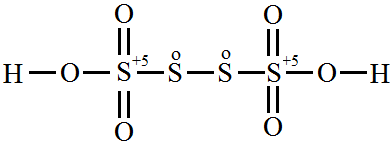
The O.N. of two of the four S atoms is +5 and the O.N. of the other two S atoms is 0. View full question & answer→Question 203 Marks
Balance the following redox reactions by ion-electron method:$\mathrm{H}_2 \mathrm{O}_2(\mathrm{aq})+\mathrm{Fe}^{2+}(\mathrm{aq}) \rightarrow \mathrm{Fe}^{3+}(\mathrm{aq})+\mathrm{H}_2 \mathrm{O}(\mathrm{l})$ (in acidic solution).
AnswerFollowing the steps as in part (a), we have the oxidation half reaction as:
$\text{Fe}^{2+}_{(\text{aq})}\rightarrow\text{Fe}^{3+}_{(\text{aq})}+\text{e}^{-}$
And the reduction half reaction as:
$\text{H}_2\text{O}_{2(\text{aq})}+2\text{H}^{+}_{(\text{aq})}+2\text{e}^{-}\rightarrow\ 2\text{H}_2\text{O}_{(\text{l})}$
Multiplying the oxidation half reaction by 2 and then adding it to the reduction half reaction, we have the net balanced redox reaction as:
$\text{H}_2\text{O}_{2(\text{aq})}+2\text{Fe}^{2+}_{(\text{aq})}+2\text{H}^{+}_{(\text{aq})}\rightarrow\ 2\text{Fe}^{3+}_{(\text{aq})}+2\text{H}_2\text{O}_{(\text{l})}$
View full question & answer→Question 213 Marks
Write balanced chemical equation for the following reactions:
Dichlorine heptaoxide ($Cl_2O_7$) in gaseous state combines with an aqueous solution of hydrogen peroxide in acidic medium to give chlorite ion ($ClO^–_2$) and oxygen gas.
(Balance by ion electron method)
Answer$\text{Cl}_2\text{O}_7(\text{g})+4\text{H}_2\text{O}_2(\text{aq})\xrightarrow{ \ \ \ \ \ \ \ }2\text{ClO}^-_2(\text{aq})+3\text{H}_2\text{O(l)}+4\text{O}_2(\text{g})+2\text{H}^+(\text{aq})$
Balancing by ion-electron method:
Oxidation half:
$\text{H}_2\text{O}_2\xrightarrow{ \ \ \ \ \ \ \ }\text{O}_2+2\text{e}^-$
Adding $2H^+$ on right side to balance H atoms and charge.
$\text{H}_2\text{O}_2\xrightarrow{ \ \ \ \ \ \ \ }\text{O}_2+2\text{H}^++2\text{e}^-$
Reduction half:
$\text{Cl}_2\text{O}_7+8\text{e}^-\xrightarrow{ \ \ \ \ \ \ \ }2\text{ClO}^-_2$
Adding $H_2O$ and $H^+$ to balance H and O atoms
$\text{Cl}_2\text{O}_7+8\text{e}^-+6\text{H}^+\xrightarrow{ \ \ \ \ \ \ \ \ }2\text{ClO}^-_2+3\text{H}_2\text{O}$
Adding oxidation and reduction half
$[\text{H}_2\text{O}_2\xrightarrow{ \ \ \ \ \ \ }\text{O}_2+2\text{e}^-+2\text{H}^+]\times4 \\ \text{Cl}_2\text{O}_7+8\text{e}^-+6\text{H}^+\xrightarrow{ \ \ \ \ \ \ \ }2\text{ClO}^-_2+3\text{H}_2\text{O} \\ \underline{ \ \ \ \ \ \ \ \ \ \ \ \ \ \ \ \ \ \ \ \ \ \ \ \ \ \ \ \ \ \ \ \ \ \ \ \ \ \ \ \ \ \ \ \ \ \ \ \ \ \ \ \ \ \ \ \ \ \ \ \ \ \ \ \ \ \ \ \ \ \ \ \ \ \ \ \ \ \ \ \ \ \ \ \ \ } \\ \text{Cl}_2\text{O}_7+4\text{H}_2\text{O}_2\xrightarrow{ \ \ \ \ \ \ \ }2\text{ClO}^-_2+3\text{H}_2\text{O}+4\text{O}_2+2\text{H}^+$
View full question & answer→Question 223 Marks
Copper dissolves in dilute nitric acid but not in dilute HCl. Explain.
AnswerSince, $\mathrm{E}^0$ of $\mathrm{Cu}^{2+} / \mathrm{Cu}$ electrode $(+0.34 \mathrm{~V})$ is higher than that of $\mathrm{H}^{+} / \mathrm{H}^2$ electrode $(0.0 \mathrm{~V})$, therefore, $\mathrm{H}^{+}$ions cannot oxidise Cu to $\mathrm{Cu}^{2+}$ ions and hence, Cu does not dissolve in dil. HCl .
In contrast, the electrode potential of $\mathrm{NO}_3^{-}$ion, i.e. $\frac{\mathrm{NO}_3^{-}}{\mathrm{NO}}$ electrode $(+0.97 \mathrm{~V}$ ) is higher than that of copper electrode and hence, it can oxidise Cu to $\mathrm{Cu}^{2+}$ ions and hence Cu dissolves in dil. HNO 3 due to oxidation of Cu by $\frac{\mathrm{NO}_3^{-}}{\mathrm{NO}}$ ions and not by $\mathrm{H}^{+}$ions.
View full question & answer→Question 233 Marks
- In the following redox reactions, identify the oxidation and reducing agents:
- $\text{H}_3\text{PO}\text{(aq)}+2\text{HgCl}_2+2\text{H}_2\text{O}\text{(aq)}\\ \xrightarrow{ \ \ \ \ }\text{H}_3\text{PO}_4\text{(aq)}+2\text{Hg(l)}+4\text{HCl(aq)}$
- $\text{O}_2\text{(g)}+\text{PtF}_6\text{g}\xrightarrow{ \ \ \ \ }\text{O}_2^+[\text{PtF}_6]^\ominus\text{(s)}$
- Why does $H_2S$ acts as reducing agent only whereas $SO_2$ acts as bot oxidant as wells as rductant?
Answera.
i. $\mathrm{H}_3 \mathrm{PO}_2$, is reducing agent, $\mathrm{HgCl}_2$ is oxidising agent.
ii. $\mathrm{O}_2$ is reducing agent where as $\mathrm{PtF}_6$ acts as oxidising agent.
b. $\mathrm{H}_2 \mathrm{~S}$ has ' S ' in -2 (lowest) oxidation state, it can only lose electrons acts as reductant. $\mathrm{SO}_2$ has ' S ' in +4 oxidation state can show +6 as well as lower oxidation state, therefore, acts as both oxidant as well as reductant.
View full question & answer→Question 243 Marks
Balance the following equations by the oxidation number method.
$\text{MnO}_2+\text{C}_2\text{O}^{2-}_4\xrightarrow{ \ \ \ \ \ \ \ }\text{Mn}^{2+}+\text{CO}_2$
Answer$\stackrel{+4 \ \ \ \ \ \ \ \ \ }{\text{MnO}}_2+\stackrel{+3 \ \ \ \ \ \ \ \ \ \ \ }{\text{C}_2\text{O}^{2-}_4}\xrightarrow{ \ \ \ \ \ \ \ \ }\stackrel{+2 \ \ \ \ \ \ \ \ \ }{\text{Mn}^{2+}}+\stackrel{+4 \ \ \ \ \ }{\text{CO}}_2$
Total increase in O.N. = 1 × 2 = 2
Total decrease in O.N. = 2
To equalize O.N. multiply $\text{CO}_2$ by 2.
$\text{MnO}_2+\text{C}_2\text{O}^{2-}_4\xrightarrow{ \ \ \ \ \ \ \ \ }\text{Mn}^{2+}+2\text{CO}_2$
Balance H and O by adding $2 \mathrm{H}_2 \mathrm{O}$ on right side, and $4 \mathrm{H}^{+}$on left side of equation.
$\text{MnO}_2+\text{C}_2\text{O}^{2-}_4+4\text{H}^+\xrightarrow{ \ \ \ \ \ \ \ \ \ }\text{Mn}^{2+}+2\text{CO}_2+2\text{H}_2\text{O}$
View full question & answer→Question 253 Marks
Why does fluorine not show disporportionation reaction?
AnswerIn a disproportionation reaction, the same species is simultaneously oxidised as well as reduced. Therefore, for such a redox reaction to occur, the reacting species must contain an element which has adeast three oxidation states.
The element, in reacting species, is present in an intermediate state while lower and higher oxidation states are available for reduction and oxidation to occur (respectively). Fluorine is the strongest oxidising agent. It does not show positive oxidation state. That’s why fluorine does not show disproportionation reaction.
View full question & answer→Question 263 Marks
How does $Cu_2O$ act as both oxidant and reductant? Explain with proper reactions showing the change of oxidation numbers in each example.
Answer$Cu^+$ undergoes disproportionation to form $Cu^{2+}$ and $Cu$.
$2\text{Cu}^+(\text{aq})\xrightarrow{\ \ \ \ }\text{Cu}^{2+}(\text{aq})+\text{Cu}(\text{s})$
Thus, Cu+ or Cu2O acts both as an oxidant as well as reductant.
- When heated in air, $Cu_2O$ is oxidised to $CuO$.
$\stackrel{+1\ \ \ \ \ \ }{\text{Cu}_2}\stackrel{-2\ \ \ }{\text{O}}+\frac12\stackrel{0\ \ \ }{\text{O}_2}\xrightarrow{\ \ \ \ \ \ }2\stackrel{+2\ \ \ \ }{\text{Cu}}\stackrel{-2\ \ }{\text{O}}$
i.e. $Cu_2O$ acts as a reductant and reduces $O_2$ to $O^{2-}$.
- When heated with $Cu_2S$, it oxidises $S^{2-}$ to $SO_2$ and hence, $Cu_2O$ acts as an oxidant.
$2\stackrel{+1\ \ \ \ \ \ }{\text{Cu}_2}\stackrel{-2}{\text{O}}+\stackrel{+1\ \ \ \ \ }{\text{Cu}_2}\stackrel{-2}{\text{S}}\xrightarrow{\ \ \ \ \ \ }6\stackrel{0\ \ \ \ \ \ }{\text{Cu}}+\stackrel{+4\ \ \ \ \ \ \ }{\text{SO}_2}$ View full question & answer→Question 273 Marks
Balance the following equations by the oxidation number method.
$\text{I}_2+\text{S}_2\text{O}^{2-}_3\xrightarrow{ \ \ \ \ \ \ }\text{I}^-+\text{S}_4\text{O}^{2-}_6$
Answer$\stackrel{0}{\text{I}_2}+\stackrel{+2 \ \ \ \ }{\text{S}_2}\stackrel{-2 \ \ \ \ \ }{\text{O}^{2-}_3}\xrightarrow{ \ \ \ \ \ \ \ }\stackrel{-1 \ \ \ \ }{\text{I}^-}+\stackrel{+2.5}{\text{S}_4}\text{O}^{2-}_6$
Total increase in O.N. = 0.5 × 4 = 2
Total decrease in O.N. = 1 × 2 =2
To equalize O.N. multiply $\text{S}_2\text{O}^{2-}_3$ and $\text{I}^-$ by 2.
$\text{I}_2+2\text{S}_2\text{O}^{2-}_3\xrightarrow{ \ \ \ \ \ \ \ }2\text{I}^-+\text{S}_4\text{O}^{2-}_6$
View full question & answer→Question 283 Marks
Using the standard electrode potentials given in the Table, predict if the reaction between the following is feasible: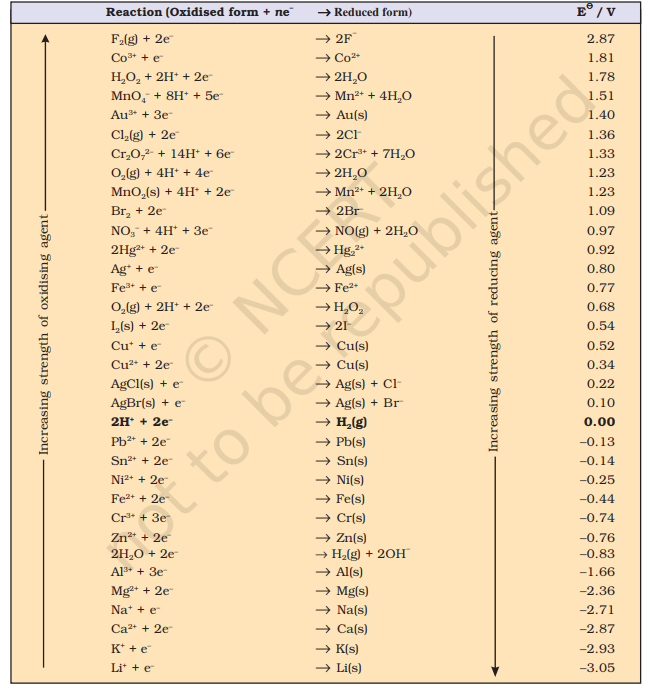
$\mathrm{Ag}^{+}(\mathrm{aq})$ and $\mathrm{Cu}(\mathrm{s})$. AnswerThe possible reaction between $\mathrm{Ag}^{+}(\mathrm{aq})$ and $\mathrm{Cu}(\mathrm{s})$. is given by,$2\text{Ag}^+_{(\text{aq})}+\text{Cu}_{(\text{s})}\rightarrow2\text{Ag}_{(\text{s})}+\text{Cu}^{2+}_{(\text{aq})}$
$\text{Oxidation half equation:}\ \ \ \ \ \ \ \ \text{Cu}_{(\text{s})}\xrightarrow{\ \ \ \ \ }\text{Cu}^{2+}_{(\text{aq})}+2\text{e}^-;\ \ \text{E}^\circ=-0.34\text{V}\\\text{Reduction half equation:}\ \ [\text{Ag}^+_{(\text{aq})}+\text{e}^-\xrightarrow{\ \ \ \ \ }\text{Ag}_{(\text{s})}]\times2;\ \ \ \text{E}^\circ=+0.80\text{V}\\\overline{\ \ \ \ \ \ \ \ \ \ \ \ \ \ \ \ \ \ \ \ \ \ \ \ \ \ \ \ \ \ \ \ \ \ \ \ \ \ \ \ \ \ \ \ \ \ \ \ \ \ \ \ \ \ \ \ \ \ \ \ \ \ \ \ \ \ \ \ \ \ \ \ \ \ \ \ \ \ \ \ \ \ \ \ \ \ \ \ \ \ \ \ \ \ \ \ \ \ \ \ \ \ \ \ \ \ \ \ \ \ \ \ \ \ \ \ \ \ }\\\ \ \ \ \ \ \ \ \ \ \ \ \ \ \ \ \ \ \ \ \ \ \ \ \ \ \ \ \ \ \ \ 2\text{Ag}^+_{(\text{aq})}+\text{Cu}_{(\text{s})}\xrightarrow{\ \ \ \ \ }2\text{Ag}_{(\text{s})}+\text{Cu}^{2+};\ \ \ \text{E}^\circ=+0.46\text{V}$
E° positive for the overall reaction is positive. Hence, the reaction between $\mathrm{Ag}^{+}(\mathrm{aq})$ and $\mathrm{Cu}(\mathrm{s})$. is feasible.
View full question & answer→Question 293 Marks
Write the anode reaction, the cathode reaction and the net cell reaction in the following cells. Which electrode would be positive terminal in each cell?
- $\text{Zn}\text{(s)}|\text{Zn}^{2+}||\text{Br}_2|\text{Br}^-|\text{Pt}\text{(s)}$
- $\text{Cr}\text{(s)}|\text{Cr}^{3+}||\text{I}_2|\text{I}^-|\text{Pt}\text{(s)}$
- $\text{Pt}\text{(s)}|\text{H}_2\text{(g)}||\text{H}^+\text{(aq)}||\text{Cu}^{2+}|\text{Cu}\text{(s)}$
Answer
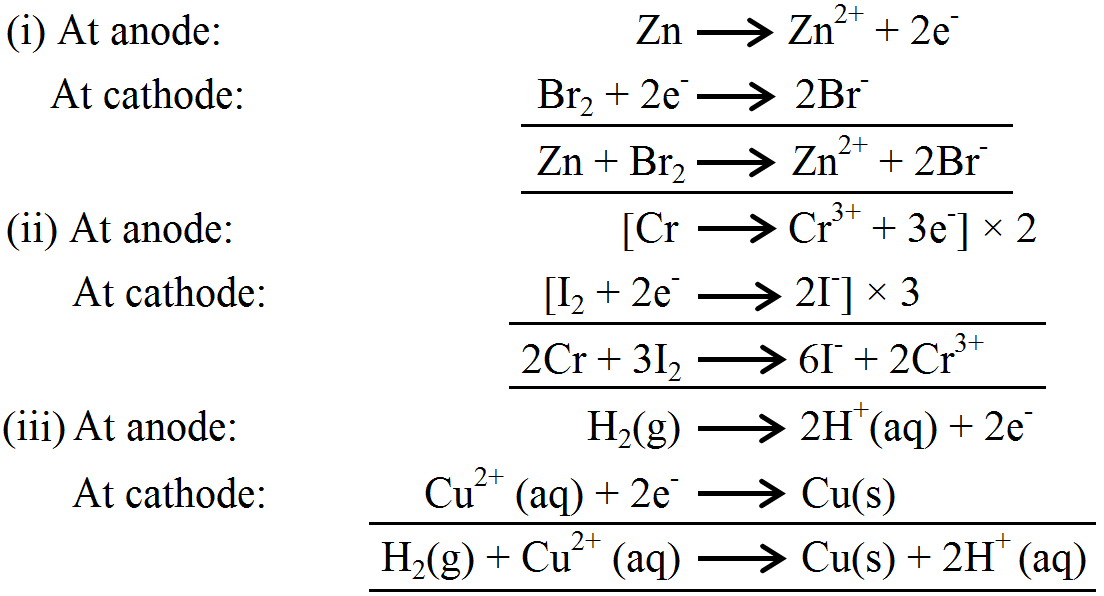
Cathode will be positive terminal in each cell.
View full question & answer→Question 303 Marks
Write balanced chemical equation for the following reactions:
Reaction of liquid hydrazine $\left(\mathrm{N}_2 \mathrm{H}_4\right)$ with chlorate ion $\left(\mathrm{ClO}^{-}{ }_3\right)$ in basic medium produces nitric oxide gas and chloride ion in gaseous state.
(Balance by oxidation number method)
Answer$3\text{N}_2\text{H}_4+4\text{ClO}^-_3\xrightarrow{ \ \ \ \ \ \ \ }6\text{NO}+4\text{Cl}^-+6\text{H}_2\text{O}$
Balancing by oxidation number method:
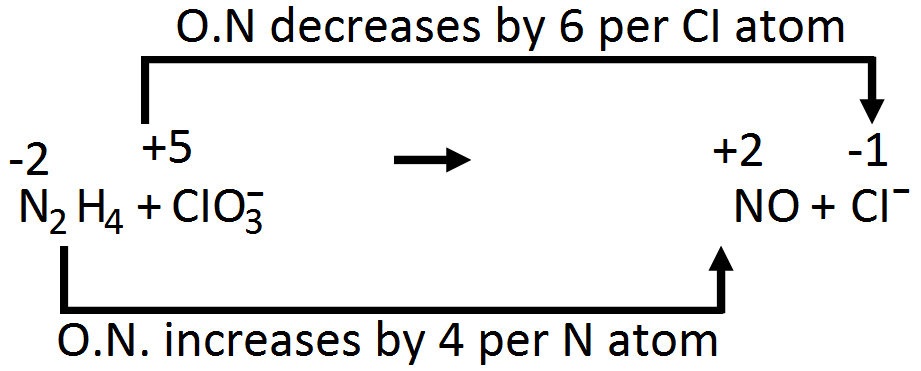
$6\text{N}_2\text{H}_4+8\text{ClO}^-_3\xrightarrow{ \ \ \ \ \ \ }12\text{NO}+8\text{Cl}^-+12\text{H}_2\text{O}$ View full question & answer→Question 313 Marks
- Identify the oxidant and reductant in the following reactions:
- $\text{Zn}\text{(s)}+\frac{1}{2}\text{O}_2\text{(g)}\xrightarrow{ \ \ \ \ \ \ \ }\text{ZnO}\text{(s)}$
- $\text{Zn}\text{(s)}+2\text{H}^+\text{(aq)}\xrightarrow{ \ \ \ \ \ }\text{Zn}^{2+}\text{(aq)}+\text{H}_2\text{(g)}$
- Name the products obtained when copper is heated with conc.$\mathrm{HNO}_3$.
Answeri.
a. Zn is reducing agent (reductant) and $\mathrm{O}_2$, is oxidising agent (oxidant).
b. Zn is reducing agent (reductant), whereas $\mathrm{H}^{+}$is oxidising agent (oxidant).
ii. $\mathrm{Cu}\left(\mathrm{NO}_3\right)$, and $\mathrm{NO}_2$.
View full question & answer→Question 323 Marks
Using the standard electrode potentials given in the Table, predict if the reaction between the following is feasible:
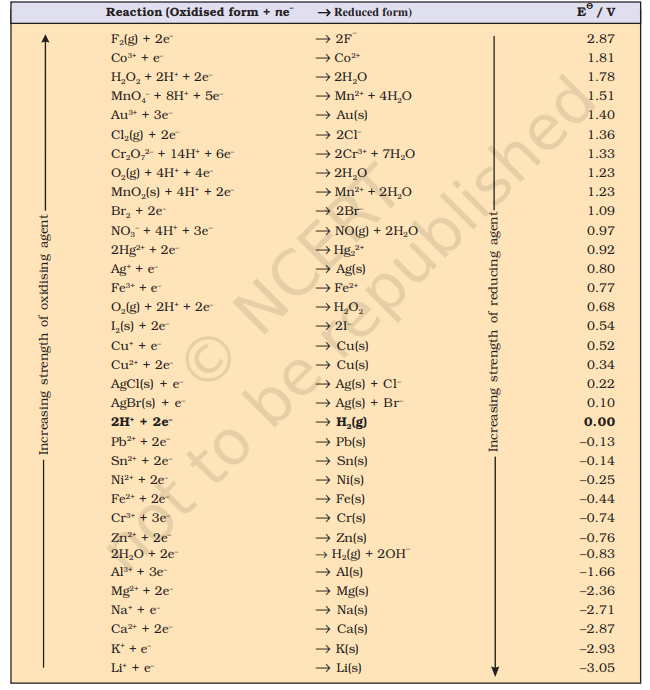
$\mathrm{Fe}^{3+}(\mathrm{aq})$ and $\mathrm{Cu}(\mathrm{s})$. AnswerThe possible reaction between $\mathrm{Fe}^{3+}(\mathrm{aq})$ and $\mathrm{Cu}(\mathrm{s})$. is given by, $2\text{Fe}^{3+}_{(\text{aq})}+\text{Cu}_{(\text{s})}\rightarrow2\text{Fe}^{2+}_{(\text{s})}+\text{Cu}^{2+}_{(\text{aq})}$ $\text{Oxidation half equation:}\ \ \ \ \ \ \ \text{Cu}_{(\text{s})}\xrightarrow{\ \ \ \ \ \ }\text{Cu}^{2+}_{(\text{aq})}+2\text{e}^-;\ \ \text{E}^\circ=-0.34\text{V}\\\text{Reduction half equation:}\ \ [\text{Fe}^{3+}_{(\text{aq})}+\text{e}^-\xrightarrow{\ \ \ \ \ }\text{Fe}^{2+}_{(\text{s})}]\times2;\ \ \ \text{E}^\circ=+0.77\text{V}\\\overline{\ \ \ \ \ \ \ \ \ \ \ \ \ \ \ \ \ \ \ \ \ \ \ \ \ \ \ \ \ \ \ \ \ \ \ \ \ \ \ \ \ \ \ \ \ \ \ \ \ \ \ \ \ \ \ \ \ \ \ \ \ \ \ \ \ \ \ \ \ \ \ \ \ \ \ \ \ \ \ \ \ \ \ \ \ \ \ \ \ \ \ \ \ \ \ \ \ \ \ \ \ \ \ \ \ \ \ \ \ \ \ \ \ \ \ \ \ \ }\\\ \ \ \ \ \ \ \ \ \ \ \ \ \ \ \ \ \ \ \ \ \ \ \ \ \ \ \ \ \ \ \ 2\text{Fe}^{3+}_{(\text{aq})}+\text{Cu}_{(\text{s})}\xrightarrow{\ \ \ \ \ }2\text{Fe}^{2+}_{(\text{s})}+\text{Cu}^{2+}_{(\text{aq})};\ \ \ \text{E}^\circ=+0.43\text{V}$E° positive for the overall reaction is positive. Hence, the reaction between $\mathrm{Fe}^{3+}(\mathrm{aq})$ and $\mathrm{Cu}(\mathrm{s})$. is feasible.
View full question & answer→Question 333 Marks
Using the standard electrode potentials given in the Table, predict if the reaction between the following is feasible:
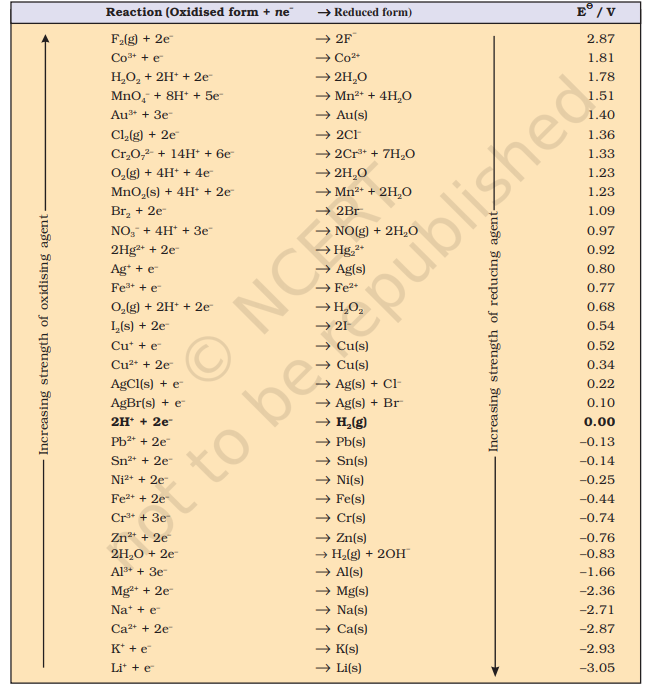
$\mathrm{Ag}(\mathrm{s})$ and $\mathrm{Fe}^{3+}(\mathrm{aq})$ AnswerThe possible reaction between $\mathrm{Ag}(\mathrm{s})$ and $\mathrm{Fe}^{3+}(\mathrm{aq})$ is given by, $\text{Ag}_{(\text{s})}+2\text{Fe}^{3+}_{(\text{aq})}\rightarrow\text{Ag}^{+}_{(\text{aq})}+\text{Fe}^{2+}_{(\text{aq})}$ $\text{Oxidation half equation:}\ \ \ \ \ \ \ \text{Ag}_{(\text{s})}\xrightarrow{\ \ \ \ \ \ }\text{Ag}^{+}_{(\text{aq})}+\text{e}^-;\ \ \text{E}^\circ=-0.80\text{V}\\\text{Reduction half equation:}\ \ \text{Fe}^{3+}_{(\text{aq})}+\text{e}^-\xrightarrow{\ \ \ \ \ }\text{Fe}^{2+}_{(\text{aq})};\ \ \ \ \ \ \ \ \text{E}^\circ=+0.77\text{V}\\\overline{\ \ \ \ \ \ \ \ \ \ \ \ \ \ \ \ \ \ \ \ \ \ \ \ \ \ \ \ \ \ \ \ \ \ \ \ \ \ \ \ \ \ \ \ \ \ \ \ \ \ \ \ \ \ \ \ \ \ \ \ \ \ \ \ \ \ \ \ \ \ \ \ \ \ \ \ \ \ \ \ \ \ \ \ \ \ \ \ \ \ \ \ \ \ \ \ \ \ \ \ \ \ \ \ \ \ \ \ \ \ \ \ \ \ \ \ \ \ }\\\ \ \ \ \ \ \ \ \ \ \ \ \ \ \ \ \ \ \ \ \ \ \ \ \ \ \ \ \ \ \ \ \ \text{Ag}^{}_{(\text{s})}+\text{Fe}^{3+}_{(\text{aq})}\xrightarrow{\ \ \ \ \ }\text{Ag}^{+}_{(\text{aq})}+\text{Fe}^{2+}_{(\text{aq})};\ \ \ \text{E}^\circ=-0.03\text{V}$Here, E° for the overall reaction is negative. Hence, the reaction between $\mathrm{Ag}(\mathrm{s})$ and $\mathrm{Fe}^{3+}(\mathrm{aq})$ is not feasible.
View full question & answer→Question 343 Marks
- Calculate e.m.f. of following cells
- $\text{Zn}|\text{Zn}^{2+}(1\text{M})||\text{CO}^{2+}(1\text{M})|\text{Co}$
$\text{E}^0_\frac{\text{Zn}^{2+}}{\text{Zn}}=-0.76\text{V}$
$\text{E}^0_\frac{\text{CO}^{2+}}{\text{Cu}}=-0.28\text{V}$
- $\text{Zn}|\text{Zn}^{2+}(1\text{M})||\text{Ag}+(1\text{M})|\text{Ag}$
$\text{E}^0_\frac{\text{Ag}+}{\text{Ag}}=+0.80\text{V}$
- What is meant by negative $\text{E}^\circ$ value and positive $\text{E}^\circ$ value of redox couple?
Answer
-
- $\text{E}^0_\text{cell}=\text{E}^0_\frac{\text{CO}^{2+}}{\text{CO}}-\text{E}^0_\frac{\text{Zn}^{2+}}{\text{Zn}}$
$=-0.28\text{V}-(0.76\text{V})$
$=0.48\text{V}$
- $\text{E}^0=\text{E}^0_\frac{\text{Ag}+}{\text{Ag}}-\text{E}_\frac{\text{Zn}^{2+}}{\text{Zn}}$
$=+0.80\text{V}-(0.76\text{V})$
$=1.56\text{V}$
- A negative $\text{E}^\circ$ value means redox couple is stronger reducing agent than $\frac{\text{H}_+}{\text{H}_2}$ couple e.g.
$\text{E}^0_\frac{\text{Zn}^{2+}}{\text{Cu}}=-0.76\text{V}$
A positive $\text{E}^\circ$ value means redox couple is increases redox couple than $\frac{\text{H}^+}{\text{H}_2}$ couple e.g.
$\text{E}^0_\frac{\text{Cu}^{2+}}{\text{Cu}}=+0.34\text{V}$ View full question & answer→Question 353 Marks
A cell is constructed using $\frac{\text{Cu}^{2+}}{\text{Cu}}$ and $\frac{\text{Al}^{3+}}{\text{Al}}$ electrodes.
- Identify cathode and anode.
- Write the reactions at anode, cathode and net cell reaction.
- Calculate $\text{E}^0_\text{cell}$
$\text{E}^0_\frac{\text{Al}^{3+}}{\text{Ag}}=-1.66\text{V}$
$\text{E}^0_\frac{\text{Cu}^{2+}}{\text{Cu}}=+0.34\text{V}$ AnswerIt is measured by potentiometer which does not have internal resistance.
- 'Al' will act as anode, 'Cu' will act as cathode because reduction potential of $\frac{\text{Cu}^{2+}}{\text{Cu}}$ is higher.
-
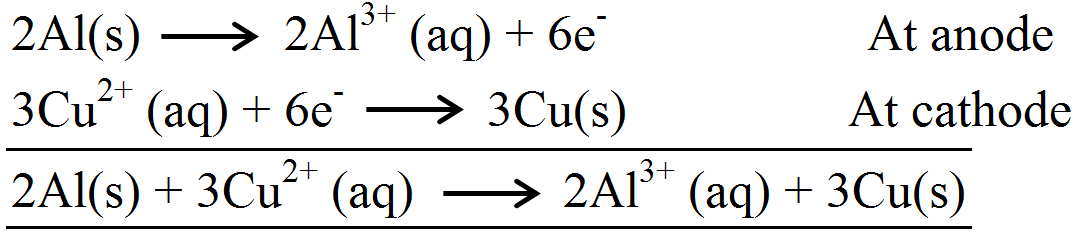
- $\text{E}^0_\text{cell}=\text{E}^0_\frac{\text{cu}^{2+}}{\text{Cu}}-\text{E}^0_\frac{\text{Al}^{3+}}{\text{Al}}$
$=+0.34\text{V}-(-1.66\text{V})$
$=2.00\text{V}$ View full question & answer→Question 363 Marks
Using the standard electrode potentials given in the Table, predict if the reaction between the following is feasible:
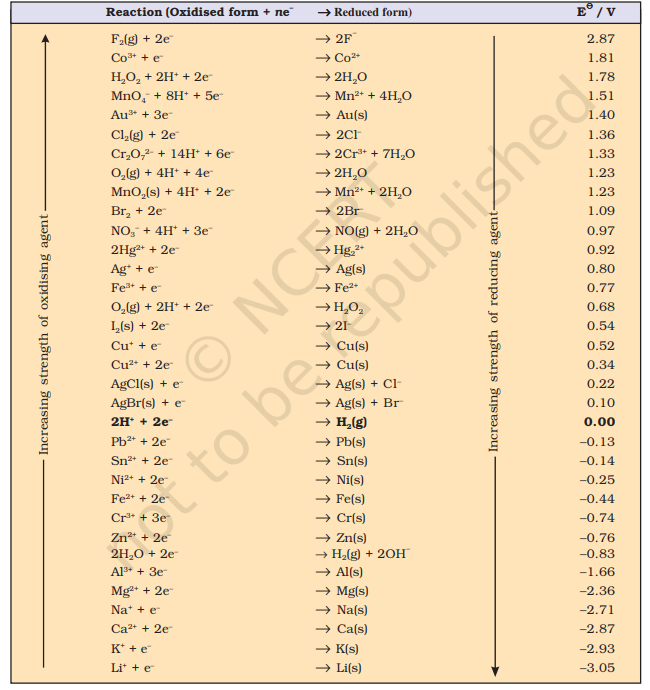
$\mathrm{Fe}^{3+}(\mathrm{aq})$ and $\mathrm{l}^{-}(\mathrm{aq})$. AnswerThe possible reaction between $\mathrm{Fe}^{3+}(\mathrm{aq})$ and $\mathrm{l}^{-}(\mathrm{aq})$. is given by, $2\text{Fe}^{3+}_{(\text{aq})}+2\text{I}^-_{(\text{aq})}\rightarrow2\text{Fe}^{2+}_{(\text{aq})}+\text{I}_{2(\text{s})}$$\text{Oxidation half equation:}\ \ \ \ \ \ \ \ \ \ 2\text{I}^-_{(\text{aq})}\xrightarrow{\ \ \ \ \ \ \ }\text{I}_{2(\text{s})}+2\text{e}^-;\ \ \text{E}^\circ=-0.54\text{V}\\\text{Reduction half equation:}\ [\text{Fe}^{3+}_{(\text{aq})}+\text{e}^-\xrightarrow{\ \ \ \ \ \ }\text{Fe}^{2+}_{(\text{aq})}]\times2;\ \ \text{E}^\circ=+0.77\text{V}\\\overline{\ \ \ \ \ \ \ \ \ \ \ \ \ \ \ \ \ \ \ \ \ \ \ \ \ \ \ \ \ \ \ \ \ \ \ \ \ \ \ \ \ \ \ \ \ \ \ \ \ \ \ \ \ \ \ \ \ \ \ \ \ \ \ \ \ \ \ \ \ \ \ \ \ \ \ \ \ \ \ \ \ \ \ \ \ \ \ \ \ \ \ \ \ \ \ \ \ \ \ \ \ \ \ \ \ \ \ \ \ \ \ \ \ \ \ \ \ \ }\\ \ \ \ \ \ \ \ \ \ \ \ \ \ \ \ \ \ \ \ \ \ \ \ \ \ \ \ \ \ \ \ \ \ \ \ \ \ \ 2\text{Fe}^{3+}_{(\text{aq})}+2\text{I}^-_{(\text{aq})}\xrightarrow{\ \ \ \ \ \ \ \ }2\text{Fe}^{2+}_{(\text{aq})}+\text{I}_{2(\text{s})};\ \ \text{E}^\circ=+0.23\text{V}$
E° for the overall reaction is positive. Thus, the reaction between $\text{Fe}^{3+}_{(\text{aq})}$ and $\text{I}^-_{(\text{aq})}$ is feasible.
View full question & answer→Question 373 Marks
Using the standard electrode potentials given in the Table, predict if the reaction between the following is feasible:
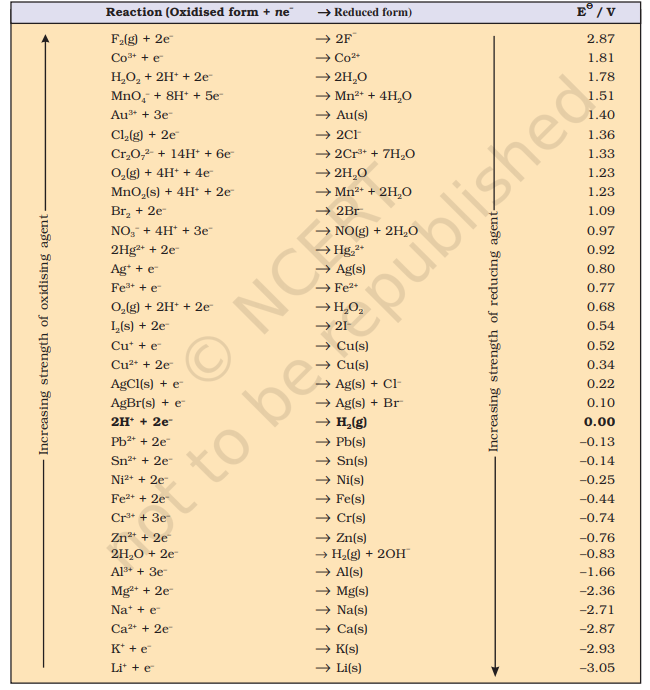
$\mathrm{Br}_2(\mathrm{aq})$ and $\mathrm{Fe}^{2+}(\mathrm{aq})$. AnswerThe possible reaction between $\mathrm{Br}_2(\mathrm{aq})$ and $\mathrm{Fe}^{2+}(\mathrm{aq})$. is given by, $\text{Br}_{2(\text{s})}+2\text{Fe}^{2+}_{(\text{aq})}\rightarrow2\text{Br}^-_{(\text{aq})}+2\text{Fe}^{3+}_{(\text{aq})}$ $\text{Oxidation half equation:}\ \ \ \ \ \ \ \text{Fe}^{2+}_{(\text{aq})}\xrightarrow{\ \ \ \ \ \ }\text{Fe}^{3+}_{(\text{aq})}+\text{e}^-]\times2\ \ ;\text{E}^\circ=-0.77\text{V}\\\text{Reduction half equation:}\ \ \text{Br}^{}_{2(\text{aq})}+2\text{e}^-\xrightarrow{\ \ \ \ \ }2\text{Br}^{-}_{(\text{aq})}\ \ \ \ \ \ \ \ \ ; \text{E}^\circ=+1.09\text{V}\\\overline{\ \ \ \ \ \ \ \ \ \ \ \ \ \ \ \ \ \ \ \ \ \ \ \ \ \ \ \ \ \ \ \ \ \ \ \ \ \ \ \ \ \ \ \ \ \ \ \ \ \ \ \ \ \ \ \ \ \ \ \ \ \ \ \ \ \ \ \ \ \ \ \ \ \ \ \ \ \ \ \ \ \ \ \ \ \ \ \ \ \ \ \ \ \ \ \ \ \ \ \ \ \ \ \ \ \ \ \ \ \ \ \ \ \ \ \ \ \ \ \ \ }\\\ \ \ \ \ \ \ \ \ \ \ \ \ \ \ \ \ \ \ \ \ \ \ \ \ \ \text{Br}^{}_{2(\text{aq})}+2\text{Fe}^{2+}_{(\text{aq})}\xrightarrow{\ \ \ \ \ }2\text{Br}^{-}_{(\text{aq})}+2\text{Fe}^{3+}_{(\text{aq})}\ \ \ \ \ ;\text{E}^\circ=-0.32\text{V}$Here, E° for the overall reaction is positive. Hence, the reaction between $\mathrm{Br}_2(\mathrm{aq})$ and $\mathrm{Fe}^{2+}(\mathrm{aq})$. is feasible.
View full question & answer→Question 383 Marks
Write the anode reaction, the cathode reaction and the net cell reaction in the following cells. Which electrode would be positive terminal in each cell ?
i. $\mathrm{Zn}(\mathrm{s})\left|\mathrm{Zn}^{2+}\right|\left|\mathrm{Br}^2\right| \mathrm{Br}^- \mid \mathrm{Pt}(\mathrm{s})$
ii. $\mathrm{Cr}(\mathrm{s})\left|\mathrm{Cr} 3+\left|\left|\mathrm{I}_2\right| \mathrm{I}^{-}\right| \mathrm{Pt}(\mathrm{s})\right.$
iii. $\mathrm{Pt}(\mathrm{s})\left|\mathrm{H}_2(\mathrm{~g})\right| \mathrm{H}^{+}(\mathrm{aq})| | \mathrm{Cu}^{2+} \mid \mathrm{Cu}(\mathrm{s})$
Answer
- $_{\begin{matrix}\text{At anode}\\\text{At cathode}\end{matrix}}{\text{Zn}\xrightarrow{\ \ \ \ \ \ }\text{Zn}^{2+} +2\text{e}^{-}\\\text{Br}_{2}+ 2\text{e}^{-}\xrightarrow{\ \ \ \ \ \ }2\text{Br}^{-}\\ \overline{\ \ \ \ \ \ \ \ \ \ \ \ \ \ \ \ \ \ \ \ \ \ \ \ \ \ \ \ \ \ \ \ \ \ \ \ \ \ \ \ \ \ \ \ }\\ \text{Zn}+ \text{Br}_{2}\xrightarrow{\ \ \ \ \ }\text{Zn}^{2+}+2\text{Br}^{-}\\\overline{\ \ \ \ \ \ \ \ \ \ \ \ \ \ \ \ \ \ \ \ \ \ \ \ \ \ \ \ \ \ \ \ \ \ \ \ \ \ \ \ \ \ \ \ }}$
- $_{\begin{matrix}\text{At anode}\\\text{At cathode}\end{matrix}} {[\text{Cr}\xrightarrow{\ \ \ \ \ \ \ \ \ \ }\text{Cr}^{3+}+3\text{e}^-]\times2\\ [\text{I}_2+\text{e}^-\xrightarrow{\ \ \ \ \ \ \ \ \ \ \ }2\text{I}^-]\times3\\\overline{\ \ \ \ \ \ \ \ \ \ \ \ \ \ \ \ \ \ \ \ \ \ \ \ \ \ \ \ \ \ \ \ \ \ \ \ \ \ \ \ \ \ \ \ \ \ \ \ }\\ \text{2Cr}+3\text{I}_2\xrightarrow{\ \ \ \ \ \ \ \ }6\text{I}^-+2\text{Cr}^{3+}\\\overline{\ \ \ \ \ \ \ \ \ \ \ \ \ \ \ \ \ \ \ \ \ \ \ \ \ \ \ \ \ \ \ \ \ \ \ \ \ \ \ \ \ \ \ \ \ \ \ \ \ }}$
- $_{\begin{matrix}\text{At anode}\\\text{At cathode}\end{matrix}}{\text{H}_2\text{(g)} \xrightarrow{\ \ \ \ \ \ \ \ \ \ \ }2\text{H}^+\text{(aq)}+2\text{e}^-\\\text{Cu}^{2+}\text{(aq)}+2\text{e}^-\xrightarrow{\ \ \ \ \ \ \ \ }\text{Cu}(\text{s}) }\\\overline{\ \ \ \ \ \ \ \ \ \ \ \ \ \ \ \ \ \ \ \ \ \ \ \ \ \ \ \ \ \ \ \ \ \ \ \ \ \ \ \ \ \ \ \ \ \ \ \ \ \ \ \ \ \ \ \ \ \ \ \ \ \ \ \ \ \ \ \ \ \ }\\{\text{H}_2\text{(g)}+\text{Cu}^{2+}\text{(aq)}\xrightarrow{\ \ \ \ \ \ \ \ \ }\text{Cu}(s)+2\text{H}^+\text{(aq)}}\\\overline{\ \ \ \ \ \ \ \ \ \ \ \ \ \ \ \ \ \ \ \ \ \ \ \ \ \ \ \ \ \ \ \ \ \ \ \ \ \ \ \ \ \ \ \ \ \ \ \ \ \ \ \ \ \ \ \ \ \ \ \ \ \ \ \ \ \ \ \ \ \ \ \ }$
Cathode will be positive terminal in each cell. View full question & answer→Question 393 Marks
Identify the type of redox reaction taking place in the following.
- $3\stackrel{0\ \ \ \ \ \ \ \ \ \ \ \ }{\text{Mg(s)}}+\stackrel{0\ \ \ \ \ \ \ \ \ \ \ }{\text{N}_2\text{(g)}}\ \xrightarrow{\ \ \ \ \ \ \ \ \ \ }\ \stackrel{+2\ \ \ \ -3\ \ \ \ \ \ \ \ }{\text{Mg}_3\text{N}_2\text{(s)}}$
- $\stackrel{+5\ \ \ \ \ \ -2\ \ \ \ \ \ \ }{\text{V}_2\text{O}_5\text{(s)}}5\stackrel{0\ \ \ \ \ \ \ \ \ \ }{\text{Ca(s)}}\xrightarrow{\ \ \ \ \ \ \ }2\stackrel{0\ \ \ \ \ \ \ \ }{\text{V(s)}}+\text{5}\stackrel{+2\ \ -2\ \ \ \ \ \ \ \ \ \ }{\text{CaO(s)}}$
- $2\stackrel{+1\ +5\ -2\ \ \ \ \ \ \ \ \ \ \ \ }{\text{KClO}_3(\text{s})}\xrightarrow{\ \ \ \ \ \ \ }2\stackrel{+1\ \ -1\ \ \ \ \ \ \ \ \ \ }{\text{KCl(s)}}+3\stackrel{0\ \ \ \ \ \ \ \ \ \ }{\text{O}_2\text{(g)}}$
- $\stackrel{0}{\text{Ca}\text{(s)}}+2\stackrel{+1-2}{\text{H}_2\text{O}\text{l}}\ \xrightarrow{\ \ \ \ \ \ \ \ \ \ \ }\stackrel{+2\ \ -2+1\ \ \ \ \ \ \ \ \ \ \ \ \ \ \ \ \ \ }{\text{Ca(OH)}_2(\text{aq})}+\stackrel{0}{\text{H}}_2\text{(g)}$
- $\stackrel{0\ \ \ \ \ \ \ \ \ \ \ }{\text{Br}_2(\text{l})}+\stackrel{-1\ \ \ \ \ \ \ \ \ \ \ \ }{2\text{I}^-(\text{aq})}\xrightarrow{\ \ \ \ \ \ \ \ \ \ }\stackrel{1-}{\text{2Br}^-}(\text{aq})+\stackrel{0\ \ \ \ \ \ \ \ \ \ }{\text{I}_2\text{(s)}}$
Answer
- Combination reaction.
- Displacement reaction.
- Decomposition reaction.
- Metal displacement reaction.
- Non-metal displacement reaction.
- Disproportionation reaction.
View full question & answer→Question 403 Marks
Balance the following ionic equations. $\text{Cr}_2\text{O}^{2-}_7+\text{H}^++\text{I}^-\xrightarrow{ \ \ \ \ \ \ \ \ \ }\text{Cr}^{3+}+\text{I}_2+\text{H}_2\text{O}$
Answer
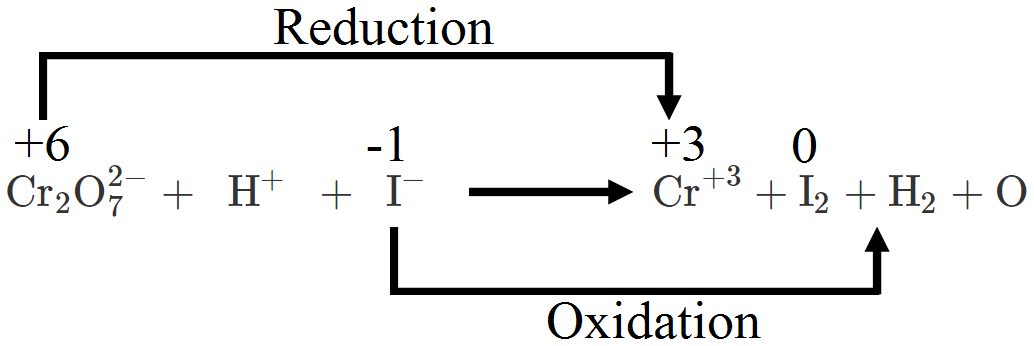
Dividing the equation into two half reactions:
Oxidation half reaction: $\text{I}^-\xrightarrow{ \ \ \ \ \ \ \ }\text{I}_2$
Reduction half reaction: $\text{Cr}_2\text{O}^{2-}_7\xrightarrow{ \ \ \ \ \ \ \ }\text{Cr}^{3+}$
Balancing oxidation and reduction half reactions separately as:
Oxidation half reaction
$\text{I}^{-}\xrightarrow{ \ \ \ \ \ \ \ }\text{I}_2$
$2\text{I}^-\xrightarrow{ \ \ \ \ \ \ \ }\text{I}_2$
$\text{2I}^-\xrightarrow{ \ \ \ \ \ \ \ \ }\text{I}_2+2\text{e }^-...(\text{i})$
Reduction half reaction
$\text{Cr}_2\text{O}^{2-}_7\xrightarrow{ \ \ \ \ \ \ \ \ }\text{Cr}^{3+}$
$\text{Cr}_2\text{O}^{2-}_7\xrightarrow{ \ \ \ \ \ \ \ }2\text{Cr}^{3+}$
$\text{Cr}_2\text{O}^{2-}_7+6\text{e}^-\xrightarrow{ \ \ \ \ \ \ \ \ }2\text{Cr}^{3+}$
$\text{Cr}_2\text{O}^{2-}_7+14\text{H}^++6\text{e}^-\xrightarrow{ \ \ \ \ \ \ \ \ }2\text{Cr}^{3+}+7\text{H}_2\text{O }...(\text{ii})$
To balance the electrons, multiply eq. (i) by 3 and add to eq. (ii)
$\text{Cr}_2\text{O}^{2-}_7+14\text{H}^++6\text{I}^-\xrightarrow{ \ \ \ \ \ \ \ \ }2\text{Cr}^{3+}+3\text{I}_2+7\text{H}_2\text{O}$ View full question & answer→Question 413 Marks
- What is the oxidation number of 'S'in $H_2SO_5$
- Balance the following equation:
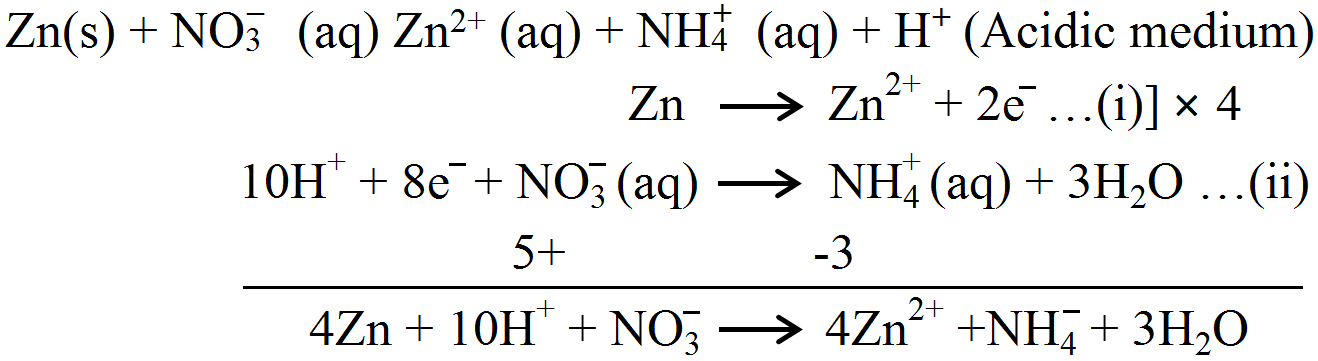
$\text{Zn}\text{(s)}+\text{NO}_3^-\text{(aq)}\xrightarrow{ \ \ \ \ \ \ \ \ }\text{Zn}^{2+}\text{(aq)}+\text{NH}_4^+\text{(aq)}+\text{H}^+$ (Acidic medium)Answer
- The oxidation number of 'S' in $H_2SO_5$ is +6 because there is one peroxide linkage, i.e. two oxygen atoms have -1 oxidation state.
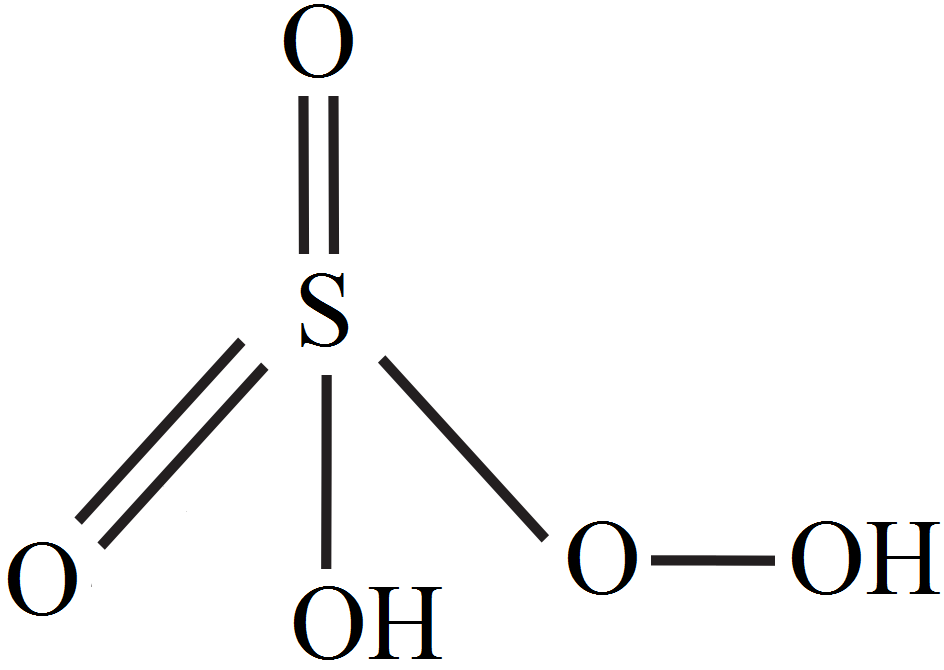
$\text{H}_2\text{SO}_5$
$+2+\text{x}-6-2=0$
$\text{x}=+6$
-
View full question & answer→Question 423 Marks
Decide whether each of the following reaction involves oxidation reduction reaction or not. If it does, identify which species is oxidised and which gets reduced?
- $\ \ \ \ \ \ \ \ \ {\text{O}\ \ \ \ \ \ \ \ \ \ \ \ \ \ \ \ \ \ \ \ \ \ \ \ \ \ \ \ \ \ \ \ \ \ \ \ \ \ \ \ \ \ \ \ \ \ \ \ \ \ \ \ \ \ \ \ \text{OH}}\\\ \ \ \ \ \ \ \ \ \ \|\ \ \ \ \ \ \ \ \ \ \ \ \ \ \ \ \ \ \ \ \ \ \ \ \ \ \ \ \ \ \ \ \ \ \ \ \ \ \ \ \ \ \ \ \ \ \ \ \ \ \ \ \ \ \ \ \ |\\ 4\text{CH}_3\text{CCH}_3+\text{LiAlH}_4+4\text{H}_2\text{O}\rightleftharpoons4\text{CH}_3\text{CHCH}_3+\text{LiOH}+\text{Al}(\text{OH})_3$
- $\text{CH}_3\text{CH}_2\text{OH}\xrightarrow{\ \text{H}_2\text{SO}_4\ \ }\text{CH}_2=\text{CH}_2+\text{H}_2\text{O}$
- $\ \ \ \ \ \ \ {\text{O}\ \ \ \ \ \ \ \ \ \ \ \ \ \ \ \ \ \ \ \ \ \ \ \ \ \ \ \ \ \ \ \ \ \ \ \ \ \ \ \ \ \text{O}}\\\ \ \ \ \ \ \ \ \|\ \ \ \ \ \ \ \ \ \ \ \ \ \ \ \ \ \ \ \ \ \ \ \ \ \ \ \ \ \ \ \ \ \ \ \ \ \ \ \ \ \ \|\\\text{CH}_3\text{C OH}+\text{CH}_3\text{NH}_2\rightleftharpoons\text{CH}_3\text{CO}^-+\text{CH}_3\text{NH}^+_3$
Answer
- In this redox reaction, H in LiAIH4 gets oxidized because of the addition of oxygen atom that leads to the formation of $\mathrm{OH}^{-}$Propanone $\left(\mathrm{CH}_3 \mathrm{COCH}_3\right)$ gets reduced because of addition of hydrogen atom to give propan-2-ol $\left(\mathrm{CH}_3 \mathrm{CH}(\mathrm{OH}) \mathrm{CH}_3\right)$.
- This is not a redox reaction as neither hydrogen or oxygen or electron is removed or added.
- This is not a redox reaction as neither hydrogen or oxygen or electron is removed or added.
View full question & answer→Question 433 Marks
Balance the following equations by the oxidation number method.
$\text{Fe}^{2+}+\text{H}^++\text{Cr}_2\text{O}^{2-}_7\xrightarrow{ \ \ \ \ \ \ \ \ \ }\text{Cr}^{3+}+\text{Fe}^{3+}+\text{H}_2 \text{O}$
Answer$\text{Fe}^{2+}+\text{H}^{+}+\text{Cr}_2\text{O}^{2-}_7\xrightarrow{ \ \ \ \ \ \ \ \ }\text{Cr}^{3+}+\text{Fe}^{3+}+\text{H}_2\text{O}$$\stackrel{+2 \ \ \ \ \ \ \ }{\text{Fe}^{2+}}\text{H}^++\stackrel{+6}{\text{Cr}}_2\stackrel{-2 \ \ \ \ \ \ \ }{\text{O}^{2-}_7}\xrightarrow{ \ \ \ \ \ \ }\stackrel{+3 \ \ \ \ \ \ \ }{\text{Cr}^{3+}}+\stackrel{+3 \ \ \ \ \ \ \ \ \ }{\text{Fe}^{3+}}+\text{H}_2\text{O}$
- Balance the increase and decrease in O.N.
$6\stackrel{+2 \ \ \ \ \ \ \ }{\text{Fe}^{2+}}+\text{H}^++\stackrel{+6 \ \ \ }{\text{Cr}_2}\stackrel{-2 \ \ \ \ \ \ }{\text{O}^{2-}_7}\xrightarrow{ \ \ \ \ \ \ \ \ }2\stackrel{+3 \ \ \ \ \ \ }{\text{Cr}^{3+}}+6\stackrel{+3 \ \ \ \ \ \ \ }{\text{Fe}^{3+}}+\text{H}_2\text{O}$
- Balancing H and O atoms by adding $\text{H}^+$ and $\text{H}_2\text{O}$ molecules
$6\text{Fe}^{2+}+14\text{H}^++\text{Cr}_2\text{O}^{2-}_7\xrightarrow{ \ \ \ \ \ \ \ \ }2\text{Cr}^{3+}+6\text{Fe}^{3+}+7\text{H}_2\text{O}$ View full question & answer→Question 443 Marks
Balance the following ionic equations.
$\text{MnO}^-_4+\text{H}^++\text{Br}^-\xrightarrow{ \ \ \ \ \ \ \ \ }\text{Mn}^{2+}+\text{Br}_2+\text{H}_2\text{O}$
Answer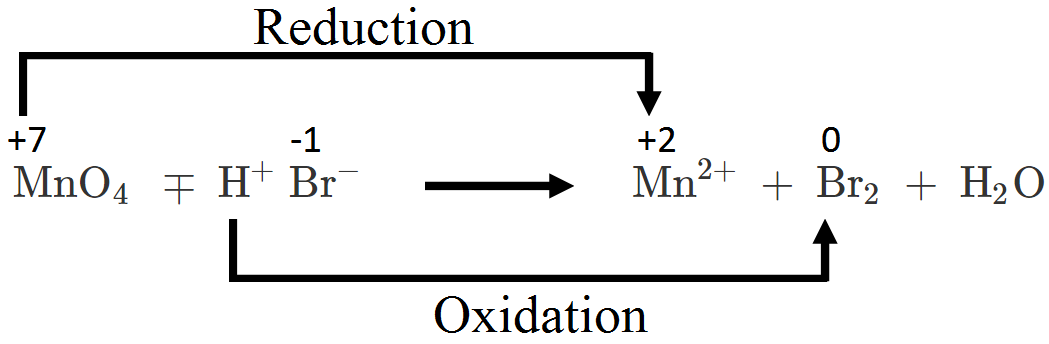
Dividing the equation into two half reactions:
Oxidation half reaction: $\text{Br}^-\xrightarrow{ \ \ \ \ \ \ \ \ }\text{Br}_2$
Reduction half reaction: $\text{MnO}^-_4\xrightarrow{ \ \ \ \ \ \ \ \ }\text{Mn}^{2+}$
Balancing oxidation and reduction half reactions separately as:
Oxidation half reaction
$\text{Br}^-\xrightarrow{ \ \ \ \ \ \ \ \ }\text{Br}_2$
$2\text{Br}^-\xrightarrow{ \ \ \ \ \ \ \ \ \ }\text{Br}_2$
$2\text{Br}^-\xrightarrow{ \ \ \ \ \ \ \ \ }\text{Br}_2+2\text{e}^-...(\text{i})$
Reduction half reaction
$\text{MnO}^-_4\xrightarrow{ \ \ \ \ \ \ \ }\text{Mn}^{2+}$
$\text{MnO}^-_4+5\text{e}^-\xrightarrow{ \ \ \ \ \ \ \ \ }\text{Mn}^{2+}$
$\text{MnO}^-_4+8\text{H}^++5\text{e}^-\xrightarrow{ \ \ \ \ \ \ \ }\text{Mn}^{2+}$
$\text{MnO}^-_4+8\text{H}^++5\text{e}^-\xrightarrow{ \ \ \ \ \ \ \ \ }\text{Mn}^{2+}+4\text{H}_2\text{O}...(\text{ii})$
To balance the electrons, multiply eq. (i) by 5 and eq. (ii) by 2 and add
$2\text{MnO}^-_4+10\text{Br}^-+16\text{H}^+\xrightarrow{ \ \ \ \ \ \ \ \ }2\text{Mn}^{2+}+5\text{Br}_2+8\text{H}_2\text{O}$ View full question & answer→Question 453 Marks
One mole of $\text{N}_2\text{H}_4$ loses 10 moles electrons to form a new compound Y. Assuming that all the nitrogen appears in the new compound, what is the oxidation number of N in Y? There is no change in oxidation state of H.
AnswerSuppose the oxidation number of N in Y is x
$(\text{N}^{2-})_2\xrightarrow{\ \ \ \ \ \ \ }(2\text{N})^{\text{x}}+\text{10e}^-$
$(\text{as N}_2\text{H}_4\xrightarrow{\ \ \ \ \ \ \ \ }\text{Y}+10{\text{e}^-})$
Therefore, 2x - 10 = -4, which geves x = +3.
Hence oxidation number of N in Y = 3.
View full question & answer→